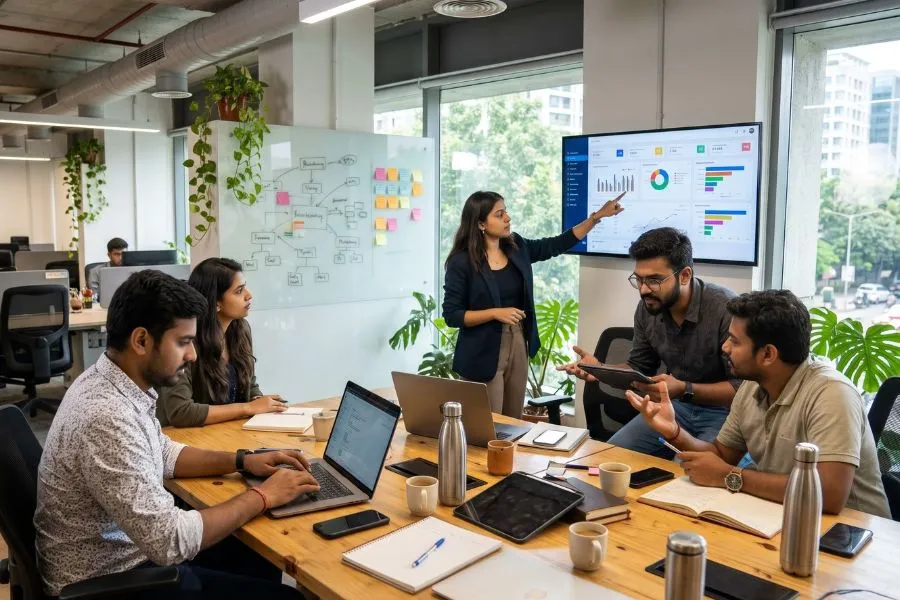
Moradabad is India’s “Brass City” — the world’s largest exporter of brass handicrafts and decorative metal goods.
From the workshops of Civil Lines and Katghar to the large export factories of UPSIDC, Moradabad’s 5,000+ brass units produce everything the world’s home decor and gifting markets desire — from hand-hammered vases and candle holders to electroplated bowls, from custom-finished photo frames to large decorative urns. The city’s ₹18,000 crore annual export turnover makes it India’s single largest handicraft export cluster, supplying stores like Walmart, IKEA, HomeGoods, Amazon US, and thousands of independent importers across 140+ countries.
But beneath the gleam of Moradabad’s polished brass lies an operational reality that is as raw as the metal before it’s finished.
Meet Irfan Ahmed, a third-generation brass exporter in Moradabad’s Patel Nagar export hub.
Irfan runs a mid-size operation — 160 workers, 3 production units, annual export turnover of ₹12 crore, and buyer relationships with US, UK, and European importers built over 20 years. His company does everything from casting and machining to electroplating, lacquering, and hand-crafted finishing. He also trades raw brass and semi-finished blanks with other Moradabad units.
His Thursday morning starts with four urgent problems:
Problem 1 — Sample and Order Cost Confusion:
A UK buyer (an IKEA supply-chain agent) just emailed about an order for 12,000 pieces of a 3-piece brass vase set — various sizes, mixed finishes (antique, lacquer, powder coat). The buyer wants a price within 48 hours. Irfan’s sales manager has no costing system — he estimates from memory. Last year, a similar-sized order was quoted at ₹340/set. Irfan now suspects the actual cost is closer to ₹420/set after accounting for current brass scrap prices (up 24% since last year), plating chemical costs (up 18%), and increased artisan wages. If he quotes at ₹340 (memory-based) on a 12,000-piece order, the potential loss is ₹9.6 lakh. If he quotes too high, he loses the order to a Vietnamese or Chinese competitor.
Problem 2 — Export Documentation Errors Costing Shipments:
A container of 840 cartons bound for a German buyer (a large home decor chain) was stopped at Nhava Sheva port in Mumbai. The customs department found: the invoice shows “Brass decorative items” (too vague — needs HS code-specific description), the declared weight is 18,400 kg but the shipping bill shows 18,381 kg (19 kg discrepancy, possibly from wrong tare weight), and the country of origin certificate shows Moradabad’s PIN code incorrectly (382001 instead of 244001). The shipment is held for physical examination — costing Irfan ₹3.4 lakh in demurrage at Mumbai port (2 days at ₹1.7 lakh/day) and delay penalty from the buyer.
Problem 3 — Artisan and Kaarigar Payment Disputes:
Irfan employs 160 workers — a mix of company employees (60 workers) and piece-rate artisans (kaarigar) who work from home or small workshops and are paid per piece. The home-based kaarigars produce hammered and engraved work on brass blanks supplied by Irfan’s factory. Every week, 40-50 kaarigars deliver finished pieces and expect payment. Disputes arise constantly: kaarigars say they delivered 820 pieces, Irfan’s store says 784 pieces were received and accepted (36 pieces rejected for quality). Irfan has no piece-level acceptance register. The financial dispute between kaarigar and factory happens on every payment cycle. Three kaarigars stopped working with Irfan this month over disputed payments.
Problem 4 — Raw Material and Scrap Metal Accounting:
Brass is expensive — currently ₹380-420/kg for primary brass, ₹310-360/kg for secondary brass (from scrap). Moradabad’s brass industry is scrap-intensive — old radiators, shell casings, plumbing fittings, and imported scrap all get melted and re-used. Irfan purchases brass scrap from local dealers and inter-state suppliers. Under GST, brass scrap purchases from unregistered dealers are subject to RCM (Reverse Charge Mechanism). Additionally, the scrap metal trade has TCS provisions. Irfan’s accounts team is confused about which transactions need RCM, which need TCS, and what the correct HSN codes are for different forms of brass — ingots, rods, sheets, blanks, and finished goods all have different codes and rates. Two notice letters arrived last week from the GST department about ITC inconsistencies.
Four problems. One root cause: No integrated ERP for Moradabad’s brass export operations.
This complete guide covers everything Moradabad brass exporters need to know about ERP software in 2026.
Explore ERP Group’s Trading ERP Solutions → for India’s most integrated brass export ERP platform.
Moradabad’s Brass Industry — The Landscape
India’s Brass City — Scale and Global Reach
Moradabad Brass Industry Overview 2026
Industry Scale:
- ₹18,000 crore annual export turnover
- 5,000+ registered brass and metal manufacturing units
- 6 lakh+ workers (including 3 lakh+ home-based kaarigars)
- World’s largest handicraft export cluster
- 45% of India’s total handicraft exports
- Buyers from 140+ countries
Key Export Products:
| Category | Product Examples | Export Value % |
|---|---|---|
| Home décor | Vases, bowls, urns, candle holders | 32% |
| Gifting and corporate | Photo frames, pen stands, keychains | 18% |
| Tableware | Serving bowls, trays, cutlery sets | 15% |
| Outdoor and garden | Planters, garden décor, lanterns | 12% |
| Spiritual and ethnic | Diyas, thali sets, idols, incense holders | 10% |
| Furniture hardware | Handles, knobs, hinges, locks | 8% |
| Other metal goods | Aluminium, iron, white metal items | 5% |
Key Export Markets:
| Region | Share | Key Buyers |
|---|---|---|
| USA | 38% | Walmart, HomeGoods, Tuesday Morning, Amazon |
| Europe (EU) | 28% | IKEA vendor base, home décor chains |
| UK | 14% | Next Home, Dunelm, garden centres |
| Middle East | 10% | Gift and souvenir chains |
| Others | 10% | Australia, Japan, Canada |
Moradabad’s Unique Operational Structure:
| Layer | Description |
|---|---|
| Large exporters | 50-1,000 workers, direct buying house relationships |
| Medium units | 20-100 workers, sub-contractors to large exporters |
| Home-based kaarigars | Individual artisans, paid per piece |
| Raw material traders | Brass scrap, ingots, rods — local supply chain |
| Electroplating units | Job work electroplating, anodising, powder coating |
| Packaging suppliers | Cartons, tissue, foam, inner packing |
The Brass Export Complexity:
- Raw material price volatility — Brass (copper + zinc alloy) prices fluctuate weekly with LME (London Metal Exchange) rates
- Multi-process manufacturing — Casting, machining, filling, polishing, electroplating, lacquering, painting — each a separate process or sub-contractor
- Home-based artisan economy — 60-70% of decorative work done by home-based kaarigars paid per piece
- Multi-finish, multi-SKU — One vase design in 5 finishes × 4 sizes = 20 SKUs; a buyer orders 200 such SKUs in one PO
- Intensive export documentation — Country of origin, inspection certificate, GSP/REX statement, AEPC export compliance
- GST complexity — Brass scrap (RCM), finished goods, electroplating services (SAC), import of findings
The 6 Core Problems ERP Solves for Brass Exporters
The Daily Operational Challenges
Problem 1 — Product Costing Without Data
The Pain:
Brass product costing involves:
- Metal weight per piece (varies by design, wall thickness)
- Metal purchase price (fluctuates — must use current price)
- Processing cost (casting, machining, polishing — labour intensive)
- Electroplating cost (per sqft of surface area, by finish type)
- Hand work (hammering, engraving — paid per piece to kaarigars)
- Packaging cost (varies by product size and buyer requirement)
- Export cost (freight, insurance, inspection)
Without a costing system, quoting from memory risks the ₹9.6 lakh loss Irfan faces.
The ERP Solution:
Bill of materials with metal weight + process cost template. Current raw material price linked to cost sheet. Finish-wise cost differentiation. Auto-calculation of order-level margin.
Problem 2 — Export Documentation Inconsistency
The Pain:
Export documents — invoice, packing list, shipping bill, COO — must be perfectly consistent. The Mumbai port stoppage (₹3.4 lakh loss) resulted from three documentation errors that would never happen if documents were generated from a single source.
The ERP Solution:
Single-entry billing generating all documents from one data source. HS code-specific product descriptions. Auto-weight calculation from packing list. PIN code and address pre-loaded from company master.
Problem 3 — Kaarigar Piece-Rate Payment Disputes
The Pain:
Moradabad’s home-based artisan economy means 40-50 kaarigars delivering pieces every week, each piece counted, quality-checked, and either accepted or rejected. Without a digital acceptance register — three kaarigars leaving Irfan over payment disputes is only the beginning.
The ERP Solution:
Digital kaarigar delivery register with piece-level acceptance and rejection. Quality rejection reason recorded. Weekly payment calculation from accepted pieces only. Digital receipt shared with kaarigar.
Problem 4 — Brass GST, RCM, and TCS Complexity
The Pain:
Brass scrap (HSN 7404) from unregistered dealers: RCM at 18%. Brass ingots from registered dealers: Normal 18% GST. TCS on scrap purchases above threshold. Finished brass goods: 28% GST (HSN 8306) or 18% (HSN 7419) depending on item. The GST notice Irfan received reflects these common misclassifications.
The ERP Solution:
HSN master with correct rates. RCM auto-trigger for unregistered suppliers. TCS tracking. ITC optimisation.
Problem 5 — Multi-SKU Order Management
The Pain:
A buyer orders 200 SKUs — 12 designs × 5 finishes × 4 sizes — each in different quantities. Tracking production status, quality, packing, and shipping for 200 SKUs in one purchase order is operationally impossible without software.
The ERP Solution:
PO management at SKU level. Production scheduling per SKU. Status tracking per SKU. Packing and carton allocation per SKU.
Problem 6 — Export Incentive and Duty Drawback Management
The Pain:
Moradabad brass exporters claim: RoDTEP (on brass goods), Duty Drawback (on imported inputs like copper and zinc), and AEPC/EPCH benefits. Without tracking, legitimate incentives of ₹20-50 lakh annually are left unclaimed or under-claimed.
The ERP Solution:
Incentive tracker per shipping bill. RoDTEP at HS code level. DBK calculation. AEPC/EPCH registration status.
For GST compliance, use ERP Group’s GST invoicing system →.
For brass HSN codes, use ERP Group’s HSN/SAC Finder →.
Module 1-3: Product Costing and Sample Management
The Financial Foundation of Every Export Order
Module 1 — Brass Product Cost Sheet
Solving Problem 1 — The ₹9.6 Lakh Quoting Risk:
PRODUCT COST SHEET: Brass 3-Piece Vase Set
Item: VAZ-3PC-ANT-SET | Order: UK Buyer (IKEA Agent)
Finish: Antique Brass | Sizes: 6", 8", 10" vases

DATE: October 29, 2026 | Current brass price: ₹408/kg

UNIT: Per 3-Piece Set (total weight: ~1.6 kg)

METAL COST:
  6" Vase: 420g × ₹408/kg = ₹171.36
  8" Vase: 580g × ₹408/kg = ₹236.64
  10" Vase: 600g × ₹408/kg = ₹244.80

  Metal waste/scrap (12% for casting process):
    1,600g ÷ 0.88 × ₹408/kg = ₹742.18 gross metal
    Less: Scrap recovery (82% recovery): ₹608.59 net

  NET METAL COST: ₹652.80

PROCESSING COSTS:
  Casting (per set): ₹38.00
  Machining and turning: ₹24.00
  Buffing and polishing: ₹18.00

  TOTAL PROCESSING: ₹80.00

HAND WORK (Kaarigar rate — antique hammered pattern):
  6" Vase hand work: ₹28/piece
  8" Vase hand work: ₹36/piece
  10" Vase hand work: ₹42/piece

  TOTAL HAND WORK: ₹106.00

FINISHING:
  Antique finish process:
    Chemical treatment: ₹18.00
    Lacquering: ₹12.00
    Final buffing: ₹8.00
  TOTAL FINISHING: ₹38.00

PACKAGING (per set):
  Inner (tissue, foam, tray): ₹22.00
  Outer carton (1/4 sets per carton): ₹18.00
  Packing labour: ₹8.00
  TOTAL PACKAGING: ₹48.00

SUB-TOTAL COST: ₹924.80/set

OVERHEAD ABSORPTION (28% of direct cost):
  ₹924.80 × 28% = ₹258.94

TOTAL COST PER SET: ₹1,183.74

EXPORT ADDITIONS:
  Freight share per set (FCL): ₹42.00
  Insurance: ₹8.00
  Inspection fee: ₹6.00
  Export overhead (AEPC, EPC fees): ₹12.00
  TOTAL EXPORT COST: ₹68.00

LANDED COST PER SET: ₹1,251.74

QUOTE CALCULATION:
  Target margin: 18% on cost
  Quote price (INR): ₹1,251.74 × 1.18 = ₹1,477.05
  Quote price (USD @ ₹83.8): USD 17.63/set

  FOR 12,000 SETS:
  Revenue: USD 2,11,560 = ₹1,77,28,080
  Total cost: ₹1,50,20,880
  Gross profit: ₹27,07,200 (18%) ✅

MEMORY-BASED QUOTE (Problem 1):
  ₹340/set (last year's rate) × 12,000 = ₹40,80,000
  Actual cost: ₹1,183.74 × 12,000 = ₹1,42,04,880
  LOSS: -₹1,01,24,880 ← Catastrophic!

  (₹340 was last year's price per piece, not per set — and at last year's metal prices)
  With ERP cost sheet: Quoted correctly ← No loss risk ✅
Module 2 — Sample Cost and Approval Management
The Sample-to-Order Pipeline:
SAMPLE MANAGEMENT: SAMP-2026-10-0892

Buyer: HomeStyle Interiors Ltd, UK
Sample request: October 15, 2026
Product: 5-piece candle holder set (various heights)
Finish options requested: Antique gold, Chrome, Black matte

SAMPLE COSTING (per set × 3 finish options):
  Metal cost: ₹820 | Processing: ₹140 | Hand work: ₹180
  Finishing — Antique gold: ₹92 | Chrome: ₹68 | Black matte: ₹84
  Packaging (sample): ₹60 (higher — gift packaging for sample)

  ANTIQUE GOLD SAMPLE COST: ₹1,292
  CHROME SAMPLE COST: ₹1,268
  BLACK MATTE SAMPLE COST: ₹1,284

  SAMPLE CHARGE TO BUYER: USD 45/set (3 sets = USD 135)
    → Courier to UK: USD 48
    → Total sample invoice: USD 183

SAMPLE DISPATCH:
  Date: October 22, 2026
  Courier: DHL Express | Tracking: 1234567890

BUYER FEEDBACK (received Oct 28):
  ✅ Antique gold: APPROVED ← Production quantity needed
  ❌ Chrome: Rejected (too shiny, wants brushed chrome) ← Revised sample needed
  ⏳ Black matte: Under review (buyer's design team checking)

ERP TRACKS:
  Sample status per option ✅
  Sample cost vs recovery ✅
  Approval to order pipeline ✅
  Revised sample requirement ← Auto-alert to production ✅
Module 3 — Finish-Wise and Size-Wise SKU Management
Managing 200 SKUs in One Order:
PO MANAGEMENT: PO-HS-2026-10-0892

Buyer: HomeStyle Interiors Ltd, UK
PO Value: GBP 48,400
Delivery: January 15, 2027 (FOB Mumbai)

SKU BREAKDOWN (sample of 20 from 200 total SKUs):

SKU | Description | Finish | Size | Qty | Unit Price | Amount
VAZ-001-AG-S | Round Vase | Antique Gold | Small 4" | 480 | GBP 2.80 | GBP 1,344
VAZ-001-AG-M | Round Vase | Antique Gold | Medium 6" | 360 | GBP 3.80 | GBP 1,368
VAZ-001-AG-L | Round Vase | Antique Gold | Large 8" | 240 | GBP 4.80 | GBP 1,152
CAN-002-CH-S | Candle Holder | Chrome | Small 2" | 720 | GBP 1.80 | GBP 1,296
CAN-002-CH-M | Candle Holder | Chrome | Medium 3" | 480 | GBP 2.40 | GBP 1,152
[...195 more SKUs...]

ERP FEATURES FOR MULTI-SKU ORDERS:
  Auto-generates: Production schedule per SKU ✅
  Tracks: Completion % per SKU ✅
  Alerts: SKUs behind schedule ✅
  Packing: Auto-assigns carton quantities per SKU ✅
  Ready to ship: Shows when all SKUs are complete ✅
Module 4-6: Export Documentation and Customs Compliance
From Factory to International Buyer
Module 4 — Export Invoice with HS Code Descriptions
Solving Problem 2 — The ₹3.4 Lakh Port Stoppage:
EXPORT COMMERCIAL INVOICE: EXP-2026-10-0892

Exporter: Irfan Ahmed Brass Exports Pvt Ltd
Address: Plot 12, UPSIDC, Ramganga Vihar, Moradabad - 244001, UP, India
  ← PIN 244001 (NOT 382001) ← Pre-loaded from company master ✅
IEC: XXXXXXXX | GSTIN: 09AABCI1234F1ZX
AEPC Registration: AEPC/XXXXX ✅

Buyer: HomeStyle Interiors Ltd
Address: 48, Oxford Street, London W1D 1BT, UK

GOODS DESCRIPTION (HS Code specific — solves Problem 2):

Item | HS Code | SPECIFIC Description | Qty | Unit | Rate | Amount
Brass decorative vases (hand-hammered, antique finish) | 83069100 | Brass handmade decorative vases, antique gold finish, assorted sizes 4"-8" | 1,080 pcs | PCS | GBP 3.13 | GBP 3,380
Brass candle holders (chrome plated) | 83062900 | Brass candle holders, chrome electroplated finish, assorted sizes 2"-3" | 1,200 pcs | PCS | GBP 2.10 | GBP 2,520
[...per HS code, full specific description...] ✅

  KEY IMPROVEMENT from Problem 2:
  OLD: "Brass decorative items" ← TOO VAGUE ← Customs flag
  NEW: "Brass handmade decorative vases, antique gold finish, assorted sizes" ← SPECIFIC ✅

WEIGHT:
  Gross weight: 18,381 kg ← FROM PACKING LIST (auto-matched) ✅
  Net weight: 16,420 kg

  Problem 2: Invoice showed 18,400 kg vs shipping bill 18,381 kg ← 19 kg discrepancy
  With ERP: Packing list generates weight → Same number in invoice + shipping bill ← ✅

COUNTRY OF ORIGIN: INDIA ← Auto-filled from company master ✅

FOB VALUE: GBP 48,400 = ₹5,18,68,000 @ 107.17

GST: ZERO-RATED (Export under LUT) | LUT Ref: AD090226XXXXXX ✅
IRN: [Auto-generated IRP] ✅
Module 5 — Packing List and Weight Management
The Document that Must Drive All Numbers:
PACKING LIST: PL/EXP-2026-10-0892

GENERATED FROM: SKU-wise production completion data in ERP

CARTON BREAKDOWN (summary of 840 cartons):

Ctn Range | SKU | Description | Pcs/Ctn | Cartons | Total Pcs | Net Wt/Ctn | Gross Wt/Ctn
1-120 | VAZ-001-AG-S | Vase 4" Antique | 24 | 120 | 2,880 | 7.2 kg | 8.1 kg
121-210 | VAZ-001-AG-M | Vase 6" Antique | 12 | 90 | 1,080 | 8.4 kg | 9.3 kg
[...]
821-840 | [Last SKUs] | [...] | [...] | 20 | [...] | [...] | [...]

TOTALS (Auto-calculated):
  Total Cartons: 840 ✅
  Total Pieces: 48,720 ✅
  Total Net Weight: 16,420 kg ✅
  Total Gross Weight: 18,381 kg ← THIS NUMBER flows to invoice + shipping bill ← No discrepancy ✅
  Total CBM: 184.2 CBM

ALL DOCUMENTS USE SAME WEIGHT:
  Invoice: 18,381 kg ✅
  Packing list: 18,381 kg ✅
  Shipping bill: 18,381 kg ✅ ← No more 19 kg discrepancy (Problem 2) ✅
Module 6 — Certificate of Origin and Export Documentation
Complete Export Document Set from ERP:
EXPORT DOCUMENT CHECKLIST: EXP-2026-10-0892

✅ Commercial Invoice (GBP, 3 originals)
   Generated: From ERP billing → HS code specific descriptions ✅

✅ Packing List (840 cartons, weight-matched)
   Generated: From production completion + packing data ✅

✅ GST Invoice (INR, zero-rated, IRN)
   Generated: Auto from commercial invoice ← LUT reference auto ✅

✅ Shipping Bill Application Data
   Generated: HS code + weight + value → Customs agent ✅

✅ Certificate of Origin (AEPC/EPCH)
   Data feed: ERP sends product details → AEPC portal ✅

✅ GSP Form A / REX Statement (for EU preferential duty)
   Generated: For European buyers → India-EU trade preference ✅

✅ Inspection Certificate (APEDA / EPC)
   Reference: Pre-shipment inspection number linked ✅

✅ Packing Declaration
   Timber packaging: ISPM 15 compliance declaration ✅

✅ e-Way Bill (factory to Mumbai port, inter-state)
   Generated: Auto from GST invoice ← 1,800+ km validity ✅

CUSTOMS AGENT RECEIVES:
  All above via email + WhatsApp ✅
  Formatted for shipping bill application ✅
  No manual re-typing → No transcription errors ✅
Module 7-9: GST, RCM, TCS, and Tax Compliance
The Most Complex Compliance Layer for Moradabad
Module 7 — Brass GST Rate Master
Solving Problem 4 — The Two GST Notice Letters:
BRASS INDUSTRY GST RATE TABLE:

RAW MATERIALS:
  HSN 7401 — Copper mattes, cement copper: 5%
  HSN 7402 — Unrefined copper: 5%
  HSN 7404 — Copper waste and scrap (including brass): 18% ← KEY
  HSN 7419 99 — Copper articles (brass fittings, blanks): 18%

  IMPORTANT: Brass is a copper alloy → Falls under Chapter 74 (Copper) ✅

SEMI-FINISHED BRASS:
  HSN 7407 — Brass bars, rods, profiles: 18%
  HSN 7408 — Brass wire: 18%
  HSN 7409 — Brass plates, sheets, strip: 18%
  HSN 7411 — Brass tubes and pipes: 18%

FINISHED BRASS GOODS (Decorative):
  HSN 8306 — Bells, gongs, statuettes, ornaments: 28%
    8306 10 — Bells, gongs: 28%
    8306 21 — Statuettes and ornaments (plated with precious metal): 28%
    8306 29 — Other statuettes and ornaments: 28%
    8306 30 — Photo, picture, mirror frames: 28%
    8306 91 — Items made of copper (functional): 28%

  HSN 7419 — Other articles of copper (functional):
    7419 99 — Brass fittings, locks, door handles, furniture hardware: 18%

ELECTROPLATING SERVICES:
  SAC 9988 — Metal treatment and finishing services: 18%
  SAC 9954 — If electroplating is on customer's goods: 18%

COMMON MORADABAD ERRORS:
  ❌ Billing decorative vases at 18% (HSN 7419) → Correct: 28% (HSN 8306)
  ❌ Buying brass scrap without RCM from unregistered dealer
  ❌ Missing TCS on scrap purchases above threshold

WITH ERP:
  Item master HSN assignment → Rate auto-applied ✅
  Supplier registration status → RCM trigger ✅
  Scrap purchase tracking → TCS compliance ✅
Module 8 — RCM on Brass Scrap and Metal Purchases
The Key Compliance Provision for Moradabad:
RCM MANAGEMENT: Irfan Ahmed Brass Exports

SCENARIO 1: Registered brass scrap dealer (has GSTIN)
  Dealer: Gulfam Metal Traders, Moradabad (GST: 09AABCG1234G1ZX)
  Purchase: Brass scrap (HSN 7404): 2,400 kg × ₹320/kg = ₹7,68,000
  GST: 18% charged by dealer → ₹1,38,240 → ITC available ✅
  Irfan pays: ₹9,06,240 (inclusive of GST) ← Normal purchase ✅

SCENARIO 2: UNREGISTERED scrap dealer
  Dealer: Hamid scrap dealer (individual, no GSTIN)
  Purchase: Brass scrap (HSN 7404): 1,000 kg × ₹310/kg = ₹3,10,000

  ERP AUTO-ACTION:
    Supplier status: UNREGISTERED ← Flag ✅
    RCM applicable: Notification 4/2017 (metal scrap)

    SELF-INVOICE GENERATED:
    Taxable value: ₹3,10,000
    IGST/CGST+SGST (18% — RCM): ₹55,800

    Journal entry:
    Dr. Brass Scrap Purchase: ₹3,10,000
    Dr. CGST Input (RCM): ₹27,900
    Dr. SGST Input (RCM): ₹27,900
    Cr. Accounts Payable (Hamid): ₹3,10,000
    Cr. CGST Payable (RCM): ₹27,900
    Cr. SGST Payable (RCM): ₹27,900

    ITC CLAIM: ₹55,800 (after payment) ✅

MONTHLY RCM SUMMARY:
  Total unregistered scrap purchases: ₹12,40,000
  RCM GST @ 18%: ₹2,23,200 ← Auto in GSTR-3B ✅
  ITC claimed after payment: ₹2,23,200 ✅
Module 9 — TCS on Scrap Purchases
The Section 206C(1) Provision:
TCS ON SCRAP PURCHASES:

Section 206C(1) — TCS ON SCRAP:
  When Irfan BUYS scrap from a SELLER (who collects TCS from him):

  If seller has turnover > ₹10 crore AND Irfan buys > ₹50L from that seller:
    Seller collects TCS @ 0.1% from Irfan
    Irfan receives TCS certificate (Form 27D)
    TCS is Irfan's advance income tax ← Reflected in 26AS ✅

  ERP TRACKS:
    TCS collected per seller per month ✅
    Annual aggregate per seller ← Threshold alert ✅
    Form 26AS quarterly reconciliation ✅

WHEN IRFAN SELLS SCRAP (from his own production):
  If Irfan's own production generates brass turnings/waste (scrap):

  Section 206C(1) — Irfan as seller of scrap:
  If Irfan sells scrap to buyers (including unregistered):
    Collect TCS @ 1% on scrap sale value ✅
    TCS collected in October: ₹18,400 (scrap sold: ₹18,40,000)
    TCS deposited by 7th November ✅
    TCS return (27EQ): Quarterly ✅

ERP TRACKS BOTH:
  TCS received (as buyer): Credit against income tax ✅
  TCS collected (as scrap seller): Liability + deposit ✅
For TCS and TDS management, use ERP Group’s TDS Calculator →.
For GST compliance dates, use ERP Group’s GST Calendar →.
For CA advisory, use ERP Group’s CA Partner Program →.
Module 10-12: Inventory — Brass, Blanks, and Finished Goods
The Material Flow from Scrap to Export
Module 10 — Raw Material Inventory
Brass Price Volatility Management:
RAW MATERIAL REGISTER: Brass Scrap and Primary Metal

OPENING STOCK (October 1, 2026):
  Primary brass (ingots, 63% Cu / 37% Zn): 8,400 kg @ ₹412/kg = ₹34,60,800
  Secondary brass (from mixed scrap): 12,600 kg @ ₹328/kg = ₹41,32,800
  Copper rods (for high-quality pieces): 800 kg @ ₹720/kg = ₹5,76,000

  TOTAL OPENING: ₹81,69,600

PURCHASES (October):
  Oct 5: Gulfam Metals — Secondary brass 2,400 kg @ ₹316/kg = ₹7,58,400
  Oct 10: LME-linked primary brass (registered importer) — 1,000 kg @ ₹418/kg = ₹4,18,000
  Oct 15: Unregistered scrap dealer — 1,000 kg @ ₹310/kg = ₹3,10,000 (RCM ✅)
  Oct 22: Electrodes (for electroplating) — consumable ← Separate track ✅

PRODUCTION CONSUMPTION (October):
  Primary brass consumed: 6,200 kg → Production batches TB-0892 to TB-0920
  Secondary brass consumed: 9,400 kg → Multiple batches ✅

  YIELD FROM CASTING:
    Input brass: 15,600 kg | Output castings: 14,040 kg (90% yield)
    Scrap/turnings recovered: 1,560 kg @ ₹280/kg = ₹4,36,800 (internal scrap)

CLOSING STOCK (October 31):
  Primary brass: 3,200 kg @ weighted avg ₹414.10 = ₹13,25,120
  Secondary brass: 5,800 kg @ weighted avg ₹325.40 = ₹18,87,320
  CLOSING VALUE: ₹32,12,440 ✅

LME PRICE TRACKING:
  Oct 1: Copper LME USD 8,842/MT | Brass equivalent: ₹412/kg
  Oct 15: Copper LME USD 9,124/MT | Brass equivalent: ₹419/kg ← UP
  Oct 29: Current: ₹408/kg (used in costing) ✅

  ERP ALERT: "Brass price changed ₹412 → ₹408 since last costing.
  Review open quotations: 3 pending quotes with old price." ← Flag for review ✅
Module 11 — WIP and Semi-Finished Goods Tracking
Tracking Through 7 Manufacturing Stages:
PRODUCTION FLOW TRACKING: Batch PB-2026-10-0234

Product: Brass Antique Vase Set (VAZ-3PC-ANT) | Order: PO-HS-0892
Quantity: 1,200 sets (3,600 pieces total)

STAGE TRACKING:

Stage 1 — CASTING (complete: Oct 8):
  Input brass: 1,920 kg (600g/piece × 3,200 pieces + 25% casting waste)
  Output castings: 3,200 pieces ← 3,600 ordered + 400 buffer for rejection
  Rejection in casting: 38 pieces (1.2%) ← Within 2% tolerance ✅
  Net good castings: 3,162 ✅

Stage 2 — MACHINING (complete: Oct 12):
  Input: 3,162 | Output: 3,148 | Rejection: 14 (surface defects) ✅

Stage 3 — HAND WORK / KAARIGAR (complete: Oct 18):
  Sent to kaarigars: 3,148 pieces (1,049 sets × 3 pieces)
  Returned: 3,108 pieces | Rejected: 40 pieces ← Document ✅ (Problem 3 solution)

Stage 4 — POLISHING AND BUFFING (complete: Oct 20):
  Output: 3,096 pieces ✅

Stage 5 — ELECTROPLATING — ANTIQUE FINISH (due: Oct 24):
  Sent to Mohan Plating Works (Oct 22): 3,096 pieces
  Expected return: Oct 26 ← 2 days overdue! 🔴
  Action: Call Mohan Plating ← Alert sent ✅

Stage 6 — QUALITY INSPECTION: PENDING (after plating return) ⚠️
Stage 7 — PACKING: PENDING ⚠️

ORDER STATUS: On-time risk (shipment Jan 15) ← Review buffer time ✅
Module 12 — Finished Goods and Export Readiness
Ready-to-Ship Tracking:
FINISHED GOODS STATUS — PO-HS-0892 (200 SKUs):

COMPLETED AND PACKED:
  SKUs: 124/200 (62%) | Pieces: 28,420/48,720 (58.3%)
  Cartons packed: 484/840 ✅

IN PRODUCTION:
  SKUs: 52/200 | In various stages ← Track per SKU ✅

DELAYED (behind schedule):
  SKUs: 24/200 ← Alert! ⚠️
  Reason: Electroplating delay (Mohan Plating) ← 5 SKUs
           Chrome finish stockout ← 8 SKUs (order placed ✅)
           Handwork delay (kaarigar sick) ← 11 SKUs (replacement sourced ✅)

BOOKING DATE: Container booked for December 20, 2026
  Buffer: 25 days to January 15 delivery ← Tight ⚠️

  Action: Expedite delayed SKUs ← Priority production plan generated ✅
For inventory management, use ERP Group’s warehouse management system →.
Module 13-15: Artisan (Kaarigar) Management and Payroll
The Heart of Moradabad’s Craft Economy
Module 13 — Kaarigar Registration and Work Allocation
Solving Problem 3 — The Payment Disputes:
KAARIGAR MASTER: Abdul Karim (KAR-0892)

PERSONAL DETAILS:
  Name: Abdul Karim | Village: Muftinagar, Moradabad
  Phone: 94XXXXXXXX | Aadhaar: XXXX-XXXX-8923

CRAFT SPECIALISATION:
  ✅ Hand hammering (traditional Moradabad technique)
  ✅ Engraving (floral patterns, Arabic calligraphy)
  ❌ Electroplating (does not do this work)

WORK ASSIGNED THIS WEEK: (October 21-28)

  SENT TO KAARIGAR:
    Date: Oct 21 | Items: Brass vase blanks 6"
    Quantity sent: 120 pieces | Batch: PB-0234
    Delivery challan: DC-KAR-0892-Oct21 ✅
    Abdul Karim's acknowledgement: Signed/WhatsApp confirmed ✅

  PIECE RATE:
    6" vase — Hand hammered antique pattern: ₹28/piece
    Expected delivery: Oct 28 (7 days work)

DELIVERY AND ACCEPTANCE (October 28):

  PIECES RECEIVED:
    Kaarigar claims: 120 pieces delivered (100% of sent)

  QUALITY INSPECTION:
    Inspector: Rashid Ali (QC) | Date: Oct 28, 11 AM

    Accepted (Grade A): 108 pieces ✅
    Accepted (Grade B — minor defect, discounted 20%): 6 pieces
    Rejected (Grade C — not acceptable): 6 pieces ← reason noted: "Pattern incomplete"

  PAYMENT CALCULATION:
    108 × ₹28 = ₹3,024
    6 × ₹28 × 80% = ₹134.40 (Grade B discounted)
    6 × ₹0 = ₹0 (rejected)

    TOTAL PAYABLE: ₹3,158.40

  DIGITAL RECEIPT SENT TO KAARIGAR:
    WhatsApp to Abdul Karim (94XXXXXXXX):
    "Your delivery Oct 28: 120 pieces received.
    Accepted: 108 pieces ✅ | Grade B: 6 pieces (20% discount)
    Rejected: 6 pieces (pattern incomplete — photos attached)
    Payment: ₹3,158 by Saturday Nov 1 ✅
    — Irfan Ahmed Brass Exports"

  KAARIGAR CONFIRMATION: "OK sir, understood ✅"

  PROBLEM 3 SOLVED:
    Old: Verbal receipt → Dispute on count → 3 kaarigars left
    New: Digital challan sent + digital receipt after QC → No count dispute
    Rejection reason documented with photo → Kaarigar can improve ✅
    Payment amount clear before payment date ✅
Module 14 — Weekly Kaarigar Payroll
Managing 50 Kaarigars’ Weekly Payments:
WEEKLY KAARIGAR PAYMENT SUMMARY — Week of Oct 28, 2026:

KAARIGAR | Work Type | Pieces Sent | Accepted | Rejected | Rate | Gross | Net
Abdul Karim | Hammering | 120 | 114* | 6 | ₹28 | ₹3,158 | ₹3,158
Khalid Shaikh | Engraving | 80 | 78 | 2 | ₹42 | ₹3,276 | ₹3,276
Mohd. Israr | Hammering | 200 | 196 | 4 | ₹24 | ₹4,704 | ₹4,704
Salim Ansari | Engraving | 60 | 60 | 0 | ₹42 | ₹2,520 | ₹2,520
[...46 more kaarigars...]

TOTAL WEEKLY PAYMENT: ₹2,84,000 (50 kaarigars)

PAYMENT MODE:
  NEFT/UPI (linked Aadhaar bank account): 38 kaarigars ✅
  Cash (with receipt): 12 kaarigars ✅

PAYMENT DATE: Saturday, November 1, 2026 ← On time ✅

YEAR-TO-DATE PER KAARIGAR:
  If any kaarigar exceeds ₹30,000 in FY: TDS Section 194C @ 1% (individual) ← ERP tracks ✅
  Abdul Karim YTD: ₹84,420 > ₹1,00,000 annual threshold ← TDS deductible ← Flag ✅
Module 15 — Factory Worker Payroll
The 60 Company Employees:
FACTORY PAYROLL — October 2026 (60 regular employees):

UTTAR PRADESH MINIMUM WAGES (Manufacturing, October 2026 revised):
  Unskilled: ₹11,040/month | Semi-skilled: ₹12,240/month
  Skilled: ₹14,040/month | Highly Skilled: ₹16,440/month

WORKFORCE MIX:
  Skilled (CNC operators, mould makers, QC inspectors): 18 workers
  Semi-skilled (lathe, buffing, assembly): 24 workers
  Unskilled (loaders, cleaning, general): 18 workers

OCTOBER PAYROLL:
  Skilled (18 × avg ₹16,800): ₹3,02,400
  Semi-skilled (24 × avg ₹13,200): ₹3,16,800
  Unskilled (18 × avg ₹11,800): ₹2,12,400

  GROSS WAGES: ₹8,31,600

  PF (employer + employee): ₹99,792
  ESI (employer + employee): ₹49,896

  NET PAYABLE TO WORKERS: ₹7,32,708

COMPLIANCE:
  PF deposit (15th November): ₹99,792 ✅
  ESI deposit (15th November): ₹49,896 ✅
  Salary slips: WhatsApp sent ✅
For HR and payroll, use ERP Group’s HR & Payroll software →.
For UP minimum wage benchmarking, use ERP Group’s Salary Calculator →.
Module 16-18: Financial Management, Export Finance, and Analytics
The Business Intelligence Layer
Module 16 — Brass Export P&L
Understanding the Economics:
MONTHLY P&L — September 2026 (Irfan Ahmed Brass Exports):

REVENUE:
  Export revenue (USD/GBP/EUR): ₹1,84,00,000 (₹1.84 crore)
  Domestic brass sales: ₹12,40,000
  Scrap sales (turnings, rejects): ₹3,60,000
  TOTAL REVENUE: ₹2,00,00,000

DIRECT COSTS:
  Raw brass (scrap + primary): ₹84,00,000 (42.0%)
  Processing (casting, machining, polishing): ₹18,40,000 (9.2%)
  Kaarigar piece-work payments: ₹18,80,000 (9.4%)
  Electroplating (external job work): ₹12,40,000 (6.2%)
  Accessories (packaging, labels, foam): ₹6,40,000 (3.2%)
  Factory labour (60 workers): ₹8,31,600 (4.2%)
  Power and fuel: ₹2,40,000 (1.2%)
  TOTAL DIRECT: ₹1,50,71,600 (75.4%)

GROSS PROFIT: ₹49,28,400 (24.6%)

OVERHEAD:
  Admin and management: ₹5,60,000
  Export expenses (freight, inspection, agents): ₹8,40,000
  Bank interest (packing credit): ₹1,80,000
  Other: ₹1,20,000
  TOTAL OVERHEAD: ₹17,00,000

NET PROFIT: ₹32,28,400 (16.1%)

EXPORT INCENTIVES (RoDTEP + DBK):
  RoDTEP (HSN 8306, estimated 1.2% of FOB): ₹2,20,800
  DBK (on copper content): ₹3,68,000
  TOTAL INCENTIVES: ₹5,88,800

ADJUSTED NET PROFIT: ₹38,17,200 (19.1%)
Module 17 — Export Finance and LC Management
Trade Finance for Moradabad Exporters:
LC REGISTER (Active LCs):

LC-2026-USD-0034:
  Buyer: HomeGoodz Inc, USA
  LC Amount: USD 84,000 | Advising Bank: PNB Moradabad
  Expiry: December 31, 2026 | Latest ship: December 15

  UTILISATION:
    Shipment 1 (planned Nov 15): USD 42,000
    Shipment 2 (planned Dec 10): USD 42,000 ✅

PACKING CREDIT:
  PNB Moradabad: ₹60,00,000 @ 8.2% p.a.
  Linked to: HomeGoodz LC + HomeStyle PO

  INTEREST TRACKER:
    Daily interest: ₹60L × 8.2% ÷ 365 = ₹1,348/day
    Oct 1-31: ₹41,788 interest ← P&L expense ✅

BANK REALISATION TRACKER:
  EXP-0892 (GBP 48,400): Expected realisation Dec 20 (LC presentation)
  EXP-0876 (USD 28,400): Realised Oct 24 ← BRC filed ✅
  Total unrealised: GBP 48,400 + USD 62,000 ← Within 9-month deadline ✅

DUTY DRAWBACK CLAIM:
  September exports DBK: ₹3,68,000 ← Filed with ICEGATE ✅
  Expected credit: November 30 in designated DBK account ✅
Module 18 — Business Analytics
Data-Driven Brass Export Management:
EXPORT MIS DASHBOARD — September 2026:

BUYER-WISE REVENUE:
  HomeStyle, UK: GBP 48,400 (38%) | HomeGoodz, USA: USD 84,000 (42%)
  EU Buyers: EUR 28,000 (16%) | Others: (4%)

PRODUCT CATEGORY MARGIN:
  Category | Revenue% | Margin%
  Decorative vases: 32% | 22.4% ✅
  Candle holders: 18% | 18.8% ✅
  Photo frames: 15% | 12.1% ← Low ⚠️ (high labor intensity)
  Planters: 12% | 26.3% ← Best ✅
  Spiritual items: 10% | 19.8% ✅

FINISH-WISE PROFITABILITY:
  Antique gold: 24.8% margin ← Best ✅
  Chrome: 18.4% ✅
  Black matte: 21.2% ✅
  Lacquer: 16.8% ← Lowest (most steps)

SHIPMENT PERFORMANCE:
  On-time: 16/18 shipments (88.9%) ✅
  Delayed: 2 ← Electroplating and kaarigar delays ← Address

KAARIGAR PERFORMANCE:
  Total active kaarigars: 48 | Rejection rate avg: 4.2%
  Top performer: Salim Ansari (0% rejection) ✅
  Improvement needed: 3 kaarigars >8% rejection ← Training required ⚠️
For accounts management, use ERP Group’s accounting software →.
For export income tax, use ERP Group’s Income Tax Calculator →.
For brass export ROI analysis, use ERP Group’s ROI Calculator →.
ERP by Business Type in Moradabad
Different Segments, Different ERP Needs
Brass Casting and Manufacturing Exporters
The Core Production Segment
ERP for Brass Manufacturers and Exporters
Large and medium casting units with 50-500 workers, direct buying house relationships, multi-SKU export orders. Need: full costing, production tracking, export documentation, kaarigar management, GST compliance.
For manufacturing management, visit ERP Group’s Manufacturing ERP →.
Electroplating and Finishing Units
The Job Work Backbone
ERP for Moradabad Electroplating Units
Electroplating is one of Moradabad’s most critical services — antique, chrome, gold, silver, and powder coat finishes that define the product’s market appeal. Electroplating units work as job workers for exporters.
Key ERP Needs:
- Job work service invoice management (SAC 9988, 18% GST)
- Batch tracking per customer
- Chemical inventory (copper sulphate, silver nitrate, cyanide solutions)
- Effluent and UPPCB compliance documentation
For industrial processing ERP, visit ERP Group’s Manufacturing ERP →.
For distribution of finished goods, visit ERP Group’s Distribution & Logistics ERP →.
Metal Handicraft Traders and Buying Houses
The Intermediary Segment
ERP for Buying Houses and Export Traders
Moradabad has many pure trading companies — they source finished brass goods from multiple small manufacturers and consolidate for export. Their ERP needs differ from manufacturers:
- Supplier management (100+ small brass units supplying to them)
- Quality inspection management
- Consolidation billing (multiple suppliers in one export consignment)
- Multi-SKU order tracking without production management
For trading ERP, visit ERP Group’s Retail & E-Commerce ERP →.
For all Moradabad business types, visit ERP Group’s Industries →.
GST Compliance for Moradabad Brass Industry
The Complete Compliance Calendar
Monthly, Quarterly, and Annual Compliance
MONTHLY:
  7th: TDS deposit (previous month) + TCS deposit (scrap sales)
  10th/11th: GSTR-1 (all sales including exports in Table 6A)
  15th: PF and ESI challan deposit
  20th: GSTR-3B + RCM payment + ITC claim

QUARTERLY:
  TDS return (26Q + 27EQ for TCS): Oct 31, Jan 31, Apr 30, Jul 31
  Advance tax income tax: Jun 15, Sep 15, Dec 15, Mar 15

ANNUAL:
  GSTR-9: December 31 ✅
  GSTR-9C (if >₹5 crore): December 31 ✅
  Income Tax Return: October 31 (audit cases) ✅
  LUT renewal: Before April 1 ← ERP reminder in February ✅
  AEPC/EPCH registration renewal: Annual ✅

EXPORT SPECIFIC:
  BRC within 30 days of export realisation ✅
  RoDTEP/DBK claims: Monthly with shipping bill data ✅
  Annual export performance statement: June 30 ✅
Use ERP Group’s GST Calendar → for the complete compliance calendar.
WhatsApp Integration for Moradabad Brass Business
Digital Communication in the Brass Trade
WhatsApp Business API for Brass Exporters
Use Case 1 — Kaarigar Delivery Confirmation:
"📋 DELIVERY ACKNOWLEDGEMENT — Irfan Ahmed Brass Exports

Dear {{KaarigarName}},

Your delivery on {{Date}} has been inspected:

PIECES:
  Total received: {{TotalReceived}}
  Accepted (A grade): {{AcceptedA}} pcs × ₹{{RateA}} = ₹{{AmountA}}
  Accepted (B grade, -20%): {{AcceptedB}} pcs × ₹{{RateB}} = ₹{{AmountB}}
  Rejected: {{Rejected}} pcs

{{#if Rejected}}
Rejection reason: {{RejectionReason}}
Photos: [Attached] ← For your reference
{{/if}}

YOUR PAYMENT: ₹{{TotalPayment}}
Payment date: {{PaymentDate}} (Saturday)

Thank you for your work! 🙏
Irfan Ahmed Brass Exports | {{Phone}}"
Use Case 2 — Buyer Shipment Alert:
"🚢 SHIPMENT READY — Irfan Ahmed Brass Exports

Dear {{BuyerName}},

Your order is ready for shipment!

PO: {{PONumber}} | Invoice: {{InvoiceNo}}
Items: {{ProductDescription}}
Quantity: {{TotalPieces}} pieces | {{Cartons}} cartons
Value: {{Currency}} {{Amount}} | Incoterms: FOB Mumbai

CONTAINER:
  Container No: {{ContainerNo}}
  Seal: {{SealNo}}
  ETD Mumbai: {{ETD}} | ETA {{Port}}: {{ETA}}

DOCUMENTS DISPATCHED (DHL: {{TrackingNo}}):
  ✅ Commercial Invoice ✅ Packing List ✅ GST Invoice
  ✅ Certificate of Origin ✅ Quality Certificate

For queries: {{ExportManagerPhone}}
Irfan Ahmed Brass Exports | Moradabad, India 🇮🇳"
For WhatsApp in brass business, use ERP Group’s WhatsApp Business API →.
For automated follow-up, read our guide on WhatsApp automation for customer follow-up India.
For payment collection from buyers, read our guide on WhatsApp payment collection for business India.
ERP for Different Sizes of Moradabad Businesses
Right-Sizing the Solution
Small Brass Unit — ₹2-8 Crore Turnover
Profile: 20-80 workers, 10-20 regular kaarigars, direct or through-agent export.
Core ERP Needs:
- Basic costing per product
- Kaarigar delivery register and payment
- Export invoice + packing list
- GST billing (28% on decorative goods)
- RCM on scrap purchases
Investment: ₹4,000-8,000/month
Medium Exporter — ₹8-30 Crore
Profile: 80-200 workers, 50+ kaarigars, direct buying house relationships, multi-SKU orders.
Core ERP Needs:
- BOM-based costing with metal price sensitivity
- Multi-SKU production tracking (200+ SKUs)
- Export documentation automation
- LC management
- RoDTEP and DBK tracking
Investment: ₹15,000-40,000/month
Large Brass Export Company — Above ₹30 Crore
Profile: 200+ workers, 100+ kaarigars, multiple buyers, multi-country export.
Core ERP Needs:
- Advanced production planning (large multi-SKU orders)
- Multi-currency LC management
- Buyer-wise profitability
- Electroplating unit integration
Investment: ₹45,000-1.8 lakh/month
ERP Selection Checklist for Moradabad Brass Exporters
The 10-Point Evaluation Framework
Point 1 — Product Costing with Metal Price Input:
Does it have a BOM-based cost sheet that uses current brass price? Does updating the metal price auto-recalculate all open quotations?
Point 2 — Export Document Integration:
Does one invoice entry generate commercial invoice, packing list, GST invoice, and e-Way bill — all with consistent weights and descriptions?
Point 3 — RCM on Unregistered Scrap Purchases:
Does it auto-identify unregistered suppliers and trigger RCM calculation?
Point 4 — Kaarigar Delivery Register:
Can it issue delivery challans to home-based kaarigars, record piece-level acceptance/rejection with reason, and calculate weekly payment?
Point 5 — HS Code Descriptions:
Does it generate HS code-specific product descriptions (e.g., “Brass handmade decorative vases, antique finish” not just “Brass items”)?
Point 6 — Multi-SKU Order Tracking:
Can it track 200 SKUs in a single PO — each at different production stages?
Point 7 — TCS on Scrap Transactions:
Does it track TCS collected on scrap sales and TCS received on scrap purchases?
Point 8 — RoDTEP and DBK Claim Tracking:
Can it calculate RoDTEP amount per shipping bill and track DBK claims?
Point 9 — UP Minimum Wages:
Does it have current Uttar Pradesh minimum wages for manufacturing workers with auto-revision?
Point 10 — Handicraft Export References:
Has the vendor implemented at other Moradabad or handicraft export companies?
The ROI of ERP for Moradabad Brass Exporters
The Financial Case
ROI Analysis for a Medium Moradabad Brass Exporter
ROI ANALYSIS: ₹12 crore exporter, 160 workers + 50 kaarigars

CURRENT COSTS (without ERP):

1. Wrong quotations / loss-making orders (Problem 1):
   1-2 underquoted orders/year × avg ₹4.8L loss: ₹9,60,000

2. Port stoppage / documentation errors (Problem 2):
   2 incidents/year × avg ₹2.4L: ₹4,80,000

3. Kaarigar payment disputes and attrition (Problem 3):
   3 kaarigars lost/month × replacement training cost ₹4,000: ₹1,44,000
   Production delays from kaarigar disputes: ₹2,40,000
   Total: ₹3,84,000

4. RCM non-compliance (Problem 4):
   GST notice penalty + CA correction: ₹2,80,000 (one-time) + ₹80,000/year risk

5. Missed RoDTEP + DBK claims (late filing, errors):
   5% of eligible ₹60 lakh: ₹3,00,000

6. ITC errors on brass purchases (wrong HSN):
   ₹4,80,000 annual ITC at risk (8%): ₹38,400

7. Accounting and documentation staff:
   2 staff × 25% time on manual work × ₹30,000/month × 12: ₹1,80,000

TOTAL ANNUAL INEFFICIENCY: ₹26,62,400

WITH ERP GROUP:
  Costing accuracy: ₹8,64,000 saved
  Documentation errors: ₹4,32,000 saved
  Kaarigar management: ₹3,45,600 saved
  RCM compliance: ₹2,52,000 saved
  Incentive claims: ₹2,70,000 saved
  ITC capture: ₹34,560 saved
  Staff efficiency: ₹1,62,000 saved

TOTAL ANNUAL BENEFIT: ₹23,60,160

ERP COST: ₹22,000/month = ₹2,64,000/year
Year 1 total: ₹3,84,000 (with implementation)

NET ROI YEAR 1: ₹23,60,160 - ₹3,84,000 = ₹19,76,160 (514%)
NET ROI YEAR 2: ₹23,60,160 - ₹2,64,000 = ₹20,96,160 (794%)

PAYBACK: Under 3 weeks ✅
For your ROI, use ERP Group’s ROI Calculator →.
How ERP Group Powers Moradabad Brass Exporters
India’s Complete ERP for the Brass Industry
ERP Group — India’s AI-Powered GST Billing & Cloud ERP Platform — delivers complete ERP for Moradabad’s brass export community.
Complete ERP Group Platform for Moradabad Brass
| Brass Business Need | ERP Group Solution |
|---|---|
| Brass export ERP + costing | Industries |
| GST billing + RCM + e-Invoice | GST Invoicing System |
| Metal inventory management | Warehouse Management |
| Brass manufacturing ERP | Manufacturing ERP |
| Retail + showroom billing | Retail & E-Commerce ERP |
| Distribution to domestic buyers | Distribution & Logistics ERP |
| Buyer CRM + order management | CRM Software |
| Export + forex accounts | Accounting Software |
| Kaarigar + worker payroll | HR & Payroll Software |
| POS for showroom | POS Software |
| WhatsApp kaarigar + buyer alerts | WhatsApp Business API |
| Brass HSN codes (7401-8306) | HSN/SAC Finder |
| RCM + GST compliance calendar | GST Calendar |
| TCS on scrap + TDS on kaarigar | TDS Calculator |
| Worker salary benchmarking | Salary Calculator |
| Brass export income tax | Income Tax Calculator |
| Brass export ERP ROI | ROI Calculator |
| Brass GST + export advisory | CA Partner Program |
| Pharma packaging brass parts | Pharma Distribution ERP |
| Food service brass items | Food & Beverage ERP |
| Textile machine brass parts | Textile & Garments ERP |
| School/hospital brass supplies | School Management Software |
| Healthcare brass instruments | Healthcare & Pharmacy ERP |
Conclusion — ERP Transforms Moradabad’s Brass Export Business in 2026
Irfan Ahmed’s four Thursday morning problems — ₹9.6 lakh potential loss from memory-based quotation on a 12,000-piece vase order, ₹3.4 lakh port demurrage from three documentation errors, three kaarigars leaving over piece-count disputes, and two GST notices from RCM and HSN misclassification — are the daily operational reality of Moradabad brass exporters without ERP.
The ERP Transformation:
- From “quoting ₹340 from memory on a ₹420 cost item” → To “BOM cost sheet with live brass price → ₹1,477/set quote → 18% margin secured”
- From “₹3.4L demurrage for vague description, weight mismatch, wrong PIN” → To “HS-code specific descriptions, weight from packing list, PIN from company master — no port stoppages”
- From “kaarigar disputes, 3 artisans left, production disrupted” → To “digital challan + WhatsApp receipt on delivery — zero disputes, zero attrition”
- From “two GST notices, RCM missed, wrong HSN rates” → To “unregistered supplier auto-flags RCM, decorative goods auto-apply 28%, zero notices”
The Strategic Context:
Moradabad’s brass export industry is at an inflection point — rising global demand for handcrafted home décor, India’s FTA negotiations opening new markets, and the shift from China+1 strategy bringing more global buyers to Moradabad. The exporters who will capture this opportunity are those with the operational precision — accurate costing, zero-defect documentation, happy kaarigars, and clean compliance — that only ERP can deliver at scale.
Use ERP Group’s Free ROI Calculator → to calculate the specific financial impact for your Moradabad brass export business.
Visit Industries → to explore ERP Group’s complete platform for Moradabad’s brass and metal handicraft exporters.
Start Your Moradabad Brass Export ERP Journey
👉 Industries → — Complete ERP for Moradabad’s brass manufacturers and exporters.
👉 GST Invoicing System → — Export billing, RCM auto-compliance, and brass GST management.
👉 Calculate Your ROI → — Find out exactly how much ERP saves your brass export business.
Related Tools and Guides for Moradabad Brass Exporters
- 🔧 Industries → — Brass export ERP
- 🔧 GST Invoicing System → — RCM + export GST (28%/18%)
- 🔧 HSN/SAC Finder → — Brass HSN codes (7401-8306)
- 🔧 Manufacturing ERP → — Brass production management
- 🔧 HR & Payroll → — Kaarigar + worker payroll
- 🔧 TDS Calculator → — TCS on scrap + TDS on kaarigar
- 🔧 ROI Calculator → — Brass ERP ROI
- 🔧 GST Calendar → — RCM + TCS compliance dates
- 🔧 CA Partner Program → — Brass export GST + TCS advisory
- 🔧 WhatsApp Business API → — Kaarigar receipts + buyer shipment alerts
- 📄 Billing Software for Tiruppur Garment Exporters
- 📄 ERP Software for Kanpur Leather Traders
- 📄 Accounting Software for Coimbatore Manufacturers
- 📄 WhatsApp Automation for Customer Follow-Up India
- 📄 WhatsApp Payment Collection for Business India
© 2026 ERP Group — India’s AI-Powered GST Billing & Cloud ERP Platform