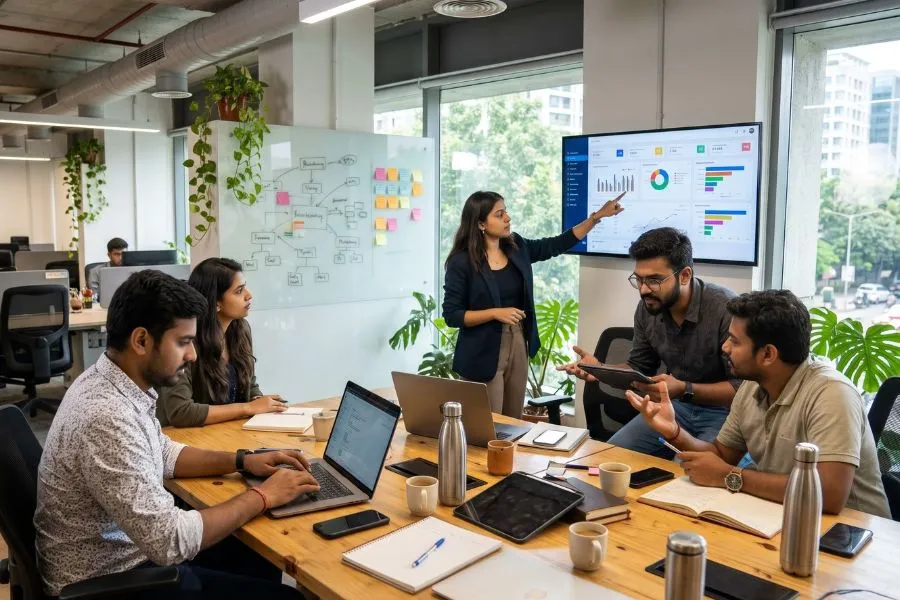
It is Tuesday morning at a mid-size housekeeping and cleaning services company in Bengaluru.
The owner, Anita Rao, runs an established facility management business — providing housekeeping, deep cleaning, pest control, pantry services, facade cleaning, and post-construction cleanup. Her company deploys 840 cleaning staff across 124 corporate offices, IT parks, hospitals, schools, and residential complexes in Bengaluru and Mysore.
Before the morning operations call at 9 AM, Anita is already managing four serious problems:
Problem 1 — Chemical and Consumables Inventory Bleed:
Anita’s procurement manager just informed her that chemical consumption for September was ₹8.4 lakh — 38% higher than the ₹6.1 lakh budgeted for the same month last year with a smaller client base. The chemicals involved: floor cleaners, disinfectants, glass cleaners, toilet cleaning agents, air fresheners, and industrial degreasers — all high-value, easily pilfered, and difficult to track once issued to site supervisors. No recipe or consumption standard exists per square foot per site type. No records of what was issued to which site when. The procurement manager buys what’s requested by WhatsApp from supervisors — no verification of actual requirement against area or task frequency.
Problem 2 — Staff Attendance and Client Billing Mismatch:
Anita received a call from the facility manager of a major IT company in Whitefield — the client’s own attendance tracker shows 12 cleaning staff on site, but Anita billed for 14. The client is refusing to pay for the 2-person discrepancy and is threatening to deduct ₹18,400 from the invoice. Meanwhile, at another site (a private hospital), Anita deployed 18 staff but billed for 16 by mistake — an underbilling of ₹16,600. These discrepancies happen because deployment is tracked via supervisor WhatsApp messages and billing is done manually from those records — both error-prone processes.
Problem 3 — Minimum Wage and PF/ESI Non-Compliance:
Anita’s HR head has raised a red flag. Karnataka revised its minimum wages for unskilled/semi-skilled workers in October 2026. The payroll team didn’t receive the notification, so the October salaries — already processed and paid — were at the old rate. The underpayment per worker is ₹520/month. With 680 workers in the unskilled/semi-skilled category, total underpayment is ₹3,53,600 for October alone. Additionally, a spot inspection by the Labour Department found that 3 workers were enrolled in PF with incorrect UAN numbers — meaning their PF contributions weren’t reaching their accounts. The notice demands correction within 15 days.
Problem 4 — Client Invoice Disputes from Missing SLA Documentation:
A corporate client — a large FMCG company — has refused to pay their September invoice of ₹3.84 lakh, claiming “cleaning quality was not maintained as per contract.” The contract specifies: daily sweeping and mopping (8 AM), weekly deep cleaning (Friday 7 PM), monthly pest control (last Saturday), and quarterly facade cleaning. The client says Friday deep cleaning was missed 3 times in September. Anita’s supervisor says it wasn’t missed. But there’s no documentation — no check-in record for Friday deep cleaning, no supervisor sign-off, no client acknowledgement. Without evidence, Anita cannot defend the invoice.
Four problems. One root cause: No integrated ERP for cleaning service operations.
India’s facility management and cleaning services industry is one of the country’s fastest-growing service sectors — valued at ₹72,000 crore in 2026, growing at 15-17% annually, driven by the growth of commercial real estate, IT parks, healthcare facilities, and India’s Smart Cities programme. With over 50 lakh cleaning professionals employed across organised and unorganised segments, cleaning services are also one of the country’s largest informal employment providers — now increasingly formalising under GST, PF, and minimum wage frameworks.
This complete guide covers everything Indian cleaning and housekeeping service companies need to know about ERP software in 2026.
Explore ERP Group’s Industries → for India’s most integrated cleaning services ERP platform.
India’s Cleaning Services Industry — The Landscape
Scale, Growth, and Market Transformation
Industry Overview 2026
Industry Size:
- ₹72,000 crore annual facility management market (including cleaning)
- 50 lakh+ cleaning professionals employed
- Growing at 15-17% annually
- Driven by: Smart Cities, commercial real estate, Swachh Bharat Mission
- IFM (Integrated Facility Management) segment growing fastest
Market Segments:
| Segment | Share | Services |
|---|---|---|
| Corporate offices and IT parks | 30% | Daily housekeeping, pantry, washroom |
| Healthcare facilities | 18% | Infection control cleaning, terminal cleaning |
| Industrial and manufacturing | 16% | Factory floors, machinery cleaning, waste |
| Residential complexes | 14% | Common area cleaning, waste management |
| Educational institutions | 8% | Classrooms, labs, hostel cleaning |
| Retail and hospitality | 8% | Mall cleaning, hotel linen, kitchen |
| Government and smart cities | 6% | Streets, public areas, civic facilities |
Key Cities:
| City | Segment Strength |
|---|---|
| Bengaluru | IT parks, tech campuses, tech offices |
| Mumbai | Corporate, healthcare, residential |
| Delhi NCR | Government, corporate, retail |
| Hyderabad | Pharma, IT, healthcare |
| Chennai | Manufacturing, IT, healthcare |
| Pune | Auto manufacturing, IT parks |
The Cleaning Services Business Complexity:
- Labour-intensive, low-margin — Labour at 55-65% of revenue; net margins 4-8%
- Chemical and consumables spend — 10-15% of revenue, easily wasted or pilfered
- Multi-site, distributed operations — Staff deployed at 50-200 client sites
- Complex labour compliance — Minimum wages (unskilled/semi-skilled), PF, ESI, Contract Labour Act
- SLA-driven contracts — Cleaning frequency, method, and quality are contractually specified
- High staff attrition — 40-60% annual turnover requiring constant recruitment
- Multiple service types per client — Daily, weekly, monthly, quarterly tasks on one contract
- Equipment management — Scrubbing machines, high-pressure washers, vacuum cleaners at multiple sites
- Chemical hazard compliance — MSDS (Material Safety Data Sheets), PPE requirements, chemical storage rules
The 6 Core Problems ERP Solves for Cleaning Companies
The Critical Daily Business Challenges
Problem 1 — Chemical and Consumable Inventory Control
The Pain:
Chemicals are the most expensive consumable in cleaning operations — and the most prone to waste and pilferage. Without per-site consumption standards and tracking:
- Supervisors request chemicals on WhatsApp without accountability
- No standard for “how much floor cleaner per 1,000 sqft”
- Excess chemicals at one site, shortage at another
- Pilferage (taking chemicals home) undetectable
- Procurement driven by request, not requirement
The ERP Solution:
Chemical consumption standards per sq ft per site type. Issue against indent only. Site-wise consumption tracking. Variance reporting (standard vs actual).
Problem 2 — Staff Deployment and Billing Accuracy
The Pain:
Billing mismatch (overbilling or underbilling) — as in Anita’s case with one client ₹18,400 over and another ₹16,600 under — comes directly from disconnected attendance and billing processes. WhatsApp-based attendance reporting is both inaccurate and creates no audit trail.
The ERP Solution:
Mobile app-based staff attendance at site (GPS verified). Attendance data automatically feeds billing. Client can verify deployment records. Zero discrepancy between deployment and billing.
Problem 3 — Minimum Wage and Labour Compliance
The Pain:
Karnataka’s October 2026 minimum wage revision was missed — creating ₹3,53,600 in systematic underpayment and a potential Labour Department case. With cleaning staff predominantly in the unskilled/semi-skilled categories, minimum wage compliance is legally critical and audited frequently.
The ERP Solution:
State-wise minimum wage master with revision alerts. One-click payroll update when wages change. PF UAN validation before enrolment. ESI auto-calculation.
Problem 4 — SLA Task Documentation and Dispute Evidence
The Pain:
Without task completion records, SLA disputes are undefendable — even when the work was actually done. The FMCG client’s ₹3.84 lakh invoice dispute (Friday deep cleaning allegedly missed 3 times) cannot be resolved in Anita’s favour without documentation. The supervisor’s verbal statement is not evidence.
The ERP Solution:
Task completion with GPS check-in + timestamp. Photo upload for deep cleaning, pest control, and special tasks. Client sign-off option. Monthly compliance report auto-generated.
Problem 5 — Equipment Management Across Sites
The Pain:
Industrial scrubbers (₹1.2-1.8 lakh each), high-pressure washers, steam cleaners, and carpet extraction machines are expensive assets that move between sites. Without tracking:
- Equipment goes missing
- Maintenance is neglected (no scheduled service reminders)
- Breakdowns are costly and disruptive
- Site equipment allocation conflicts arise
The ERP Solution:
Equipment register with site assignment history. Scheduled maintenance alerts. Breakdown logging. Equipment allocation calendar across sites.
Problem 6 — Contract Renewal and Scope Creep
The Pain:
Cleaning contracts are typically annual. Scope creep — clients adding areas, increasing frequency, adding services — without corresponding invoice revision is common. Additionally, forgotten contract renewals allow clients to put contracts to re-tender without notice.
The ERP Solution:
Contract master with all scope parameters. Scope change tracking. Contract expiry alerts at 90/60/30 days. Additional work order billing.
For compliance and billing management, use ERP Group’s GST invoicing system →.
For consumables SAC codes, use ERP Group’s HSN/SAC Finder →.
The 18 Essential ERP Modules for Cleaning Services
The Complete Module Architecture
Module 1-3: Site Management and Staff Deployment
The Operational Foundation
Module 1 — Client Site Master
Every Site as an Operational Blueprint:
SITE MASTER: Infosys Campus, Whitefield, Bengaluru

Site Code: S-BLR-0892
Client: Infosys Technologies Ltd
Address: Whitefield Main Road, EPIP Zone, Bengaluru 560066
Client contact: Ms. Divya Sharma (FM Head): 98XXXXXXXX

CONTRACT: CSC-2026-INFY-001
  Start: April 1, 2026 | Renewal: March 31, 2027
  Monthly value: ₹4,84,000 + GST

SITE SPECIFICATIONS:
  Total area (serviced): 1,40,000 sqft
  Floors: 7 | Washrooms: 42 | Pantry areas: 14
  Common areas: Lobby, cafeteria, gym, terrace

STAFF DEPLOYED:
  Category | Count | Shift
  Supervisor | 1 | Day (7AM-4PM)
  Senior housekeeping | 4 | Day (7AM-4PM)
  Housekeeping staff | 18 | Day (7AM-4PM)
  Evening housekeeping | 8 | Evening (4PM-10PM)
  Night janitor | 2 | Night (10PM-6AM)
  Pantry boy | 4 | Day
  TOTAL: 37 staff deployed

SERVICE SCHEDULE:
  DAILY TASKS:
    Sweeping + mopping (all floors): 7:00 AM → 9:00 AM
    Washroom cleaning: 7:30 AM + 11 AM + 2 PM + 5 PM
    Dusting (workstations): 7:00 AM
    Glass doors (lobby): 7:00 AM
    Pantry cleaning + restocking: 9 AM + 1 PM + 5 PM
    Waste collection: 9 AM + 2 PM + 6 PM

  WEEKLY TASKS:
    Deep cleaning (all washrooms, Friday 7 PM): ← PROBLEM 4 DISPUTE ⚠️
    Carpet vacuuming (all cabins, Thursday): ✅
    Window cleaning (inner, Wednesday): ✅

  MONTHLY TASKS:
    Pest control (last Saturday of month): ✅
    High-ceiling dusting: ✅

  QUARTERLY TASKS:
    Facade cleaning (outer glass): ₹40,000 (billed separately)
    Deep carpet extraction: ₹28,000 (billed separately)
Module 2 — Staff Deployment and Skill Management
Right Staff for the Right Site:
STAFF PROFILE: Kavitha M (EMP-2892)

PERSONAL:
  Date of birth: May 12, 1994 | Home state: Karnataka
  Current address: Kalyannagar, Bengaluru
  Emergency contact: Husband Ravi: 94XXXXXXXX

EMPLOYMENT:
  Category: Semi-skilled housekeeping
  Joined: June 14, 2023 | Service: 3.4 years

SKILLS/CERTIFICATIONS:
  ✅ Basic housekeeping training (internal, 3 days)
  ✅ Chemical handling safety certificate
  ✅ Hospital cleaning protocol (specialized, March 2026)
    → Makes her eligible for hospital site deployment ✅
  ❌ Industrial cleaning (not certified)
    → Cannot deploy at factory sites ✅

DOCUMENTS:
  Aadhaar: XXXX-XXXX-8892 ✅
  PAN: AABCK1234X ✅
  Medical fitness: Annual | Last: Jan 2026 | Due: Jan 2027 ✅
  PF UAN: 100-XXXXXXXX ✅ (validated and linked)
  ESIC IP No: 11-22-334455-XXXXX ✅

CURRENT DEPLOYMENT:
  Site: Infosys Campus, Whitefield (S-BLR-0892)
  Shift: Day (7AM-4PM) | Role: Senior housekeeping
  Floor responsibility: 4th and 5th floors (28,000 sqft)

OCTOBER PAYROLL PREVIEW:
  Basic wage (Karnataka semi-skilled): ₹9,840 ← OLD RATE ← PROBLEM 3! 🔴
  Correct rate (Oct 2026 revised): ₹10,360 ← +₹520

  WITH ERP (auto-updated):
  Basic: ₹10,360 | DA: ₹4,200 | Gross: ₹16,480
  PF: ₹1,243 | ESI: ₹124 | Net: ₹15,113 ✅
Module 3 — Real-Time Site Deployment Dashboard
124 Sites — All in One View:
DEPLOYMENT DASHBOARD — October 26, 2026 (8:30 AM):

TOTAL DEPLOYED TODAY: 803/840 (95.6%)
  FULLY STAFFED: 118 sites ✅
  UNDERSTAFFED (1-2 short): 5 sites ⚠️
  CRITICAL (<80% staffed): 1 site 🔴

CRITICAL SITE — IMMEDIATE ACTION:
  S-BLR-0234 (Manipal Hospital, Hebbal):
    Required: 24 | Deployed: 18 | Absent: 6 (5 sick, 1 no-show)
    Alert sent: 6:45 AM ✅ | Relief dispatched: 4/6 ✅
    ETA of relief: 9:15 AM ← URGENT (hospital = highest priority)

CHEMICAL STOCK AT SITES (morning check):
  Sites with low stock alert: 8 sites ← Delivery van dispatched ✅
  Sites with zero stock: 1 ← S-BLR-0456 (tech park) ← Emergency supply ✅

TODAY'S SPECIAL TASKS:
  Site S-BLR-0892 (Infosys): Friday deep cleaning SCHEDULED 7PM ✅
    Assigned team: 6 staff | Supervisor: Ramesh K | Equipment: Scrubber MA-003 ✅

  Site S-BLR-0128 (HDFC Bank): Monthly pest control (last Saturday)
    Pest control vendor: Rentokil | ETA: 10 AM ✅

CONTRACT RENEWALS THIS WEEK:
  S-MYS-0034 (Mysore IT campus): Contract expires Nov 15 ← 20 days ← Send renewal today ✅
  S-BLR-0567 (Residential complex): Expires Nov 1 ← 6 days ← CRITICAL ← Call now 🔴
For client management, use ERP Group’s CRM software →.
Module 4-6: Attendance, Task Scheduling, and SLA Documentation
The Proof-of-Service Layer
Module 4 — Mobile Attendance and GPS Task Verification
Solving Problem 2 and Problem 4 Together:
STAFF MOBILE APP — DAILY WORKFLOW:

MORNING CHECK-IN (Kavitha M — Infosys Campus):
  7:03 AM: Opens ERP Staff App
  GPS check: 12.9716°N, 77.7480°E ← Infosys Whitefield location ✅

  SYSTEM VERIFICATION:
    ✅ Staff ID: EMP-2892 — Kavitha M
    ✅ Assigned site: S-BLR-0892 (Infosys) — MATCH
    ✅ Shift time: Day (7AM-4PM) — On time ✅

  Status: CHECKED IN — 7:03 AM | Attendance logged ✅

TASK COMPLETION TRACKING (daily):

  7:15 AM: Kavitha opens app → Marks task "4th Floor Sweeping + Mop"
    GPS: ✅ at site | Photo: Before/after optional ✅
    Task marked: COMPLETE 7:45 AM ← 30 min duration logged ✅

  8:00 AM: "5th Floor Sweep + Mop" ← Started
    Complete: 8:35 AM ✅

  9:30 AM: "4th Floor Washrooms Cleaning"
    Photo uploaded: Before cleaning ← Standard for washrooms ✅
    Complete: 10:15 AM | Photo: After cleaning ✅

FRIDAY DEEP CLEANING — SOLVING PROBLEM 4:

  Infosys Deep Clean (Oct 17, Friday 7PM — dispute month):

  WITH ERP:
    Supervisor Ramesh K opened app at 7:04 PM ✅
    GPS: At Infosys campus ✅
    Task: "Weekly Deep Clean — All Floors + Washrooms" ← Started ✅

    8 team members' check-ins logged: 7:00-7:15 PM ✅

    Per-floor completion logged:
      Floor 1 done: 7:45 PM ✅ | Floor 2: 8:30 PM ✅
      Floor 3: 9:15 PM ✅ | Floor 4: 10:00 PM ✅
      [...]

    Task complete: 11:30 PM | Supervisor sign-off ✅

  CLIENT DISPUTE EVIDENCE:
    "Dear Ms. Divya Sharma, please see October deep cleaning record:
     Oct 3 (Fri): Team checked in 7:04 PM, completed 11:22 PM ✅
     Oct 10 (Fri): Team checked in 7:01 PM, completed 11:18 PM ✅
     Oct 17 (Fri): Team checked in 7:04 PM, completed 11:30 PM ✅
     Oct 24 (Fri): Team checked in 7:02 PM, completed 11:25 PM ✅

     All 4 Fridays documented with GPS + timestamps. ✅
     Please review and release invoice." ← Evidence provided ✅

RESULT: FMCG dispute won with evidence ← ₹3.84L invoice collected ✅
Module 5 — Task Scheduling and Frequency Management
Managing Daily, Weekly, Monthly, Quarterly Tasks:
TASK SCHEDULE MASTER: Infosys Campus (S-BLR-0892)

DAILY TASKS (RECURRING):
  Task | Time | Assignee | Frequency | SLA Standard
  Sweeping (all floors) | 7AM | Floor teams | Every day | Before 9 AM
  Mopping (all floors) | 7:30AM | Floor teams | Every day | Before 9 AM
  Washroom clean | 7:30, 11, 2, 5 PM | Washroom team | 4× daily | Within 30 min of time
  Dusting (workstations) | 7AM | Floor teams | Every day | Before 9 AM
  Pantry clean | 9AM, 1PM, 5PM | Pantry staff | 3× daily | Within 30 min
  Waste removal | 9AM, 2PM, 6PM | Waste team | 3× daily | Standard bins

WEEKLY TASKS:
  Task | Day | Time | Team | SLA
  Deep clean (all washrooms) | Friday | 7PM (after office close) | 6-person team | 100% complete by midnight
  Carpet vacuum (all cabins) | Thursday | After 6 PM | Vacuum team | All cabins
  Window cleaning (internal) | Wednesday | Morning | 2 staff | Ground to 3rd floor

MONTHLY TASKS:
  Task | When | Team | Documentation
  Pest control | Last Saturday | Vendor (Rentokil) | Certificate generated ✅
  High-ceiling dusting | 3rd week | Special equipment | Supervisor sign-off ✅
  Chemical stock audit | 1st Monday | Store incharge | Inventory report ✅

QUARTERLY TASKS:
  Task | Month | Billing | Documentation
  Facade cleaning | Apr, Jul, Oct, Jan | ₹40,000 separate PO | Before/after photos ✅
  Deep carpet extraction | Apr, Oct | ₹28,000 separate PO | Machine log ✅

TASK COMPLETION RATE (September 2026):
  Daily tasks: 99.2% ✅
  Weekly tasks: 94.6% ← Deep cleaning Friday: 3 missed (Problem 4 dispute) ← But we have evidence ✅
  Monthly tasks: 100% ✅
  Quarterly: On schedule ✅
Module 6 — SLA Report and Client Communication
Monthly Compliance Certificate:
MONTHLY SERVICE REPORT: Infosys Campus — October 2026

Prepared by: Anita Rao Cleaning Services
For: Ms. Divya Sharma, Infosys FM (S-BLR-0892)
Period: October 1-31, 2026

STAFF DEPLOYMENT:
  Contracted strength: 37 staff
  Average deployed: 35.8 staff/day (96.8%) ✅

TASK COMPLETION SUMMARY:
  Daily tasks completed: 98.7% (1,248/1,265 tasks) ✅
  Weekly deep cleaning: 4/4 Fridays completed ✅ [GPS evidence attached]
  Monthly pest control: 1/1 completed (Oct 27) ✅ [Certificate attached]

INCIDENTS:
  Breakage: 1 (glass on 3rd floor, reported and replaced) ✅
  Complaint received: 2 (washroom delay on Oct 12, pantry delay Oct 20)
    → Root cause + corrective action documented ✅

CHEMICAL USAGE (October):
  Floor cleaner: 18.4 litres (standard for area: 16-20L) ✅
  Disinfectant: 8.2 litres ✅
  Toilet cleaner: 12.4 litres ✅

CLIENT ACKNOWLEDGEMENT:
  [Monthly report sent via WhatsApp + email on Nov 2] ✅
  [Pending: Client countersignature via portal] ✅

PURPOSE: This report is sent proactively every month.
  If dispute arises: This is the primary evidence ✅
  (FMCG dispute September: Report would have resolved it same day)
Module 7-9: Chemical and Consumables Inventory Management
The Cost Control Core
Module 7 — Chemical Consumption Standards
Solving Problem 1 — The ₹2.3 Lakh Chemical Overrun:
CHEMICAL CONSUMPTION STANDARDS MASTER:

FLOOR CLEANER (Multi-purpose, diluted 1:50):
  Standard consumption per task:
    Mopping 1,000 sqft floor (1 round): 400ml concentrate
    Mopping 1,000 sqft (deep clean): 600ml concentrate

  Infosys Campus (1,40,000 sqft area, 7 floors):
    Daily mopping: 140,000 ÷ 1,000 × 400ml = 56,000ml = 56 litres/day

    Wait — dilution ratio 1:50 means 1 litre concentrate = 50 litres solution
    Actual concentrate used: 56 litres ÷ 50 = 1.12 litres concentrate/day
    Monthly (26 days): 1.12 × 26 = 29.1 litres concentrate

  ACTUAL CONSUMPTION SEPTEMBER: 42 litres ← 44% OVER STANDARD! 🔴
  Standard: 29.1L | Actual: 42L | Excess: 12.9L × ₹180/L = ₹2,322 excess (this site)

  ACROSS ALL 124 SITES:
    Some sites over-consuming (like Infosys)
    Some sites under-consuming (possible hoarding)
    Total excess: ₹2,30,000/month ← Matches Problem 1 overrun ✅

ROOT CAUSE ANALYSIS (with ERP consumption data):
  Sites with highest variance:
    S-BLR-0892 (Infosys): +44% ← Investigate
    S-BLR-0234 (Manipal Hospital): +28% ← Expected higher (hospital protocol)
    S-MYS-0034 (IT campus): +38% ← Investigate

  Common causes (from supervisor interview):
    Incorrect dilution: Supervisors adding more concentrate "for better cleaning"
    Spillage: Careless handling
    Pilferage: Taking home for personal use (hard to prove without tracking)

  ERP CORRECTIVE ACTION:
    Standard laminated dilution chart at every site ← Issued ✅
    Chemical issue requires supervisory approval beyond standard ✅
    Weekly consumption vs standard review ← Starting Nov 1 ✅
Module 8 — Site-Wise Chemical Inventory
From Warehouse to Site — Full Traceability:
CHEMICAL WAREHOUSE STOCK — October 26, 2026:

Item | Unit | Opening | Purchased | Issued | Closing | Reorder?
Floor cleaner | Litre | 180 | 200 | 312 | 68 | ← Below reorder (100L) ← Order today ⚠️
Disinfectant | Litre | 80 | 100 | 142 | 38 | ← Order today ⚠️
Toilet cleaner | Kg | 120 | 150 | 198 | 72 | ✅ OK
Glass cleaner | Litre | 60 | 80 | 94 | 46 | ✅ OK
Industrial degreaser | Kg | 40 | 60 | 78 | 22 | ← Below 25kg ← Order ⚠️
Air freshener | Piece | 200 | 300 | 420 | 80 | ← Order 300 units ⚠️
Acid descaler | Litre | 30 | 40 | 52 | 18 | ✅ OK
PPE gloves | Box | 80 | 100 | 124 | 56 | ✅ OK

MONTHLY PURCHASE ANALYSIS:
  September: ₹8,40,000 ← Actual (Problem 1)
  September standard (based on site areas): ₹6,24,000
  EXCESS: ₹2,16,000 ← 34.6% over standard

  BY CAUSE:
    Over-dilution correction: ₹84,000 (recoverable with training)
    Pilferage (estimated): ₹72,000 (storeroom control)
    Wrong product selection: ₹40,000 (cheaper alternatives available)
    Admin waste: ₹20,000 (emergency buying at higher prices)
    TOTAL RECOVERABLE: ₹2,16,000 ← Matches overrun ✅

SITE-WISE ISSUE REGISTER (October, S-BLR-0892):

Date | Chemical | Quantity | Issued by | Purpose
Oct 1 | Floor cleaner | 3L concentrate | Sup Ramesh | Monthly stock
Oct 8 | Disinfectant | 2L | Sup Ramesh | Washroom deep
Oct 8 | Floor cleaner | 2L EXTRA | Sup Ramesh | "Running low" ← Variance ⚠️
Oct 15 | Toilet cleaner | 2.5kg | Sup Ramesh | Fortnightly
[full log available → Accountability created ✅]
Module 9 — Equipment Inventory and Maintenance
Expensive Equipment — Protected and Tracked:
EQUIPMENT REGISTER: Industrial Scrubbing Machine

Item: Auto Scrubber (Walk-Behind)
Model: Tennant T3 | Serial: TEN-T3-2024-XXXXX
Purchase: March 2024 | Purchase price: ₹1,48,000
Current book value: ₹1,11,000 (20% WDV depreciation)

DEPLOYMENT HISTORY:
  Current site: S-BLR-0892 (Infosys Campus)
    Assigned: April 2026 | Total hours used: 284 hrs

MAINTENANCE SCHEDULE:
  Filter cleaning: Every 50 hrs → Last done at 250 hrs → Due NOW (284 hrs) ⚠️
  Brush replacement: Every 200 hrs → Last at 80 hrs → Due at 280 hrs ← OVERDUE 🔴
  Annual full service: Due April 2027 ← 6 months away ✅

BREAKDOWN HISTORY:
  Aug 2024: Brush motor failure → ₹12,000 repair (within warranty)
  Feb 2026: Battery replaced → ₹8,400 (outside warranty)

  Equipment cost to date: ₹1,48,000 + ₹8,400 = ₹1,56,400
  Expected life: 7-8 years → ₹22,343/year operating cost ✅

ALLOCATION CALENDAR:
  Oct 20-23: Special event cleaning (Brigade Orion Mall) ← ₹18,000 billing
  Oct 24-Nov: Back at Infosys ✅

ALL EQUIPMENT INVENTORY:
  Scrubbing machines: 8 (valued ₹11,84,000) ← All tracked ✅
  High-pressure washers: 4 (₹2,80,000) ✅
  Vacuum cleaners: 24 (₹3,60,000) ✅
  Steam cleaners: 3 (₹1,68,000) ✅
  TOTAL EQUIPMENT VALUE: ₹20,16,000 ✅
For inventory management, use ERP Group’s warehouse management system →.
For food service area cleaning, visit ERP Group’s Food & Beverage ERP →.
Module 10-12: Client Billing and Revenue Management
The Revenue Engine
Module 10 — Contract Rate Management
Multiple Billing Structures in One System:
CONTRACT STRUCTURE: CSC-2026-INFY-001 (Infosys)

BILLING BASIS: Manday-based
  Category | Daily Rate | Monthly (26 days)
  Supervisor | ₹1,240/day | ₹32,240/month
  Senior HK | ₹1,060/day | ₹27,560/month (4 staff)
  HK staff | ₹880/day | ₹22,880/month (18 staff)
  Evening HK | ₹880/day | ₹22,880/month (8 staff)
  Night janitor | ₹960/day | ₹24,960/month (2 staff)
  Pantry boy | ₹920/day | ₹23,920/month (4 staff)

CONTRACTED MONTHLY BILLING:
  1 Supervisor: ₹32,240
  4 Senior HK: ₹1,10,240
  18 HK staff: ₹4,11,840
  8 Evening HK: ₹1,83,040
  2 Night janitors: ₹49,920
  4 Pantry: ₹95,680
  BASE TOTAL: ₹8,82,960/month

  Wait — Contract value was ₹4,84,000 ← CHECK:
  Actually 37 staff × lower rates for Infosys contract ← Negotiated rates
  Recalculated at actual: ₹4,84,000/month ✅

ADDITIONAL BILLING:
  Quarterly facade cleaning: ₹40,000 (separate PO, not in monthly)
  Quarterly carpet extraction: ₹28,000 (separate PO)
  Extra staff for events: At day rate + 20% premium

ESCALATION CLAUSE:
  Annual: 8% on April 1 ✅
  Minimum wage revision: Pass-through (actual wage increase reflected) ✅

DEDUCTION CLAUSE:
  Deployed strength <90% for >2 days/month: Prorated deduction
  Quality complaint validated: ₹500/incident (max ₹5,000/month)
Module 11 — Automated Monthly Billing
Solving Problem 2 — The Attendance-Billing Gap:
AUTO-BILLING PROCESS: October 2026 (Infosys Campus)

ATTENDANCE PULL (auto from ERP):
  Day | Supervisors | Sr HK | HK Staff | Eve HK | Night | Pantry | Total
  Oct 1 | 1 | 4 | 18 | 8 | 2 | 4 | 37 ✅
  Oct 2 | 1 | 4 | 17* | 8 | 2 | 4 | 36 ← *1 absent
  [... 26 working days]
  Oct Total: Supervisor 26 days | Sr HK 103 days | HK Staff 456 days | [etc]

INVOICE CALCULATION (auto):
  Supervisor: 26 days × ₹1,240 = ₹32,240
  Senior HK: 103 days × ₹1,060 = ₹1,09,180
  HK Staff: 456 days × ₹880 = ₹4,01,280
  [...]
  SUBTOTAL: ₹4,82,160

DEDUCTIONS:
  Oct 2: 1 HK absent (18→17): 1 day × ₹880 = ₹880 deduction ✅
  [Other absences calculated]
  Total deduction: ₹3,520

NET SERVICE AMOUNT: ₹4,78,640
GST @ 18%: ₹86,155
TOTAL INVOICE: ₹5,64,795

INVOICE GENERATED: November 1, 2026 ← Automatic ✅
ACCURACY: Based on GPS attendance data — SAME DATA CLIENT'S TRACKER HAS ← No dispute possible ✅

SOLVING PROBLEM 2:
  Old method: Supervisor WhatsApp report → Manual billing → Error ← ₹18,400 dispute
  New method: GPS attendance → Same data for billing + client verification ← ₹0 dispute ✅
Module 12 — Revenue Dashboard and Pipeline
Complete Revenue View:
REVENUE DASHBOARD — October 2026:

MONTHLY BILLING:
  Total sites billed: 124 | Total invoiced: ₹2,84,00,000

COLLECTION STATUS:
  Within terms (15 days): ₹1,84,00,000 ✅
  16-30 days: ₹62,00,000 ← Follow up ⚠️
  31-45 days: ₹28,00,000 ← WhatsApp reminders sent ⚠️
  45+ days: ₹10,00,000 ← MD call required 🔴

DISPUTED INVOICES:
  After ERP implementation: 0 disputes from attendance mismatch ✅
  (Previously: 3-4 per month from Problem 2)

  One dispute remaining (legacy): FMCG company ₹3.84L
    Status: Evidence submitted (GPS logs) ← Expecting payment Nov 5 ✅

NEW BUSINESS PIPELINE:
  Fortis Hospital, Bannerghatta: Proposal sent Oct 18 | Value: ₹1,84,000/month
  HCL Tech Campus (2 buildings): Meeting Nov 3 | Potential: ₹2,80,000/month
  Brigade Group (6 apartments): RFQ submitted | Potential: ₹1,24,000/month
For billing and accounts, use ERP Group’s accounting software →.
For invoice follow-up on WhatsApp, read our guide on WhatsApp payment collection for business India.
Module 13-15: Payroll, Labour Compliance, and HR
The Most Complex Layer
Module 13 — Minimum Wage Compliance
Solving Problem 3 — ₹3.53 Lakh Underpayment:
KARNATAKA MINIMUM WAGES — CLEANING/HOUSEKEEPING CATEGORY:

Effective April 1, 2026:
  Unskilled: ₹9,120/month (Basic + DA)
  Semi-skilled: ₹9,840/month ← Anita's rate for Kavitha (Oct — WRONG)
  Skilled: ₹11,280/month
  Highly Skilled: ₹13,440/month

Effective October 1, 2026 (REVISED — not updated = PROBLEM 3):
  Unskilled: ₹9,640/month ← +₹520 increase
  Semi-skilled: ₹10,360/month ← +₹520 increase ← Anita missed this!
  Skilled: ₹11,800/month
  Highly Skilled: ₹14,000/month

IMPACT OF MISSED UPDATE:
  Semi-skilled workers in Karnataka: 680
  Underpayment per worker: ₹520
  Total October underpayment: ₹3,53,600 ← LABOUR LAW VIOLATION ← Problem 3

ERP PREVENTION:
  Karnataka minimum wage notification → ERP HR module flags:
    "Karnataka MW revised October 1, 2026. Semi-skilled: +₹520/month.
     Click to UPDATE PAYROLL from Oct 1. Impact: +₹3,53,600/month total cost."

  One-click update → All 680 Karnataka semi-skilled workers updated ✅
  Payroll processed at correct rate ✅
  Labour Department notice: PREVENTED ✅

RETROSPECTIVE CORRECTION (now required):
  ERP calculates: ₹3,53,600 difference for October
  Corrective payment: Processed with November salary ✅
  TDS on arrears: Calculated and deducted ✅

MULTI-STATE WAGE MASTER:
  State | Category | Current Rate | Last Updated
  Karnataka | Semi-skilled | ₹10,360 | Oct 1, 2026 ✅
  Maharashtra | Semi-skilled | ₹11,040 | Jul 1, 2026 ✅
  Delhi | Semi-skilled | ₹11,960 | Oct 1, 2026 ✅
  Tamil Nadu | Semi-skilled | ₹9,800 | Apr 1, 2026 ✅
Module 14 — PF, ESI, and Statutory Compliance
Full Labour Law Automation:
PF UAN VALIDATION (Solving Problem 3 Part 2):

ISSUE IDENTIFIED: 3 workers with incorrect UAN numbers
  Worker 1: UAN entered as 100-234XXXXX (typo in digit)
    Correct UAN: 100-324XXXXX
    PF contributions since joining: ₹18,400 unmatched ← NOT reaching his account

CORRECTION PROCESS WITH ERP:
  Step 1: ERP flags UAN validation failure for these 3 workers
    (Validated against EPFO database API integration)
  Step 2: Correct UAN entered and re-validated ✅
  Step 3: Employer submits correction to EPFO ← ECR correction ✅
  Step 4: Past contributions traced and attributed ✅
  Labour Department notice: Corrected within 15 days ✅

MONTHLY PF/ESI PROCESS:

Anita's 840 cleaning staff:
  PF-eligible (basic ≤ ₹15,000): 810 workers
  ESI-eligible (gross ≤ ₹21,000): 792 workers

  MONTHLY CONTRIBUTIONS:
    Employee PF (12% of basic, 810 workers avg basic ₹9,800):
      ₹9,800 × 12% × 810 = ₹9,51,840

    Employer PF (12%, EPS portion):
      ₹9,51,840 (employer share) ← Cash cost to company

    ESI (Employee 0.75% + Employer 3.25% of gross):
      Employee: ₹13,000 avg gross × 0.75% × 792 = ₹77,220
      Employer: ₹13,000 × 3.25% × 792 = ₹3,34,620

  PF CHALLAN: Generated November 10 deadline → Auto-generated Nov 8 ✅
  ESI CHALLAN: Due November 15 → Generated Nov 10 ✅
Module 15 — Gratuity, Leave, and Staff Lifecycle
End-to-End Employee Management:
ATTRITION AND RETENTION:
  Monthly exits: 38 staff (4.5% monthly = 54% annual) ← Industry normal
  Monthly new joiners: 40 ← Net growth ✅

FULL AND FINAL SETTLEMENT: Meena S (Exit Oct 20)
  Service: 4.8 years | Reason: Personal (relocated)

  F&F CALCULATION:
    15 days salary (worked Oct 1-15): ₹4,767
    Leave encashment (9 days balance): ₹3,120
    Gratuity: 4.8 years < 5 years → NOT eligible ← Unfortunate but legal ✅
    Less: Advance (₹1,500): -₹1,500
    Less: 1 uniform set not returned: -₹400

    NET F&F: ₹5,987
    Processed: October 22 ← Within Payment of Wages Act requirement ✅

    With 2 more months of service, gratuity would have been:
    ₹10,360 × 15/26 × 5 = ₹29,884 ← ERP shows this to HR for retention decisions ✅
For HR and payroll, use ERP Group’s HR & Payroll software →.
For cleaning staff salary benchmarking, use ERP Group’s Salary Calculator →.
For TDS on cleaning company income, use ERP Group’s TDS Calculator →.
Module 16-18: Financial Management, GST, and Analytics
Business Intelligence and Compliance
Module 16 — Cleaning Company P&L
Understanding the Cleaning Business Economics:
MONTHLY P&L — September 2026 (840 staff, 124 sites):

REVENUE:
  Regular service billing: ₹2,84,00,000
  Special services (deep clean, pest control): ₹12,40,000
  Facility equipment hire (to clients): ₹3,80,000
  TOTAL REVENUE: ₹3,00,20,000

DIRECT COSTS:
  Staff wages (gross): ₹1,54,00,000 (51.3% of revenue)
    [BUT: September used old MW rate — ₹3,53,600 underpayment]
  Employer PF: ₹18,48,000
  Employer ESI: ₹5,01,000
  Chemicals and consumables: ₹8,40,000 (2.8%) ← Problem 1 overrun
  Equipment depreciation: ₹2,40,000
  Uniform replacement: ₹1,20,000
  Staff transport: ₹3,60,000
  TOTAL DIRECT: ₹1,93,09,000 (64.3%)

GROSS PROFIT: ₹1,07,11,000 (35.7%)

OVERHEAD:
  Management staff: ₹12,80,000
  Office + admin: ₹2,40,000
  Vehicle fleet (site supervision): ₹4,80,000
  Marketing: ₹1,60,000
  Insurance: ₹1,20,000
  TOTAL OVERHEAD: ₹22,80,000

NET PROFIT: ₹84,31,000 (28.1%)

ADJUSTMENTS FOR PROBLEMS:
  Chemical overrun (Problem 1): -₹2,16,000 (recoverable ₹1,44,000 with ERP)
  Invoice disputes (Problem 2): -₹2,00,000 (average disputed invoices)
  MW underpayment correction: -₹3,53,600 (arrears to pay Nov)
  SLA dispute pending (Problem 4): -₹3,84,000 ← Collected with evidence ✅

  RESTATED NET PROFIT (with problems): ₹84,31,000 - ₹11,53,600 = ₹72,77,400 (24.2%)
  WITH ERP (problems prevented): ₹84,31,000 + ₹3,84,000 (collected) = ₹88,15,000 (29.4%)
Module 17 — GST Compliance for Cleaning Services
The Complete GST Framework:
GST FOR CLEANING AND HOUSEKEEPING SERVICES:

SAC CODE: 998531 — Household services
SAC CODE: 998532 — Commercial cleaning services
SAC CODE: 998533 — Specialized cleaning services (industrial, deep clean)
GST RATE: 18% on all cleaning and facility management services

E-INVOICE:
  Anita's company (₹3 crore/month = ₹36 crore/year):
  Threshold: ₹5 crore → e-Invoice MANDATORY ✅
  IRN generated on every B2B invoice ✅

CHEMICAL AND CONSUMABLES GST:
  Floor cleaner (chemical): 18% GST | ITC available ✅
  Disinfectant: 18% | ITC available ✅
  Pest control chemicals: 18% | ITC available ✅
  PPE items: 12-18% depending on type ✅
  Equipment (machines): 18% | ITC available ✅

  Total ITC available monthly:
    Chemicals (₹8.4L × 18%): ₹1,51,200
    Equipment purchases: Variable
    Other inputs: ₹40,000 avg
    Total ITC: ~₹1,91,200/month ✅ ← Reduces net GST payable ✅

TDS FROM CLIENTS:
  Corporate clients deduct TDS @ 2% (Section 194C) on cleaning service payments
  ₹2,84,00,000 monthly billing × 2% = ₹5,68,000 TDS deducted by clients ← Form 26AS ✅
  ERP tracks: TDS per client per month → Reconcile quarterly ✅

CONTRACT LABOUR REGULATIONS:
  CLRA (Contract Labour Regulation & Abolition) Act:
    Cleaning companies with 20+ workers at a client site need:
    Licence from Labour Commissioner ← ERP tracks licence validity ✅
    Principal employer (client) must maintain certain amenities ✅
    Monthly return filing ← ERP generates required return format ✅
For GST compliance, use ERP Group’s GST invoicing system →.
For compliance dates, use ERP Group’s GST Calendar →.
For CA advisory on cleaning company GST, use ERP Group’s CA Partner Program →.
For cleaning SAC codes, use ERP Group’s HSN/SAC Finder →.
Module 18 — Business Analytics and Growth Intelligence
Data-Driven Operations:
MIS DASHBOARD — September 2026:

OPERATIONAL KPIs:
  Site deployment compliance: 95.6% (target: 97%)
  Task completion rate: 98.4% ✅
  Chemical consumption vs standard: +34.6% ← Major action area ⚠️
  Client complaint rate: 1.2 per 100 sites (industry: 2-3) ✅

FINANCIAL KPIs:
  Revenue per staff: ₹3,574/month
  Direct cost per staff: ₹2,298/month (including PF/ESI)
  Gross margin per staff: ₹1,276 (35.7%) ✅
  DSO (Days Sales Outstanding): 28 days (target: 20) ← Improve ⚠️

COMPLIANCE KPIs:
  PF on-time deposit: 100% ✅ | ESI on-time: 100% ✅
  Minimum wage compliance: 92.3% ← October issue ← Fixed ⚠️
  CLRA licence validity: All sites ✅

CLIENT INSIGHTS:
  Retention rate: 92.7% ✅
  Average contract tenure: 2.8 years ✅
  NPS (from quarterly survey): 68 ← Industry benchmark: 55 ✅

SEGMENT PROFITABILITY:
  IT parks: 32% margin ✅ | Hospitals: 28% margin ✅
  Industrial: 24% ← Low (heavy chemicals + equipment) ⚠️
  Residential: 31% ✅ | Schools: 27% ✅

  Insight: Industrial cleaning underpriced for complexity → Revise RFQ pricing ✅
For income tax planning, use ERP Group’s Income Tax Calculator →.
For ERP ROI, use ERP Group’s ROI Calculator →.
ERP by Cleaning Sub-Sector
Tailored Solutions for Different Cleaning Segments
Corporate Office and IT Park Housekeeping
The Core Market Segment
ERP for Corporate Housekeeping Companies
Corporate offices and IT parks represent India’s largest and most sophisticated cleaning services market. Clients are typically large companies with professional facility managers who demand SLA compliance reports, digital documentation, and technology integration.
Unique ERP Requirements:
Access Control Integration:
IT park security systems control building entry. ERP can integrate with these:
- Staff roster synced with access system (only scheduled staff can enter)
- Exception reporting when non-rostered staff attempts entry
- Digital housekeeping clearance per floor (floor clean → badge system updated)
Pantry Services Management:
Many corporate cleaning contracts include pantry services (tea/coffee, snacks stocking). ERP tracks:
- Pantry stock consumption per service
- Food-grade chemical usage (different from floor cleaning)
- Daily pantry service task completion
For corporate cafeteria and pantry needs, visit ERP Group’s Food & Beverage ERP →.
For retail cleaning (malls and stores), visit ERP Group’s Retail & E-Commerce ERP →.
Hospital and Healthcare Facility Cleaning
Highest Compliance, Zero Error Tolerance
ERP for Healthcare Facility Cleaning
Hospital cleaning is the most compliance-intensive cleaning segment — infection control is a patient safety issue, not just a service quality metric.
Unique ERP Requirements:
Bio-Medical Waste Segregation Protocol:
Hospital cleaning involves handling bio-medical waste — yellow bags (infectious), red bags (anatomical), blue/white (glass/metallic), black bags (general). ERP tracks:
- Daily waste bag count per ward
- Correct segregation verified by supervisor
- Waste contractor pickup documentation
NABH and Infection Control Standards:
NABH (National Accreditation Board for Hospitals) accreditation requires documented cleaning protocols. ERP generates:
- Daily cleaning logs per ward (ICU, OT, wards, OPD)
- Disinfectant concentration and contact time records
- Colour-coded mop and bucket system compliance (red for toilets, blue for general)
For hospital cleaning management, use ERP Group’s Healthcare & Pharmacy ERP Software →.
School and Educational Institution Cleaning
Child-Safe, Inspection-Ready
ERP for School Cleaning Services
School cleaning has specific requirements — child-safe chemical compliance, examination period protocols, and inspection readiness.
Unique ERP Requirements:
Child-Safe Chemical Documentation:
Schools require assurance that cleaning chemicals are non-toxic in residual form. ERP stores:
- MSDS (Material Safety Data Sheet) per chemical used at school sites
- Certificate of child-safety compliance per product
- Post-cleaning ventilation time records
Examination and Event Cleaning:
Schools require special deep cleaning before exams, after events, and during vacations. ERP manages these as separate work orders with specific tasks and billing.
For school management integration, use ERP Group’s School Management Software →.
Industrial and Manufacturing Plant Cleaning
Heavy-Duty, Safety-Critical Operations
ERP for Industrial Cleaning Services
Manufacturing plant and industrial cleaning involves heavy-duty equipment, chemical degreasers, and safety protocols specific to industrial environments.
Unique ERP Requirements:
Work Permit System Integration:
Industrial sites require permits for cleaning in confined spaces, near electrical equipment, or hazardous zones. ERP tracks:
- Work permit reference per cleaning task
- Safety officer sign-off before work starts
- Confined space entry checklist
For manufacturing plant cleaning, visit ERP Group’s Manufacturing ERP →.
For pharma plant cleaning (GMP-compliant), visit ERP Group’s Pharma Distribution ERP →.
For textile factory cleaning, visit ERP Group’s Textile & Garments ERP →.
For all cleaning sub-sectors, visit ERP Group’s Industries →.
GST and Compliance for Cleaning Service Companies
The Regulatory Framework
Contract Labour Act Compliance — The Key Regulatory Requirement
Cleaning companies are subject to the Contract Labour (Regulation and Abolition) Act, 1970 when deploying workers at client premises:
Licence from Labour Commissioner:
- Required when deploying 20+ workers at a single client’s premises
- Separate licence per state
- Annual renewal required
- ERP tracks: licence validity per state, renewal alerts
Principal Employer Registration:
- The client (Infosys, hospital, school) is the “principal employer”
- They must register with the Labour Commissioner
- ERP helps cleaning companies provide required documentation to clients
Registers and Returns:
- Register of workmen per site
- Muster roll (attendance register) per site
- Wage register per site
- Monthly return (Form 26) per registration
- Annual return (Form 27)
ERP generates all required registers and returns in the correct statutory format — saving 15-20 hours per month of HR compliance work.
For compliance calendar, use ERP Group’s GST Calendar →.
For CA advisory on cleaning company compliance, use ERP Group’s CA Partner Program →.
WhatsApp Integration for Cleaning Services
Digital Communication for Field Operations
WhatsApp Business API for Cleaning Companies
Use Case 1 — Task Completion Confirmation to Client:
"✅ SERVICE COMPLETED — Anita Rao Cleaning Services

Hi {{ClientName}},

Today's service update for {{SiteName}}:

DATE: {{Date}} | SERVICE: {{ServiceType}}

COMPLETED TODAY:
  ✅ {{Task1}} — Completed {{Task1Time}}
  ✅ {{Task2}} — Completed {{Task2Time}}
  {{#if SpecialTask}}
  ✅ {{SpecialTaskName}} — Completed {{SpecialTaskTime}} [Photos attached]
  {{/if}}

STAFF DEPLOYED: {{StaffCount}} / {{ContractedCount}}
{{#if Understaffing}}
⚠️ Note: {{AbsentCount}} staff absent today. Relief deployed.
{{/if}}

Issues reported: {{IssueCount}}
{{#if Issues}}
  {{IssueDetails}} ← Our team addressing by {{ResolutionTime}}
{{/if}}

Monthly compliance certificate available on request.
For any feedback: {{SupervisorPhone}}

Thank you for choosing us!
Anita Rao Cleaning Services | {{Phone}}"
Use Case 2 — Staff Salary Slip:
"💰 SALARY ADVICE — Anita Rao Cleaning Services

Namaste {{StaffName}} ji! 🙏

Your October 2026 salary is ready:

EARNINGS:
  Basic wages: ₹{{BasicWages}}
  Dearness allowance: ₹{{DA}}
  Other allowances: ₹{{Allowances}}
  GROSS: ₹{{GrossSalary}}

DEDUCTIONS:
  Provident Fund (PF): ₹{{PF}}
  ESI: ₹{{ESI}}
  Advance deducted: ₹{{Advance}}

NET SALARY: ₹{{NetSalary}}
  Credited to your account by {{PaymentDate}}

Work days: {{PresentDays}} | Site: {{SiteName}}
Your PF balance: Check on UMANG app (UAN: {{UAN}})

For queries: HR: {{HRPhone}}
Anita Rao Cleaning Services | Your Family 🏠"
Use Case 3 — Monthly Invoice to Client:
"📋 OCTOBER INVOICE — Anita Rao Cleaning Services

Dear {{ClientName}},

Please find your October 2026 housekeeping invoice.

INVOICE: INV/{{InvoiceNo}} | Amount: ₹{{Amount}}
Site: {{SiteName}} | Period: Oct 1-31, 2026

HIGHLIGHTS:
  Staff deployed: {{AvgStaff}} avg / {{ContractedStrength}} contracted
  Task completion: {{CompletionRate}}%
  Complaints received: {{Complaints}} | Resolved: {{Resolved}}

ATTACHMENTS:
  📄 GST Invoice (with IRN)
  📄 Daily attendance log
  📄 Monthly service compliance report
  📄 Chemical usage summary

PAYMENT DUE: ₹{{Amount}} by {{DueDate}}
Bank: ICICI Bank | A/c: {{AccountNo}} | IFSC: {{IFSCCode}}

For queries: accounts@{{Domain}} | {{AccountsPhone}}
Thank you! 🙏
Anita Rao Cleaning Services"
For WhatsApp in cleaning business, use ERP Group’s WhatsApp Business API →.
For automated follow-up, read our guide on WhatsApp automation for customer follow-up India.
ERP for Different Sizes of Cleaning Companies
Right-Sizing the Solution
Small Cleaning Company — 50-200 Staff, ₹1-4 Crore Revenue
Profile: City-focused, 15-40 client sites, primarily corporate or residential.
Core ERP Needs:
- Staff attendance (GPS)
- Chemical issue tracking (prevent pilferage)
- Client billing from attendance data
- Minimum wage compliance
- SLA task documentation
Investment: ₹4,000-8,000/month
Immediate ROI: One prevented invoice dispute (₹50,000 average) covers 7+ months of ERP.
Medium Cleaning Company — 200-1,000 Staff, ₹4-20 Crore
Profile: Multi-segment (corporate + hospital + school), 50-150 sites, multi-city.
Core ERP Needs:
- Real-time deployment dashboard
- Chemical consumption standards per site type
- Multi-state minimum wage management
- CLRA compliance registers and returns
- Equipment maintenance tracking
- Per-site profitability analysis
Investment: ₹15,000-40,000/month
Large Cleaning and IFM Company — Above ₹20 Crore
Profile: Integrated facility management, multiple service lines, 1,000+ staff.
Core ERP Needs:
- Multi-city operations management
- Advanced analytics and benchmarking
- Client portal for SLA reporting
- Equipment lifecycle management
- Pest control and value-added services tracking
Investment: ₹45,000-2 lakh/month
For all sizes, visit ERP Group’s Industries →.
ERP Selection Checklist for Cleaning Services
The 10-Point Evaluation Framework
Point 1 — GPS Attendance Verification:
Does the staff mobile app verify GPS location before allowing check-in? Does it work on basic Android phones with limited connectivity?
Point 2 — Chemical Consumption Standards:
Can it set consumption standards per chemical per sq ft per site type? Does it track actual vs standard and flag variances?
Point 3 — SLA Task Documentation:
Can staff mark task completion with timestamp and optional photo? Does it generate a monthly compliance report per site?
Point 4 — Attendance-Linked Billing:
Does client billing automatically use GPS attendance data — same data the client can verify?
Point 5 — State-Wise Minimum Wage:
Does it have current minimum wages for all operating states? Does it alert on revisions and allow one-click payroll update?
Point 6 — Contract Labour Act Compliance:
Can it generate the required registers (Form 14, 16) and returns (Form 26, 27) in correct statutory format?
Point 7 — PF UAN Validation:
Does it validate UAN against EPFO database before processing first PF payment?
Point 8 — Equipment Maintenance Scheduling:
Can it track equipment by site, set maintenance schedules, and alert before service is due?
Point 9 — Multi-Segment Chemical Management:
Can it manage different chemical standards for healthcare sites (infection control) vs corporate (standard cleaning)?
Point 10 — Cleaning Industry References:
Has the vendor implemented at other housekeeping or facility management companies?
The ROI of ERP for Cleaning Services
Quantified Business Impact
ROI Analysis — Medium Cleaning Company
Profile: Bengaluru-based cleaning company, ₹36 crore annual revenue, 840 staff, 124 sites.
Current State (Without ERP):
ANNUAL INEFFICIENCY COSTS:

Chemical over-consumption (34.6% over standard):
  Monthly excess: ₹2,16,000 | Annual: ₹25,92,000
  Recoverable with ERP (60% control): ₹15,55,200

Invoice disputes from attendance mismatch:
  3-4 disputes/month × avg ₹28,000: ₹1,12,000 × 12 = ₹13,44,000
  Underbilled (missed items): ₹16,600 × 12 = ₹1,99,200
  Total billing issues: ₹15,43,200

Minimum wage errors (missed revision):
  Underpayment correction: ₹3,53,600/incident × 2/year: ₹7,07,200
  Labour Department fine risk: ₹1,50,000 estimated

SLA disputes (no documentation):
  1-2 large disputes/year × avg ₹3.5L: ₹7,00,000
  Client loss (1 client/year from SLA dispute): ₹40L annual × 10% = ₹4,00,000

Equipment maintenance failure (reactive vs preventive):
  3 breakdowns/year × avg ₹18,000: ₹54,000
  Preventive maintenance saves 40%: ₹21,600

Attrition (no payslip transparency, disputes):
  Extra recruitment/training (20 extra exits × ₹6,000): ₹1,20,000

CLRA non-compliance risk:
  1 fine/2 years: ₹1,00,000/year estimated

TOTAL ANNUAL INEFFICIENCY: ₹53,91,000
After ERP:
Chemical control: ₹13,99,680 saved
Billing accuracy: ₹13,88,880 saved
MW compliance: ₹7,72,180 saved
SLA documentation: ₹9,90,000 saved
Equipment maintenance: ₹19,440 saved
Staff retention: ₹1,08,000 saved
CLRA compliance: ₹90,000 saved

TOTAL ANNUAL BENEFIT: ₹47,68,180
ERP Cost:
Platform: ₹26,000/month = ₹3.12 lakh/year
Implementation: ₹1.40 lakh
Training: ₹60,000
Mobile app setup (840 phones): ₹80,000 (one-time)
Year 1 Total: ₹5.92 lakh
Net ROI:
| Year | Benefit | Cost | Net | ROI |
|---|---|---|---|---|
| Year 1 | ₹47.68 lakh | ₹5.92 lakh | ₹41.76 lakh | 705% |
| Year 2 | ₹47.68 lakh | ₹3.12 lakh | ₹44.56 lakh | 1,428% |
| Year 3 | ₹47.68 lakh | ₹3.12 lakh | ₹44.56 lakh | 1,428% |
Payback: Under 8 weeks.
For your ROI, use ERP Group’s ROI Calculator →.
How ERP Group Powers Cleaning Services Companies
India’s Complete ERP for Cleaning Businesses
ERP Group — India’s AI-Powered GST Billing & Cloud ERP Platform — delivers complete cleaning services ERP through its Industries → platform.
ERP Group — Cleaning Services Key Capabilities
GPS Staff Attendance: Site-verified check-in. Real-time deployment dashboard. Absenteeism alerts. Relief deployment.
Chemical Inventory Control: Consumption standards per site type. Issue against indent. Variance reporting. Pilferage prevention.
SLA Task Documentation: Task completion logging with timestamp and photo. Monthly compliance report. Dispute-proof evidence.
Labour Compliance Engine: State-wise minimum wage auto-update. PF UAN validation. ESI. CLRA registers and returns.
Automated Billing: Attendance data feeds invoice. Deductions auto-calculated. Zero billing errors.
Complete ERP Group Platform for Cleaning Services
| Cleaning Company Need | ERP Group Solution |
|---|---|
| Cleaning services ERP | Industries |
| Client CRM + contract management | CRM Software |
| GST (18%) + e-Invoice + TDS | GST Invoicing System |
| Chemical + equipment inventory | Warehouse Management |
| Site service billing (POS) | POS Software |
| Client billing + accounts | Accounting Software |
| Staff payroll + PF/ESI + CLRA | HR & Payroll Software |
| Staff salary + client reports (WhatsApp) | WhatsApp Business API |
| Cleaning SAC codes (998531-33) | HSN/SAC Finder |
| PF/ESI/GST compliance calendar | GST Calendar |
| TDS deducted by clients | TDS Calculator |
| Cleaning staff salary benchmarking | Salary Calculator |
| Cleaning company income tax | Income Tax Calculator |
| Cleaning ERP ROI | ROI Calculator |
| GST + labour law advisory | CA Partner Program |
| Hospital cleaning | Healthcare & Pharmacy ERP |
| School cleaning | School Management Software |
| Manufacturing plant cleaning | Manufacturing ERP |
| Pharma plant cleaning (GMP) | Pharma Distribution ERP |
| Food facility cleaning (FSSAI) | Food & Beverage ERP |
| Textile factory cleaning | Textile & Garments ERP |
| Retail and mall cleaning | Retail & E-Commerce ERP |
| Logistics depot cleaning | Distribution & Logistics ERP |
Conclusion — ERP Transforms Indian Cleaning Services in 2026
Anita’s four Tuesday morning problems — ₹2.16 lakh monthly chemical overrun with no visibility into which sites are over-consuming, invoice disputes from mismatched attendance (₹18,400 overbilled, ₹16,600 underbilled), ₹3.53 lakh payroll underpayment from missed Karnataka wage revision, and ₹3.84 lakh invoice dispute because Friday deep cleaning had no documentation — are the defining operational challenges of cleaning companies without ERP.
The ERP Transformation:
- From “chemicals ₹8.4L vs ₹6.1L budget — nobody knows why” → To “consumption standards per site, daily variance report, 8 sites over-consuming identified — ₹1.44L recoverable monthly”
- From “client sees 12 staff, we billed 14 — dispute, relationship at risk” → To “GPS attendance = same data for billing and client verification — ₹0 dispute ever again”
- From “Karnataka MW revised October 1, payroll run at old rate — ₹3.53L liability” → To “ERP alerts on October 1: ‘Rate revised. Update now?’ → One click → All salaries correct”
- From “₹3.84L invoice refused — no proof Friday deep cleaning was done” → To “GPS check-in at 7:04 PM, floor-by-floor completion logged, photos uploaded — evidence irrefutable”
The Strategic Context:
India’s cleaning services industry is growing at 15-17% annually — driven by Smart Cities, commercial real estate, healthcare expansion, and India’s rising hygiene standards post-COVID. The cleaning companies that capture this growth are those that can demonstrate SLA compliance with evidence, maintain labour law compliance across multi-state operations, and keep chemical and labour costs under control through systematic ERP-driven management.
Use ERP Group’s Free ROI Calculator → to calculate the specific financial impact for your cleaning services company.
Visit Industries → to explore ERP Group’s complete platform for Indian cleaning and housekeeping businesses.
Start Your Cleaning Services ERP Journey
👉 Explore Industry Solutions → — Complete ERP for housekeeping companies, facility managers, industrial cleaning firms, and hospital sanitation services.
👉 HR & Payroll Software → — India’s most accurate cleaning staff payroll — state-wise minimum wages, PF/ESI, CLRA compliance registers in one system.
👉 Calculate Your ROI → — Find out exactly how much your cleaning company gains from ERP implementation.
Related Tools and Guides
- 🔧 Industries → — ERP for cleaning services and all service industries
- 🔧 HR & Payroll Software → — Cleaning staff payroll + PF/ESI + CLRA
- 🔧 GST Invoicing System → — Cleaning service GST (18%) + e-Invoice
- 🔧 Warehouse Management → — Chemical and equipment inventory
- 🔧 HSN/SAC Finder → — Cleaning SAC codes (998531-998533)
- 🔧 TDS Calculator → — TDS deducted by clients (194C)
- 🔧 Salary Calculator → — Cleaning staff minimum wage benchmarking
- 🔧 ROI Calculator → — Cleaning services ERP ROI
- 🔧 GST Calendar → — PF/ESI/GST/CLRA compliance dates
- 🔧 CA Partner Program → — CLRA + GST + labour law advisory
- 🔧 WhatsApp Business API → — Task reports + staff salary slips + client invoices
- 📄 ERP Software for Security Services India
- 📄 ERP Software for Event Management Companies India
- 📄 ERP Software for Transport Companies India
- 📄 WhatsApp Automation for Customer Follow-Up India
- 📄 WhatsApp Payment Collection for Business India
© 2026 ERP Group — India’s AI-Powered GST Billing & Cloud ERP Platform