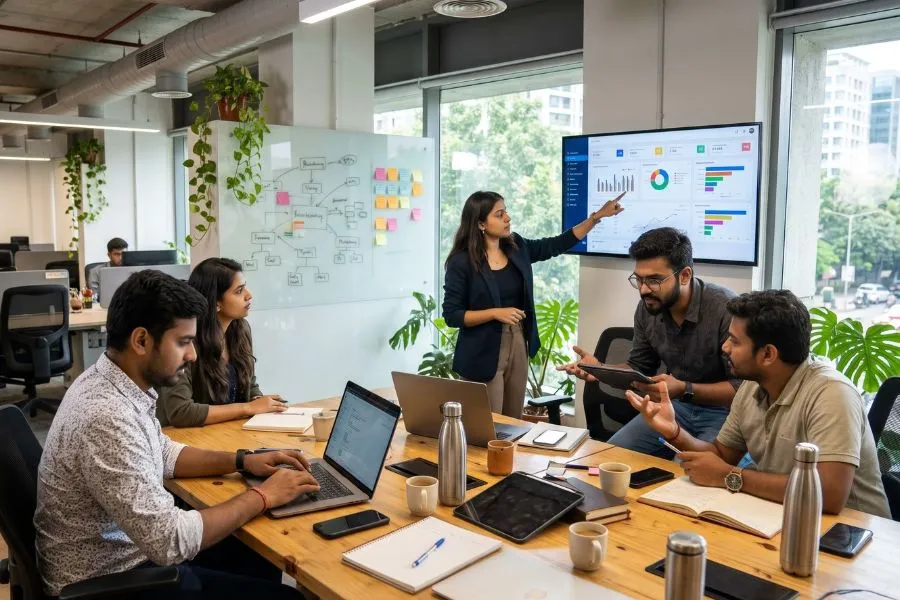
It is Wednesday morning at a mid-size event management company in Mumbai.
The founder, Neha Sharma, runs an established event management business — corporate conferences and MICE events, large wedding productions, product launches, award nights, and exhibition stall management. Her company executes 15-20 major events per month, manages a proprietary inventory of ₹2.4 crore worth of AV equipment and event infrastructure, and works with 80+ vendor partners.
Before the weekly production meeting, Neha is already managing four serious problems:
Problem 1 — The Post-Event Invoice Shock:
A corporate client — a pharma MNC — just received Neha’s invoice for their annual sales conference (320 delegates, 3 days, Hyderabad). The quote sent and accepted 6 weeks ago was ₹28,40,000. The invoice raised yesterday: ₹34,60,000. The client’s procurement head is furious: “You exceeded budget by ₹6.2 lakh without prior approval. We cannot pay the excess without signed change orders.” The problem: during the event, 14 additional items were added — extra LED panels on Day 2, 2 additional breakout rooms with full AV, photographer extension by one day, and 40 extra covers added to the gala dinner. None were formally documented as change orders. The event coordinator assumed the client’s on-site contact’s verbal “yes” was sufficient. It wasn’t — and now ₹6.2 lakh is disputed.
Problem 2 — Equipment Inventory Chaos:
Neha’s company owns 48 LED video wall panels (P3.9, 500×500mm), 24 moving head lights, 12 truss towers, 4 stage sets, and hundreds of other AV and décor items. This Saturday, two major events are running simultaneously — a corporate launch in Bandra and a wedding reception in Juhu (7 km apart). Yesterday, the logistics team discovered that 12 of the LED panels were already committed to a third event (a college fest in Pune) that starts Friday. Available for Saturday’s two events: 36 panels instead of 48. Both event coordinators claim their event was promised 24 panels each. Conflict, scramble, and a rental of ₹1.4 lakh from a competitor’s inventory at short notice.
Problem 3 — Vendor Payment and TDS Confusion:
Neha works with 80+ vendors — decorators, photographers, videographers, caterers, logistics companies, AV technicians. Every month, vendor payments run to ₹40-50 lakh. Three issues are compounding: TDS (Tax Deducted at Source) is not being correctly deducted on vendor payments — the accountant is unsure which section applies to decorators (194C? 194J?), whether photographers are “technical services” (194J, 10%) or “contracts” (194C, 2%), and the ₹30,000 and ₹1,00,000 thresholds are not being tracked per vendor. Second, three vendors haven’t been paid for 45+ days despite the client having paid in full — causing vendor relationship damage and threatening availability for upcoming events. Third, ₹14.2 lakh of vendor bills are pending in accounts without being matched to any event or client.
Problem 4 — Event Profitability Mystery:
Neha’s company did ₹4.8 crore in revenue last month (biggest month ever). Net profit: ₹24,000. Something is wrong. Every event feels profitable when it’s happening — but at month end, the money is gone. Neha suspects: untracked overruns (Problem 1 in every event), too much vendor credit extended, equipment not being costed correctly into events, and some events running at hidden losses. Without per-event P&L, she can’t identify which event types make money and which don’t.
Four problems. One root cause: No integrated ERP for event management operations.
India’s event management industry is one of the country’s fastest-growing service sectors — valued at ₹10,000 crore in 2026, growing at 16-18% annually, and projected to reach ₹18,000 crore by 2028. From high-budget Bollywood-style weddings (₹50 lakh-₹5 crore budgets) to large-scale corporate conferences and exhibitions, event management has become a sophisticated, technology-driven industry — yet most companies still manage it through WhatsApp groups, Excel, and intuition.
This complete guide covers everything Indian event management companies need to know about ERP software in 2026.
Explore ERP Group’s Food & Beverage ERP → and Industries → for India’s most integrated event management ERP solutions.
India’s Event Management Industry — The Landscape
Scale, Growth, and Market Complexity
Industry Overview 2026
Industry Size:
- ₹10,000 crore annual event management market
- Growing at 16-18% annually
- Projected ₹18,000 crore by 2028
- 5,000+ registered event management companies
- 1,00,000+ freelancers and vendors in the ecosystem
Event Management Market Segments:
| Segment | Market Share | Typical Budget |
|---|---|---|
| Corporate events (conferences, MICE, townhalls) | 35% | ₹5L-₹5 crore |
| Weddings and social events | 30% | ₹10L-₹5 crore |
| Exhibitions and trade shows | 12% | ₹2L-₹50 crore (pavilion) |
| Product launches and brand activations | 10% | ₹10L-₹2 crore |
| Concerts and entertainment | 8% | ₹50L-₹10 crore |
| Sports events | 3% | ₹1 crore+ |
| Government and institutional | 2% | Varies |
Key Hub Cities:
| City | Specialty |
|---|---|
| Mumbai | Corporate, entertainment, brand events |
| Delhi/NCR | MICE, government, large weddings |
| Bengaluru | Tech corporate events, product launches |
| Hyderabad | Pharma MICE, corporate conferences |
| Chennai | Corporate, cultural, government |
| Jaipur, Udaipur | Destination weddings |
The Event Management Operations Complexity:
- Project-based, non-recurring — Every event is a unique project with a defined budget, timeline, and deliverable set
- Multi-vendor coordination — An event requires 15-40 vendors working in coordination on a single day
- Equipment-intensive — Owned AV and infrastructure assets worth ₹50 lakh-₹5 crore need careful allocation
- Cash flow mismatch — 30-50% advance from clients but 100% vendor payment upfront or on delivery
- Last-minute changes — Events have constant scope changes that must be documented as paid change orders
- GST complexity — Event management involves multiple SAC codes, sub-contractor TDS, and composite supplies
- Labour intensive on-site — 20-200 on-site staff per event, many contractual/on-call
- Zero error tolerance — Unlike most businesses, mistakes at events cannot be undone — they happen live, in front of clients and guests
The 6 Core Problems ERP Solves for Event Management Companies
The Critical Business Challenges
Problem 1 — Budget Overrun and Change Order Management
The Pain:
Every event has scope creep — items added during planning or on-site during execution. Without a formal change order process:
- Verbal additions by client contacts are treated as confirmed
- Additional costs are incurred without client documentation
- Invoice disputes arise post-event (as in Neha’s ₹6.2 lakh dispute)
- The event company loses money they legitimately earned
The ERP Solution:
Digital change order system. Every addition generates an instant change order with pricing. Client approval via WhatsApp/email before cost is incurred. Invoice compiled from original quote + all approved change orders.
Problem 2 — Equipment Inventory and Allocation Conflicts
The Pain:
Event management companies own expensive equipment that must be tracked across multiple events happening simultaneously. Without an inventory management system:
- Double-committed equipment creates on-site crises
- Competitor rental costs inflate event costs
- Equipment damage goes unattributed
- Equipment returning from events isn’t reconciled
The ERP Solution:
Equipment register with event-wise allocation calendar. Availability check before any commitment. Return reconciliation. Damage reporting per event.
Problem 3 — Vendor Payment and TDS Compliance
The Pain:
40-50 lakh monthly vendor payments with complex TDS implications (different sections for different vendor types) and no per-event cost attribution creates:
- TDS non-compliance and notices
- Delayed vendor payments damaging availability
- Unmatched bills creating accounting chaos
The ERP Solution:
Vendor master with TDS section pre-configured. Per-event vendor allocation. Payment schedule linked to event delivery. TDS auto-calculated and tracked.
Problem 4 — Per-Event Profitability Tracking
The Pain:
₹4.8 crore revenue with ₹24,000 net profit — the money disappears because costs aren’t tracked at event level. Without per-event P&L:
- Profitable and loss-making event types are indistinguishable
- Overruns on one event subsidise another (invisibly)
- Pricing decisions are not data-informed
The ERP Solution:
Every cost (equipment, vendor, staff, logistics, materials) allocated to specific events. Per-event P&L report available immediately after event completion. Event-type profitability analysis.
Problem 5 — Multi-Event Simultaneous Execution
The Pain:
Running 15-20 events simultaneously — at different stages (planning, execution, post-event billing) — requires visibility into all events, all staff assignments, all equipment deployments, all pending deliverables, and all client communications in one place.
The ERP Solution:
Event pipeline dashboard. Every event’s stage and status visible. Staff and equipment allocation board. Multiple event coordinator dashboard.
Problem 6 — Post-Event Documentation and Learnings
The Pain:
After an event, the company must: reconcile all vendor invoices vs POs, produce final client invoice, collect client feedback, archive event documentation, and identify learnings. Without a system, post-event documentation is incomplete and historical data isn’t usable for future event quoting.
The ERP Solution:
Post-event closure checklist. Vendor invoice vs PO reconciliation. Client feedback collection. Event archive with actual costs for future reference.
For GST compliance, use ERP Group’s GST invoicing system →.
For event industry SAC codes, use ERP Group’s HSN/SAC Finder →.
The 18 Essential ERP Modules for Event Management
The Complete Module Architecture
Module 1-3: Event Budgeting, Costing, and Change Orders
The Financial Foundation of Every Event
Module 1 — Event Budget and Cost Sheet
The Detailed Event Cost Sheet:
EVENT COST SHEET: Pharma MNC Annual Sales Conference
Event: EV-2026-10-0892
Client: GlobalPharma India Pvt Ltd
Event dates: October 14-16, 2026 (3 days)
Venue: Novotel HICC, Hyderabad | Delegates: 320

VENUE AND INFRASTRUCTURE:
  Venue rental (3 days, main hall + 4 breakout rooms): ₹8,40,000
  Stage design and fabrication: ₹3,20,000
  LED video wall (48 panels P3.9, 3 days): ₹1,92,000
    (Own equipment — costed at ₹4,000/panel/day × 16 panels per day × 3)
  Stage lighting (design + operation): ₹1,44,000
  AV system (sound, projection): ₹1,08,000
  Backdrop printing and branding: ₹84,000

CREATIVE AND PRODUCTION:
  Concept and creative design: ₹2,40,000
  Opening film/AV production: ₹1,80,000
  Presentation design (30 sessions): ₹1,20,000

F&B:
  Day 1 (320 pax, full day): ₹1,280/pax = ₹4,09,600
  Day 2 (320 pax + 40 extra): 360 pax = ₹4,60,800 ← CHANGE ORDER
  Day 3 (Gala dinner, 320 pax): ₹2,400/pax = ₹7,68,000

PHOTOGRAPHY AND VIDEOGRAPHY:
  Photo (2 photographers, 3 days): ₹1,20,000
  Video (2 videographers, 3 days): ₹1,44,000
  Day 4 extension (1 photographer) ← CHANGE ORDER: ₹24,000

LOGISTICS:
  Delegate transport (Day 1-3): ₹2,16,000
  Equipment transport: ₹84,000

ADDITIONAL SERVICES:
  Registration management: ₹48,000
  Technical support (on-site): ₹72,000

ORIGINAL QUOTE TOTAL: ₹28,40,000

CHANGE ORDERS (all verbal — PROBLEM 1):
  CO-1: Extra LED panels Day 2 (8 extra) ← ₹64,000 ← NOT DOCUMENTED ❌
  CO-2: 2 extra breakout rooms with AV ← ₹2,40,000 ← NOT DOCUMENTED ❌
  CO-3: Photo extension Day 4 ← ₹24,000 ← NOT DOCUMENTED ❌
  CO-4: 40 extra covers gala dinner ← ₹1,84,000 ← NOT DOCUMENTED ❌
  CO-5: Extra staging elements ← ₹1,08,000 ← NOT DOCUMENTED ❌

TOTAL CHANGE ORDER VALUE: ₹6,20,000
TOTAL INVOICE: ₹34,60,000
CLIENT DISPUTE: ₹6,20,000 ← All change orders undocumented

WITH ERP CHANGE ORDER SYSTEM:
  Every addition → Instant digital change order
  Client WhatsApp approval before work starts
  Approved CO total: ₹6,20,000 ← INVOICED WITH BACKING ✅
  Dispute: ₹0 ✅
Module 2 — Digital Change Order System
Solving Problem 1 — The ₹6.2 Lakh Dispute:
CHANGE ORDER: CO-2026-10-0892-02

Event: EV-2026-10-0892 (GlobalPharma Conference)
Date: October 15, 2026 (Day 2 of event)
Requested by: Mr. Arjun Nair (Client GM, Operations)
Raised by: Neha's Coordinator Riya (on-site)

REQUEST:
  "2 additional breakout rooms required for afternoon workshops.
   Each room needs: projector, sound system, 50-chair setup"

COST CALCULATION (auto from ERP rate card):
  Breakout room AV (per room × 2): ₹1,20,000
  Additional setup staff (2 hrs): ₹20,000
  TOTAL CHANGE ORDER: ₹1,40,000 + GST 18% = ₹1,65,200

APPROVAL WORKFLOW:
  CO generated: 11:30 AM ← On-site coordinator enters into ERP app ✅

  Client WhatsApp message:
    "Hi Mr. Nair, As discussed, we're adding 2 breakout rooms
     with full AV for the afternoon session. Change Order below:

     CO-2026-10-0892-02
     Items: 2 × Breakout AV setup
     Amount: ₹1,40,000 + GST = ₹1,65,200

     Please reply APPROVE or call 98XXXXXXXX
     [View CO Details: Link]" ← Sent 11:32 AM ✅

  Mr. Nair reply: "Approved" ← 11:45 AM ✅
  Screenshot: Saved to event record ✅

  Work starts: 12:00 PM ✅ (after approval) ✅

WITHOUT ERP (Problem 1):
  Mr. Nair verbally: "Can we add 2 breakout rooms?"
  Coordinator: "Sure" ← Does it
  Client invoice: +₹1.4L → Dispute 3 weeks later

WITH ERP:
  Digital CO → Client approval → Work done → Invoice backed ✅
Module 3 — Event-Wise Budget vs Actual Tracking
Solving Problem 4 — The Profitability Mystery:
EVENT P&L: EV-2026-10-0892 (GlobalPharma Conference)

REVENUE:
  Original quote accepted: ₹28,40,000
  Change orders approved: ₹6,20,000
  TOTAL BILLED: ₹34,60,000

COSTS:
  Category | Budget | Actual | Variance
  Venue | ₹8,40,000 | ₹8,40,000 | ₹0 ✅
  Stage + LED + Lighting | ₹6,36,000 | ₹6,36,000 | ₹0 ✅
  Own equipment (depreciation): ₹1,92,000 | ₹1,92,000 | ₹0 ✅
  Creative + Production: ₹5,40,000 | ₹5,82,000 | +₹42,000 ⚠️
    (presentation redesign on Day 2 — ₹42K extra) ← Unplanned ⚠️
  F&B: ₹16,38,400 | ₹16,38,400 | ₹0 ✅
  Photography/Video: ₹2,64,000 | ₹2,88,000 | +₹24,000 (CO-3 approved) ✅
  Logistics: ₹3,00,000 | ₹3,24,000 | +₹24,000 ⚠️
    (extra transport run, unplanned) ← Need CO in future
  Other: ₹1,20,000 | ₹1,36,000 | +₹16,000

TOTAL COST: ₹45,30,400 | ACTUAL: ₹46,36,400 | VARIANCE: +₹1,06,000

OPERATING MARGIN CALCULATION:
  Revenue: ₹34,60,000
  Direct costs: ₹46,36,400 ← MORE THAN REVENUE ← LOSS?

  WAIT — Own equipment is ERP Group's owned (not cash cost)
  Equipment depreciation is a non-cash charge
  Cash cost: ₹46,36,400 - ₹1,92,000 (depreciation) = ₹44,44,400 ← Still a loss

  NET LOSS: ₹34,60,000 - ₹44,44,400 = -₹9,84,400 ← MASSIVE LOSS EVENT!

WHAT WENT WRONG:
  F&B costs: ₹16,38,400 (47.4% of revenue — way too high for this event)
  Venue was locked in at a rate that was too expensive
  Creative production overran

INSIGHT: This event type (3-day full-service conference) is loss-making
  at current pricing → Quote needs to be 35% higher ← Pricing revision ✅
Event Portfolio P&L (where is Neha’s profit going?):
MONTHLY EVENT PORTFOLIO — September 2026:

Event Type | Count | Revenue | Cost | P&L | Margin
Corporate conference (1-day) | 4 | ₹48L | ₹32L | +₹16L | 33% ✅
Corporate conference (3-day) | 2 | ₹68L | ₹84L | -₹16L | -24% 🔴
Wedding | 3 | ₹84L | ₹52L | +₹32L | 38% ✅
Product launch | 3 | ₹42L | ₹28L | +₹14L | 33% ✅
Award night | 2 | ₹36L | ₹26L | +₹10L | 28% ✅
Exhibition stall | 2 | ₹24L | ₹22L | +₹2L | 8% ⚠️
TOTAL | 16 | ₹302L | ₹244L | +₹58L | 19.2%

OVERRUNS AND UNAPPROVED COSTS: -₹34L ← Problem 1 across all events!
OTHER COSTS (office, staff, etc): -₹14L
REPORTED NET PROFIT: ₹24L (not ₹58L gross — because overruns)

KEY INSIGHT:
  3-day corporate conferences: LOSING MONEY ← Stop taking or re-price ✅
  Exhibition stalls: 8% margin ← Not worth the effort ← Review ✅
  Weddings: 38% margin ← FOCUS HERE ← Grow this segment ✅
Module 4-6: Equipment and Asset Inventory Management
The Asset Allocation Engine
Module 4 — Equipment Register and Valuation
48 LED Panels + 300+ Items — All Tracked:
EQUIPMENT MASTER REGISTER:

CATEGORY: LED VIDEO WALL
  Item: LED Panel P3.9 (500×500mm)
  Total owned: 48 panels
  Total value: ₹72,00,000 (₹1,50,000/panel)
  Depreciation rate: 20% WDV per annum

  CONDITION STATUS (October 23, 2026):
    Good condition (A grade): 42 panels ✅
    Minor damage (B grade — usable): 4 panels ✅
    Repair needed: 2 panels ← In workshop ← Est. repair: Oct 28 🔴

  AVAILABILITY FOR BOOKING:
    Good + B grade available: 46 panels (42+4)
    In repair (not available): 2 panels
    Currently deployed:
      College fest, Pune (Oct 24-25): 12 panels committed ✅
      Available for Oct 25+: 34 panels

CATEGORY: MOVING HEAD LIGHTS
  Total: 24 units | Value: ₹36,00,000
  Available: 20 | Deployed: 4 (ongoing event) | In repair: 0

CATEGORY: TRUSS SYSTEM
  Total: 120 metres (12 × 10m sections) | Value: ₹14,40,000
  Available: 80 metres | Deployed: 40 metres

CATEGORY: STAGES
  Stage sections (4×4 ft): 200 sections | Value: ₹18,00,000
  Stage legs (variable height): 180 sets

TOTAL EQUIPMENT VALUE: ₹2,40,00,000
TOTAL INSURED VALUE: ₹2,40,00,000 ✅ (comprehensive coverage)
Module 5 — Event-Wise Equipment Allocation Calendar
Solving Problem 2 — The Double-Committed LED Panels:
EQUIPMENT ALLOCATION CALENDAR: LED Panels (48 total)

        | Oct 22 | Oct 23 | Oct 24 | Oct 25 | Oct 26 | Oct 27
--------|--------|--------|--------|--------|--------|--------
EV-891  | 16     | 16     | --     | --     | --     | --
(Pune)  |        |        |        |        |        |
--------|--------|--------|--------|--------|--------|--------
EV-894  | --     | --     | 12     | 12     | 12     | --
(College| --     | --     |  ✅    |  ✅    |  ✅    | --
fest)   |        |        |        |        |        |
--------|--------|--------|--------|--------|--------|--------
EV-897  | --     | --     | --     | 24     | 24     | --
(Bandra | --     | --     | --     | PLANNED| PLANNED| --
launch) |        |        |        |        |        |
--------|--------|--------|--------|--------|--------|--------
EV-899  | --     | --     | --     | 24     | 24     | --
(Juhu   | --     | --     | --     | PLANNED| PLANNED| --
wedding)|        |        |        |        |        |
--------|--------|--------|--------|--------|--------|--------
TOTAL   | 16     | 16     | 12     | 60 !!  | 60 !!  | --
DEMAND  |        |        |        |  🔴    |  🔴    |
AVAILABLE| 48    | 48     | 48     | 48     | 48     | 48

CONFLICT DETECTED:
  October 25-26: 60 panels required, only 48 available!
  Shortage: 12 panels ← CONFLICT ALERT! 🔴

  ERP WOULD HAVE SHOWN THIS AT BOOKING STAGE:
    When EV-899 (Juhu wedding) requested 24 panels on Oct 25:
    System: "⚠️ Only 24 panels available on Oct 25 (24 allocated to EV-897)"
    → Coordinator must: reduce allocation OR find rental OR notify client ✅
    → Decision made in advance ← Not a crisis on event day ✅

WITH ERP: Problem 2 PREVENTED at booking stage ✅
WITHOUT ERP (Problem 2): Crisis discovered day before event → ₹1.4L emergency rental
Module 6 — Equipment Returns, Damage Tracking, and Maintenance
Post-Event Equipment Reconciliation:
EQUIPMENT RETURN CHECKLIST: EV-2026-10-0892 (GlobalPharma)

EQUIPMENT DISPATCHED:
  LED Panels P3.9: 24 units ✅
  Moving heads: 8 units ✅
  Sound system (line array): 2 arrays ✅
  Microphones: 12 (wired + wireless) ✅
  Cables (various): 1 lot ✅

EQUIPMENT RETURNED (October 17):
  LED Panels: 23 units returned | 1 MISSING ← 🔴
    → Driver checked: Panel left at venue loading bay
    → Recovered same day ✅ | Total: 24/24 ✅

  Moving heads: 8/8 ✅

  DAMAGE REPORT:
    Sound System Array 2: Physical crack on cabinet corner
    Repair estimate: ₹8,400 | Photos: Uploaded ✅

  WHO IS LIABLE:
    Damage occurred during client's own loading activity ← Client liability
    Change order: Equipment damage — billed to client as CO-6: ₹8,400
    Client approved: ✅

MAINTENANCE SCHEDULE (after event):
  Annual service (2 moving heads due): Scheduled Nov 1 ✅
  LED Panel cleaning (24 panels from event): Done Oct 19 ✅
For equipment and asset management, use ERP Group’s warehouse management system →.
Module 7-9: Client CRM and Sales Management
Revenue Generation and Client Relationships
Module 7 — Event Lead and Enquiry Management
The Event Sales Funnel:
SALES PIPELINE — October 23, 2026:

STAGE | Events | Value | Action
New enquiry | 8 | ₹1.84 crore | Respond + qualify today
Concept presented | 12 | ₹3.84 crore | Follow up (5-10 days)
Quote submitted | 6 | ₹1.44 crore | Awaiting decision
Advance paid (confirmed) | 14 | ₹4.80 crore | Production phase
Execution (happening) | 3 | ₹1.20 crore | On-ground team
Post-event billing | 4 | ₹92 lakh | Invoice + collect

PRIORITY FOLLOW-UPS TODAY:
  TechMahindra Annual Day (Jan 2027):
    Concept: Submitted Oct 12 | 11 days ← Follow up ← Budget: ₹45L ✅

  Sharma-Patel Wedding (Dec 2026, Jaipur):
    Quoted: ₹28L | Decision pending 8 days ← Call today ← HIGH VALUE ✅

  HDFC Regional Conference (Nov 2026):
    Quote: ₹18L | Decision due Oct 25 ← Confirm by EOD tomorrow ✅

CONVERSION METRICS (September):
  Enquiries to quote: 72% | Quote to confirmation: 58%
  Average value per event: ₹30.1L
  Average deal cycle: 32 days

TOP SOURCES:
  Client referral: 42% ← Best quality leads ✅
  Corporate direct: 28% ← Good quality
  Online/social: 18% ← Growing
  Exhibition/walk-in: 12%
Module 8 — Client Account and Event History
Repeat Client Management:
CLIENT PROFILE: GlobalPharma India Pvt Ltd

Relationship since: 2019
Total events managed: 8
Total revenue: ₹1.84 crore

EVENT HISTORY:
  2019: Regional conference (250 pax) | ₹18L ✅
  2020: Virtual event (COVID) | ₹8L ✅
  2021: Annual sales meet (280 pax) | ₹24L ✅
  2022: Product launch + conference | ₹32L ✅
  2023: Annual conference (300 pax) | ₹28L ✅
  2024: 2 regional conferences | ₹24L ✅
  2025: Annual conference | ₹26L ✅
  2026: Annual conference (current dispute) | ₹34.6L ← DISPUTE ⚠️

CLIENT LTV: ₹1.84 crore | Estimated future annual: ₹30-35L
RISK: Current dispute (₹6.2L) could damage 7-year relationship ← CRITICAL

PREFERENCES (from event history):
  Venue preference: 5-star hotel (Hyatt, Marriott, Novotel)
  Stage: LED wall preferred | Catering: Premium Indian + Continental
  CEO's preference: No dark stage lighting, warm white preference

ANNUAL CONFERENCE BRIEF (for 2027 planning):
  Expected: Nov/Dec 2027 | Estimated pax: 340 | Budget: ₹38-42L
  Start planning: April 2027 ← Reminder set ✅
Module 9 — Concept-to-Quote Workflow
Professional Event Quotation:
EVENT QUOTE: EQ-2026-10-0934

Client: Infosys Technologies (New client)
Event type: Leadership conference + awards
Date requested: January 15-16, 2027
Pax: 180 delegates + 50 award ceremony guests

CONCEPT BRIEF (from client meeting):
  Day 1: Leadership conference (6 sessions, 180 delegates, hotel ballroom)
  Day 2: Awards evening (230 pax, gala dinner, entertainment)
  Tone: Premium corporate, international feel
  Budget indication: "₹20-25 lakh"

QUOTE PREPARATION (from ERP cost templates):
  Day 1 — Conference:
    Venue (hotel ballroom, 180 pax): ₹3,20,000
    Stage + LED wall (24 panels): ₹1,44,000
    AV (sound, projection, mics): ₹72,000
    Creative direction: ₹80,000
    F&B (conference day, 180 pax): ₹96,000
    Registration management: ₹24,000

  Day 2 — Awards evening:
    Awards design (12 trophies): ₹48,000
    Stage transformation: ₹80,000
    Lighting special design: ₹96,000
    Host/anchor: ₹1,20,000
    Entertainment (live band 2 hrs): ₹1,60,000
    F&B (gala dinner, 230 pax × ₹2,200): ₹5,06,000
    Photography + video: ₹1,20,000

  LOGISTICS + SUNDRY: ₹1,84,000

  TOTAL COST: ₹19,50,000
  MARGIN (20%): ₹3,90,000
  QUOTE VALUE: ₹23,40,000

  WITHIN CLIENT BUDGET (₹20-25L) ✅ → Proceed with quote ✅

  GST @ 18%: ₹4,21,200
  TOTAL WITH GST: ₹27,61,200
For client relationship management, use ERP Group’s CRM software →.
Module 10-12: Vendor and Supply Chain Management
The External Execution Network
Module 10 — Vendor Master and Category Management
Managing 80+ Vendors:
VENDOR MASTER: StarLight Decorators, Mumbai

Category: Event decoration (floral + non-floral)
Contact: Rajan Mehta | Phone: 98XXXXXXXX
GST Registered: Yes | GSTIN: 27XXXXXXX1234F1ZX
PAN: AAJCM1234X

SERVICES:
  Floral decoration (stage + tables): ₹80-400/sqft
  Non-floral (drapes, fabric): ₹40-180/sqft
  Entrance décor: Package-based
  Speciality: Wedding + luxury corporate

TDS SECTION: 194C (contractor) ← ₹35,000/event typical
  TDS rate: 2% (company, PAN provided)
  Threshold check: ₹1,00,000 per FY ← Exceeded in July ← TDS active ✅

PERFORMANCE HISTORY:
  Events worked: 28 | Rating: 4.6/5
  On-time delivery: 96% ✅ | Quality: 4.7/5 ✅

PAYMENT TERMS:
  50% advance before event | 50% within 7 days post-event

CURRENT STATUS:
  Advance due (EV-2026-10-0897 — Bandra launch): ₹42,000 ← Pay by Oct 25 ⚠️
  Outstanding from September: PAID ✅ (45-day problem resolved ✅)
Module 11 — Vendor Purchase Orders and Bill Matching
Structured Vendor Management:
PURCHASE ORDER: PO-2026-10-0892-04

Event: EV-2026-10-0892 (GlobalPharma Conference)
Vendor: StarLight Decorators
PO Date: September 28, 2026

SERVICES ORDERED:
  Stage floral backdrop (12×8 ft): ₹48,000
  Conference table centrepieces (30 tables × ₹800): ₹24,000
  Entrance floral arch: ₹18,000

  TOTAL PO VALUE: ₹90,000
  TDS @ 2% (194C): ₹1,800
  NET PAYMENT: ₹88,200

DELIVERY TERMS:
  Setup: October 13, 2026 (Day before event) by 6 PM
  Breakdown: October 17, 2026 by 10 AM

VENDOR INVOICE RECEIVED: ₹90,000 ← Matches PO ✅
PAYMENT SCHEDULE:
  Advance (50%): ₹45,000 paid Sep 30 ✅
  Balance (50%): ₹45,000 → Due Oct 19 (2 days post-event)
  Less TDS (2%): ₹1,800 ← Deposited to government ✅
  Net balance: ₹43,200 ← Pay Oct 19 ✅

SOLVING PROBLEM 3 (₹14.2L unmatched bills):
  Every vendor bill: Matched to PO + Event ✅
  No unmatched bills ← Each bill has an event reference ✅
  Accounts can process in 24 hours ← No backlog ✅
Module 12 — Vendor Payment Schedule and TDS
Solving Problem 3 — TDS Confusion:
TDS FRAMEWORK FOR EVENT MANAGEMENT COMPANIES:

SECTION 194C — CONTRACTS:
  Applicable to: Decorator, logistics, tent/furniture rental, caterer,
    security agency, printing, stationery supplier
  Rate: 1% (individual/HUF) | 2% (company/LLP)
  Threshold: ₹30,000 per payment OR ₹1,00,000 aggregate per FY

SECTION 194J — PROFESSIONAL/TECHNICAL:
  Applicable to: Photographers, videographers, host/anchors,
    AV technical consultants, event designers/creative directors,
    musicians, performers, DJ
  Rate: 10%
  Threshold: ₹30,000 per payment

SECTION 194I — RENT:
  Applicable to: Venue rental, equipment rental, furniture rental
    when from a landlord/owner (not a service company)
  Rate: 10% (furniture, equipment) | 10% (building)
  Threshold: ₹2,40,000 per year (₹20,000/month)

NEHA'S MONTHLY TDS TRACKER:

Vendor | Section | Amount | Rate | TDS | Status
StarLight Decorators | 194C | ₹90,000 | 2% | ₹1,800 | ✅ Deducted
Click & Frame Photos | 194J | ₹48,000 | 10% | ₹4,800 | ✅ Deducted
Raj Logistics | 194C | ₹1,20,000 | 2% | ₹2,400 | ✅ Deducted
Venue (direct owner) | 194I | ₹3,40,000 | 10% | ₹34,000 | ⚠️ WAS MISSED
DJ Ashish | 194J | ₹35,000 | 10% | ₹3,500 | ✅ Deducted
[...]

TOTAL TDS THIS MONTH: ₹1,24,800
TDS DEPOSITED BY 7TH: ₹90,800 (partial — ₹34,000 missed) ← Fix ⚠️

ERP AUTO-ALERTS:
  "TDS due date: Nov 7. Pending TDS: ₹34,000 (venue rent).
   Deposit before Nov 7 to avoid 1.5%/month interest." ✅
For TDS management, use ERP Group’s TDS Calculator →.
For accounts management, use ERP Group’s accounting software →.
For vendor payment on WhatsApp, read our guide on WhatsApp payment collection for business India.
Module 13-15: Financial Management and GST
The Financial Control Layer
Module 13 — Event Company P&L and Cash Flow
The Event Company Financial Model:
MONTHLY P&L — September 2026:

REVENUE:
  Event execution fees: ₹4,80,00,000
  Equipment rental income: ₹18,40,000
  Production services: ₹12,80,000
  TOTAL REVENUE: ₹5,11,20,000

DIRECT COSTS:
  Vendor payments (venue, catering, décor, AV rental): ₹2,40,00,000
  Own equipment depreciation (cost allocated to events): ₹24,00,000
  On-site staff (contractual, per event): ₹48,00,000
  Logistics and transport: ₹28,80,000
  Materials (printing, fabrication, supplies): ₹36,00,000
  TOTAL DIRECT COST: ₹3,76,80,000

GROSS PROFIT: ₹1,34,40,000 (26.3%)

OVERHEAD:
  Full-time staff (20 people): ₹24,00,000
  Office rent + utilities: ₹3,20,000
  Marketing: ₹4,80,000
  Insurance (equipment + professional liability): ₹1,60,000
  Other overhead: ₹2,00,000
  TOTAL OVERHEAD: ₹35,60,000

REPORTED PROFIT BEFORE OVERRUNS: ₹98,80,000 (19.3%)
UNAPPROVED OVERRUNS (Problem 1 × all events): -₹34,00,000 ← MASSIVE!
ACTUAL NET PROFIT: ₹24,00,000 (0.47%) ← Barely breaks even!

AFTER ERP (change order system):
  Overruns all become approved change orders ← Revenue, not loss
  Actual net profit potential: ₹98,80,000 (19.3%) ← Real profitability
Module 14 — Advance Collection and Client Payment Management
Event Company Cash Flow:
CASH FLOW MANAGEMENT:

CLIENT ADVANCES POLICY:
  At booking confirmation: 30% advance
  At final production plan sign-off (4 weeks before): 40% advance
  Final 30%: Within 7 days post-event

CURRENT RECEIVABLES (Oct 23):
  Total advances received: ₹1,84,00,000 (for future events)
  Post-event balance due: ₹92,40,000
    of which: >30 days: ₹28,00,000 ← Follow up ⚠️

MILESTONE BILLING TRACKER:
  Event | 30% | 40% | Final | Status
  EV-897 (Bandra): ✅ | ✅ | Pending | Post-event ← Invoice today ✅
  EV-899 (Wedding): ✅ | Due Nov 1 | — | Upcoming ← Remind Oct 28 ✅
  EV-912 (Tech conf): ✅ | — | — | In planning ✅

  GlobalPharma dispute: ₹6,20,000 pending resolution
    Action: Meeting with client MD ← Scheduled Oct 28 ✅
Module 15 — GST Compliance for Event Management Companies
The Event Management GST Framework:
GST FOR EVENT MANAGEMENT COMPANIES:

SAC CODE DETERMINATION:
  Event management services (pure management/coordination): SAC 998596
    GST Rate: 18%
    Description: Event management services (not including supply of goods/food)

  Turnkey event services (management + supply of goods):
    This is a COMPOSITE SUPPLY ← Most common scenario

  Catering supply (if event company provides food directly):
    SAC 9963 | 18% (outdoor catering) ← Check

  Exhibition stall construction: SAC 998364 (display/stall design): 18%

  Photography/videography: SAC 998961: 18%

COMPOSITE SUPPLY (most events):
  Event management company provides:
    Management/coordination + Decoration + AV + Transport + Catering
    = Bundle of services

  For composite supply: Single GST rate of predominant service
    If management is predominant → 18% on full value ✅

  CRITICAL: Do NOT separately bill services at different rates to avoid 18%
    This is "artificial unbundling" and creates compliance risk ✅

E-INVOICE REQUIREMENT:
  Neha's annual turnover (estimate): ₹6 crore+
  Threshold: ₹5 crore → E-Invoice MANDATORY ✅
  IRN generated for every B2B invoice ✅

GSTR-1 SPECIFIC TO EVENTS:
  Each event invoice is typically B2B (corporate clients mostly)
  All invoices: B2B section of GSTR-1 ← Client gets ITC ✅

  For weddings (B2C, individual clients): B2C in GSTR-1 ← No ITC issue

ITC ON PURCHASES:
  Vendor services (decorator, logistics, AV): Full ITC @ 18% ✅
  Venue rental (from hotel): ITC @ 12% or 18% depending on venue type ✅

  BLOCKED ITC (Section 17(5)):
    Vehicle purchase: ITC not available ❌
    Personal consumption: Not available ❌
    Food/beverage purchases (where directly provided to clients as F&B service):
      Complex — CA advisory required ← CA Partner ✅
For GST compliance, use ERP Group’s GST invoicing system →.
For event management SAC codes, use ERP Group’s HSN/SAC Finder →.
For GST compliance calendar, use ERP Group’s GST Calendar →.
For CA advisory on event management GST, use ERP Group’s CA Partner Program →.
Module 16-18: HR, Payroll, and Analytics
People and Performance Management
Module 16 — Workforce Management for Event Companies
Hybrid Workforce — Full-Time + Contractual:
NEHA'S EVENTS WORKFORCE STRUCTURE:

FULL-TIME TEAM (20 employees):
  CEO/MD (Neha): 1
  Senior Event Directors: 2 (corporate + social)
  Event Managers: 4
  Production Managers: 2
  Client Servicing: 3
  Creative/Design: 2
  Accounts + Finance: 2
  Logistics + Equipment: 2
  Admin + HR: 2

CONTRACTUAL/ON-CALL (per event):
  Event Coordinators (on-site): 4-8 per event
  Hospitality staff (ushers, registration): 10-50 per event
  Technical staff (AV, lighting): 2-6 per event
  Security: 2-8 per event (outsourced through agency)

EVENTS STAFF ALLOCATION — November 2026:
  EV-0912 (Nov 3, Tech conf): 3 coordinators + 8 hospitality + 3 AV
  EV-0918 (Nov 5, Wedding): 4 coordinators + 30 hospitality + 4 lighting
  EV-0924 (Nov 8, Launch): 2 coordinators + 12 hospitality + 2 AV

CONFLICT ALERT:
  Event Nov 5 (Wedding Juhu) and Event Nov 5 (Corporate Andheri):
    Both requesting Priya (Senior Coordinator) ← CONFLICT 🔴
    Resolution: Priya → Wedding (higher complexity) ← Arranged ✅
    Corporate: Rajesh (junior, but supported by Event Manager) ✅
For HR and payroll, use ERP Group’s HR & Payroll software →.
For event company staff salary planning, use ERP Group’s Salary Calculator →.
For income tax on event management business, use ERP Group’s Income Tax Calculator →.
Module 17 — Contractual Staff Payroll
Per-Event Staff Cost Management:
CONTRACTUAL STAFF PAYMENT: EV-2026-10-0892 (GlobalPharma)

ON-SITE STAFF HIRED:
  Hospitality coordinator (1, 4 days incl setup): ₹2,800/day × 4 = ₹11,200
  Registration executives (3, 3 event days): ₹1,400/day × 3 × 3 = ₹12,600
  Ushers (8, 3 event days): ₹1,000/day × 8 × 3 = ₹24,000
  Technical crew (3, 4 days): ₹2,400/day × 3 × 4 = ₹28,800

  TOTAL CONTRACTUAL: ₹76,600
  TDS (194C, contractual): ₹76,600 × 1% = ₹766 (if individuals, below threshold)
  ← Below ₹30,000 per person ← No TDS deduction ✅

PAYMENT: Cash + NEFT on event completion day ✅

AGGREGATED FREELANCER TRACKING:
  If same freelancer works >₹1,00,000 total in FY:
    TDS becomes mandatory even if individual payments < ₹30,000 ✅
  ERP tracks: Freelancer-wise annual payment total ✅
  Alert: When approaching ₹1L threshold → Start TDS ✅
Module 18 — Event Company MIS and Analytics
Business Intelligence for Growth:
BUSINESS ANALYTICS — September 2026:

REVENUE ANALYTICS:
  Revenue by event type: Corporate 58% | Wedding 28% | Other 14%
  Revenue by client type: Repeat 64% | New 36%
  Average event value: ₹30.1L | Target: ₹32L

OPERATIONAL ANALYTICS:
  Events executed: 16 | On-time delivery: 81% ← Target: 95% ⚠️
  Client satisfaction (post-event survey): 4.2/5
  Equipment utilisation: 68% ← Target: 80% ⚠️

PROFITABILITY BY EVENT TYPE:
  1-day corporate: 33% ✅ | 3-day corporate: -24% 🔴 | Wedding: 38% ✅
  Product launch: 33% ✅ | Exhibition: 8% ⚠️

STRATEGIC INSIGHTS:
  → Stop pursuing multi-day corporate conferences ← Losing money
  → Grow wedding segment ← Best margin
  → Improve equipment utilisation ← More events with same asset base
  → Exhibition stalls: Consider pricing revision or exit ✅

VENDOR PERFORMANCE:
  On-time delivery: 88% ← Some vendors consistently late ← Review list ✅
  Quality rating: 4.3/5 | Best vendor: StarLight Decorators 4.6/5 ✅
ERP by Event Management Sub-Sector
Tailored Solutions for Different Event Types
Corporate Events, MICE, and Conferences
The Largest Revenue Segment
ERP for Corporate Event Management Companies
Corporate events — conferences, product launches, townhalls, annual days, training programmes, and MICE (Meetings, Incentives, Conferences, Exhibitions) — form the backbone of India’s event management industry revenue.
Unique ERP Requirements:
Multi-Day Conference Management:
Large conferences span 2-5 days with multiple parallel sessions, different delegate tracks, and complex F&B scheduling. ERP manages:
- Session schedule with room allocation
- AV requirement per session
- Per-day cost tracking
- Delegate registration and management
RFP Response and Bid Management:
Large corporates issue formal RFPs (Request for Proposals) for conferences. ERP generates proposal documents from templates, calculates costs from rate masters, and tracks bid status across multiple competing events.
For corporate hospitality logistics, visit ERP Group’s Distribution & Logistics ERP →.
For corporate catering, visit ERP Group’s Food & Beverage ERP →.
Wedding and Social Events
High-Emotion, High-Budget Productions
ERP for Wedding Event Management Companies
Weddings are India’s highest-margin event segment — high budgets, high expectations, and deeply personal nature make them both the most financially rewarding and operationally demanding events.
Unique ERP Requirements:
Multi-Function Wedding Management:
Indian weddings typically span 3-7 days with multiple functions: Mehendi, Sangeet, Haldi, Pheras/Nikah, Reception. Each function has separate:
- Guest count
- F&B requirement
- Décor theme
- AV requirement
- Vendor mix
ERP manages each function as a sub-event, with consolidated billing to the family.
Vendor Coordination at Scale:
A premium wedding involves 30-50 vendors simultaneously on the wedding day. ERP provides:
- Master vendor call sheet (every vendor’s arrival time, contact, deliverable)
- Run-of-show (minute-by-minute timeline)
- Task assignment per coordinator
For wedding décor manufacturing, visit ERP Group’s Manufacturing ERP →.
For wedding textile sourcing, visit ERP Group’s Textile & Garments ERP →.
Exhibitions and Trade Shows
B2B Event Infrastructure
ERP for Exhibition and Trade Show Organisers
Exhibition and trade show companies manage complex, large-scale events — exhibitor stall allocation, visitor management, stall construction, and B2B meeting facilitation.
Unique ERP Requirements:
Stall Inventory and Allocation:
An exhibition floor plan has 200-2,000 stalls of different sizes. ERP manages:
- Floor plan with stall positions
- Stall booking per exhibitor
- Stall construction contractor allocation
- Move-in/move-out scheduling
Exhibitor Account Management:
Each exhibitor is a client with their own stall package, add-ons, and billing. ERP manages:
- Stall booking contract per exhibitor
- Add-on services (electricity upgrade, carpet, furniture)
- Exhibitor-wise invoice generation
For exhibition logistics, visit ERP Group’s Distribution & Logistics ERP →.
For all event sub-sectors, visit ERP Group’s Industries →.
Product Launches and Brand Activations
Marketing-Driven Events
ERP for Product Launch and Brand Activation Companies
Product launches and brand activations are marketing-driven events — executed by agencies on behalf of FMCG, automobile, technology, and pharma brands. The client is typically a marketing team with strict brand guidelines and ROI measurement requirements.
Unique ERP Requirements:
Brand Asset Management:
Product launch events require strict brand compliance — client’s logo, brand colours, and messaging must appear correctly across all production elements. ERP tracks:
- Brand assets uploaded per client
- Production element review and approval workflow
- Brand compliance checklist
For pharma product launches (most regulated), visit ERP Group’s Pharma Distribution ERP →.
For retail brand activations, visit ERP Group’s Retail & E-Commerce ERP →.
GST and Tax Compliance for Event Companies
The Complete Compliance Framework
Key Tax Compliance Points for Event Companies
Advance Receipt and GST:
Event companies typically collect 30-70% advance at booking, weeks or months before the event. Under GST:
- GST is payable on advance receipt (not just on invoice)
- Advance receipt must generate a receipt voucher
- Tax is payable in the month advance is received
- This creates a cash flow challenge — GST paid before costs are incurred
ERP manages: Advance receipt vouchers, GST on advances, adjustment when final invoice is raised.
Sub-Contractor TDS at Scale:
With 80+ vendors, TDS management becomes complex. The key is maintaining a vendor master with:
- TDS section pre-configured (194C, 194J, 194I)
- Annual aggregate tracker per vendor
- Threshold breach alert (₹30,000 per payment, ₹1,00,000 annual)
- Monthly TDS deposit reminder (7th of next month)
- Quarterly TDS return filing (24Q/26Q)
For TDS compliance, use ERP Group’s TDS Calculator →.
For GST compliance, use ERP Group’s GST invoicing system →.
For compliance calendar, use ERP Group’s GST Calendar →.
For CA advisory on event management, use ERP Group’s CA Partner Program →.
WhatsApp Integration for Event Management
Digital Communication Across the Event Ecosystem
WhatsApp Business API for Event Management Companies
Use Case 1 — Change Order Approval:
"📋 CHANGE ORDER REQUEST — Neha Events

Hi {{ClientName}},

Change requested during event execution:

CHANGE ORDER: {{CONumber}}
Event: {{EventName}} | Date: {{EventDate}}

REQUEST: {{ChangeDescription}}

COST IMPACT:
  Additional cost: ₹{{Amount}} + GST 18% = ₹{{TotalWithGST}}

This is above the original scope of {{OriginalQuote}}.

Please APPROVE or DECLINE:
  Reply APPROVE to confirm
  Reply DECLINE to cancel this addition
  Call {{CoordinatorPhone}} for any query

⏰ Response needed within 30 minutes (on-site team awaiting)

[View Change Order Details: {{COLink}}]

Neha Events | Making your event extraordinary"
Use Case 2 — Vendor Briefing Before Event:
"📢 EVENT BRIEFING — Neha Events

Hello {{VendorName}},

You're confirmed for our upcoming event. Please read carefully:

EVENT DETAILS:
  Event: {{EventName}} | Client: {{ClientName}}
  Date: {{EventDate}} | Venue: {{VenueName}}
  Your role: {{VendorRole}}

REPORTING:
  Arrival time: {{ArrivalTime}} (SHARP — do not be late)
  Reporting to: {{CoordinatorName}}: {{CoordinatorPhone}}
  Entry gate: {{EntryGate}}
  Parking: {{ParkingInstructions}}

YOUR DELIVERABLES:
  {{Deliverable1}}
  {{Deliverable2}}

PAYMENT:
  Advance already paid: ₹{{AdvancePaid}}
  Balance payable after event: ₹{{BalanceDue}} (within 3 days)

EMERGENCY: {{NehaPhone}} (MD direct)

Confirm receipt: Reply YES ✅
Neha Events"
Use Case 3 — Post-Event Client Survey:
"🌟 HOW WAS YOUR EVENT? — Neha Events

Hi {{ClientName}}!

It was a privilege to produce {{EventName}} for you!

We'd love 2 minutes of your feedback:

1. Overall event: ⭐⭐⭐⭐⭐
2. Creativity: ⭐⭐⭐⭐⭐
3. Execution: ⭐⭐⭐⭐⭐
4. Team professionalism: ⭐⭐⭐⭐⭐

[Rate your experience: {{SurveyLink}}]

OR reply with a number (1-5) for overall rating.

Your feedback helps us serve you better for {{NextEventYear}}!

{{#if Photo}}
📸 Here's a sneak peek from the event:
[Photo attached]
{{/if}}

Thank you for trusting us! 🙏
Neha Sharma | Neha Events | {{Phone}}"
For WhatsApp in event business, use ERP Group’s WhatsApp Business API →.
For automated follow-up, read our guide on WhatsApp automation for customer follow-up India.
For invoice sharing, read our guide on WhatsApp invoice sharing for small business India.
ERP for Different Sizes of Event Management Companies
Right-Sizing the Solution
Small Event Management Company (₹1-5 Crore Revenue)
Profile: 5-12 person team, 8-15 events/month, primarily local market.
Core ERP Needs:
- Event cost sheet and budgeting
- Basic change order tracking
- Vendor payment with TDS
- GST compliance (18% on events)
Investment: ₹4,000-8,000/month
Immediate ROI: One change order dispute prevented (₹2-5 lakh) covers 6-12 months of ERP.
Medium Event Company (₹5-25 Crore Revenue)
Profile: 20-40 person team, 15-25 events/month, multi-city operations, owned equipment.
Core ERP Needs:
- Complete event management with per-event P&L
- Equipment inventory allocation calendar
- Multi-vendor management with TDS
- Client CRM with event history
- WhatsApp integration for change orders
Investment: ₹15,000-40,000/month
Large Event Management Company (Above ₹25 Crore)
Profile: 50+ person team, multiple cities, specialised divisions (corporate, wedding, exhibitions), large equipment inventory.
Core ERP Needs:
- Multi-division, multi-city operations
- Large equipment asset management
- Advanced profitability analytics
- Sub-contractor workforce management
Investment: ₹45,000-2 lakh/month
For all sizes, visit ERP Group’s Industries →.
ERP Selection Checklist for Event Management
The 10-Point Evaluation Framework
Point 1 — Change Order Workflow:
Does it generate digital change orders with client approval workflow? Can client approve via WhatsApp? Does the final invoice automatically include all approved COs?
Point 2 — Equipment Allocation Calendar:
Does it show equipment availability across all future events? Does it prevent double-booking of specific items? Does it alert on conflicts at the time of commitment?
Point 3 — Per-Event P&L:
Can it track all costs (vendor, staff, equipment, materials) per event and generate a P&L report showing actual margin vs quoted margin?
Point 4 — Multi-Vendor TDS Management:
Does it have TDS section pre-configured per vendor (194C, 194J, 194I)? Does it track annual aggregate per vendor and alert at threshold?
Point 5 — Advance and Milestone Billing:
Can it track the advance/milestone/final billing schedule per event and send payment reminders when milestones fall due?
Point 6 — Event Pipeline Dashboard:
Does it show all active events at different stages simultaneously — planning, execution, billing — in one view?
Point 7 — GST on Advances:
Does it handle GST on advance receipts correctly — generating receipt vouchers and adjusting when final invoice is raised?
Point 8 — Vendor Bill Matching:
Does it match vendor bills to purchase orders and events, preventing the ₹14+ lakh unmatched bills problem?
Point 9 — Post-Event Reconciliation:
Does it have a post-event closure checklist — equipment returned, vendor bills matched, client invoice raised, feedback collected?
Point 10 — Event Industry References:
Has the vendor implemented at other event management companies? Corporate, wedding, or exhibition companies are all valid references.
The ROI of ERP for Event Management Companies
Quantified Business Impact
ROI Analysis — Medium Event Management Company
Profile: Mumbai-based event company, ₹5.7 crore annual revenue, 20 full-time staff, 80+ vendors, owned equipment worth ₹2.4 crore.
Current State (Without ERP):
ANNUAL INEFFICIENCY COSTS:

Change order disputes and revenue leakage:
  ₹6.2L per major event × 4 incidents/year: ₹24,80,000
  Smaller undocumented additions (all events): ₹8,40,000
  Total change order loss: ₹33,20,000

Equipment double-booking (emergency rental):
  3 incidents/year × avg ₹1.4L: ₹4,20,000

Vendor TDS non-compliance:
  Interest (1.5%/month on missed TDS × 2 months avg): ₹1,80,000
  CA penalty recovery: ₹1,20,000
  Total: ₹3,00,000

Delayed vendor payments (angry vendors, premium pricing):
  Vendors charge 5-10% premium for late-payer clients:
  ₹5 crore vendor spend × 5% premium: ₹25,00,000

Equipment under-utilisation:
  68% utilisation vs 80% target (₹2.4 crore asset base)
  12% incremental utilisation (rental rate ₹800 crore equivalent): ₹4,80,000

Loss-making events (no per-event P&L to identify and fix):
  2 event types at negative margin: ₹16,00,000/year loss

TOTAL ANNUAL INEFFICIENCY: ₹86,20,000
After ERP:
Change order system: ₹29,88,000 saved
Equipment conflict prevention: ₹3,78,000 saved
TDS compliance: ₹2,70,000 saved
Vendor payment efficiency: ₹22,50,000 saved
Equipment utilisation: ₹4,32,000 saved
Loss-making event identification: ₹14,40,000 saved

TOTAL ANNUAL BENEFIT: ₹77,58,000
ERP Cost:
Platform: ₹24,000/month = ₹2.88 lakh/year
Implementation: ₹1.20 lakh
Training: ₹60,000
Year 1 Total: ₹4.68 lakh
Net ROI:
| Year | Benefit | Cost | Net | ROI |
|---|---|---|---|---|
| Year 1 | ₹77.58 lakh | ₹4.68 lakh | ₹72.90 lakh | 1,558% |
| Year 2 | ₹77.58 lakh | ₹2.88 lakh | ₹74.70 lakh | 2,594% |
| Year 3 | ₹77.58 lakh | ₹2.88 lakh | ₹74.70 lakh | 2,594% |
Payback: Under 3 weeks.
For your ROI, use ERP Group’s ROI Calculator →.
How ERP Group Powers Event Management Companies
India’s Complete ERP for Event Businesses
ERP Group — India’s AI-Powered GST Billing & Cloud ERP Platform — delivers complete event management company ERP through its Industries → platform.
ERP Group — Event Management Key Capabilities
Change Order Management: Digital CO with client WhatsApp approval. Every addition documented. Invoice = Quote + COs. Zero disputes.
Equipment Allocation Calendar: Visual availability across all events. Conflict prevention at booking stage. Emergency rental eliminated.
Per-Event P&L: Every cost attributed to events. Profitable vs loss-making event types identified. Pricing decisions data-driven.
Vendor TDS Engine: 80+ vendors managed with correct TDS sections. Threshold tracking. Monthly deposit alerts. Quarterly return data.
WhatsApp Automation: Change orders, vendor briefings, client feedback — all automated and documented.
Complete ERP Group Platform for Event Management Companies
| Event Company Need | ERP Group Solution |
|---|---|
| Event management ERP | Industries |
| Client CRM + event history | CRM Software |
| GST (18%) + e-Invoice + TDS | GST Invoicing System |
| Equipment + material inventory | Warehouse Management |
| On-site billing + bar | POS Software |
| Vendor payment + accounts | Accounting Software |
| Staff HR + contractual payroll | HR & Payroll Software |
| WhatsApp CO + vendor + feedback | WhatsApp Business API |
| Event management SAC codes | HSN/SAC Finder |
| GST + TDS compliance calendar | GST Calendar |
| TDS on vendors (194C/J/I) | TDS Calculator |
| Event staff salary planning | Salary Calculator |
| Event company income tax | Income Tax Calculator |
| Event company ERP ROI | ROI Calculator |
| Event GST + TDS advisory | CA Partner Program |
| Event F&B and catering | Food & Beverage ERP |
| Event logistics and transport | Distribution & Logistics ERP |
| Event décor manufacturing | Manufacturing ERP |
| Event fabric and textile | Textile & Garments ERP |
| Event retail merchandise | Retail & E-Commerce ERP |
| Corporate medical event | Healthcare & Pharmacy ERP |
| School events | School Management Software |
Conclusion — ERP Transforms Indian Event Management Companies in 2026
Neha’s four Wednesday morning problems — ₹6.2 lakh invoice dispute from undocumented change orders, ₹1.4 lakh emergency equipment rental from a double-booking, TDS confusion across 80+ vendors creating compliance risk, and ₹4.8 crore revenue with ₹24,000 profit because of invisible overruns — are the defining operational challenges of event management companies without ERP.
The ERP Transformation:
- From “₹6.2L disputed because verbal approvals only” → To “digital change order in 2 minutes, client WhatsApp approval before work starts — every addition invoiceable, ₹0 disputed”
- From “2 events need 48 panels, only 36 available — discovered day before” → To “equipment calendar shows conflict at booking stage — weeks to solve, not hours of panic”
- From “TDS confusion on 80 vendors, ₹14.2L unmatched bills, vendors angry” → To “every vendor has TDS section in master, every bill matched to event — accounts processed in 24 hours”
- From “₹4.8 crore revenue, ₹24,000 profit — money disappeared” → To “per-event P&L shows 3-day conferences losing money, weddings making 38% margin — strategic decisions from data”
The Strategic Context:
India’s event management industry is growing at 16-18% annually. The events industry’s clients — corporates with procurement systems, large families with high expectations — are increasingly demanding professional, documented, dispute-free processes. Event companies that can deliver this professionalism through ERP will command premium pricing, repeat business, and word-of-mouth referrals that grow faster than the market.
Use ERP Group’s Free ROI Calculator → to calculate the specific financial impact for your event management company.
Visit Industries → to explore ERP Group’s complete platform for Indian event management businesses.
Start Your Event Management ERP Journey
👉 Explore Industry Solutions → — Complete ERP for corporate event companies, wedding planners, exhibition organisers, and entertainment event businesses.
👉 GST Invoicing System → — Event management GST (18%) compliance with advance receipts, e-Invoice, and TDS management.
👉 Calculate Your ROI → — Find out exactly how much your event management company gains from ERP implementation.
Related Tools and Guides
- 🔧 Industries → — ERP for event management and all service industries
- 🔧 GST Invoicing System → — Event GST + advance receipts + e-Invoice
- 🔧 CRM Software → — Client management + event history
- 🔧 Warehouse Management → — Equipment inventory + allocation
- 🔧 HSN/SAC Finder → — Event management SAC codes (998596)
- 🔧 TDS Calculator → — TDS on vendors (194C/194J/194I)
- 🔧 ROI Calculator → — Event management ERP ROI
- 🔧 CA Partner Program → — Event GST + TDS advisory
- 🔧 WhatsApp Business API → — Change order approvals + vendor briefs
- 🔧 Food & Beverage ERP → — Event F&B and catering management
- 📄 ERP Software for Restaurant and Hotel India
- 📄 ERP Software for Tour and Travel Companies India
- 📄 WhatsApp Automation for Customer Follow-Up India
- 📄 WhatsApp Invoice Sharing for Small Business India
- 📄 WhatsApp Payment Collection for Business India
© 2026 ERP Group — India’s AI-Powered GST Billing & Cloud ERP Platform