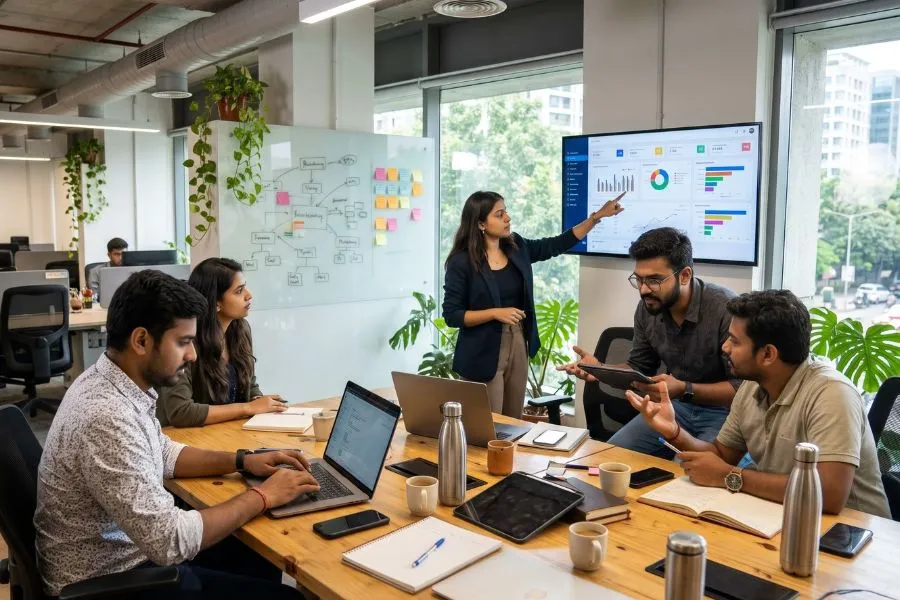
A mid-size FMCG distributor in Jaipur. 180 active retail accounts. 12 delivery routes. 3 salespeople. Daily business reality:
Without WhatsApp Business API:
Monday morning. Salesperson Rakesh reaches Anand General Store at 9:15 AM for the weekly order. Shopkeeper Anand is busy with a customer — Rakesh waits. At 9:32 AM, Anand gives the order verbally: “Teen box Maggi, do box Sunfeast, ek box Parle...” Rakesh writes in his order book. Gets back to the office by 6 PM. Hands order book to operations.
Tuesday morning: Operations team manually enters 23 salesperson order books into the system. By noon, purchase orders are raised. By Wednesday, stock pulled and loaded. Thursday delivery — 3 days after order.
Meanwhile: 8 retailers called/WhatsApp-messaged the distributor asking “Order aaya kya?” Staff spending 2 hours answering these calls. Three retailers are overdue on payment from last month — someone needs to call each one separately. And the company principal is asking for October week 1 sales data — which takes another half-day to compile from handwritten order books.
With WhatsApp Business API:
Same Monday. Retailers who want to order don’t wait for the salesperson — they’ve already ordered Saturday evening via the WhatsApp ordering system. Rakesh visits Anand General Store for relationship management and new product introduction, not just order-taking. Anand checks his WhatsApp: order confirmed, invoice attached, delivery scheduled Wednesday.
Monday evening: Distributor reviews automated order dashboard — 94 orders received (68 via WhatsApp, 26 via salesperson). All orders in system, no manual entry. Tuesday: Picking slips auto-generated. Wednesday: Delivery with digital e-way bills. Payment reminders automatically sent to the 23 retailers with overdue amounts. Principal’s weekly data: Available on dashboard.
That is the transformation WhatsApp Business API creates for FMCG distributors in India.
India’s FMCG distribution sector — connecting 100+ national and regional brands to 12+ crore retail outlets — runs on relationships, speed, and information. WhatsApp Business API is the technology that modernizes all three, without disrupting the relationship-driven culture that makes Indian distribution work.
This complete guide covers everything FMCG distributors, super-stockists, and C&F agents in India need to know about WhatsApp Business API in 2026.
Explore ERP Group’s WhatsApp Business API → for the complete FMCG distribution communication platform.
The FMCG Distribution Landscape India 2026
The Scale and Complexity of Indian FMCG Distribution
India’s FMCG Distribution — Key Numbers
The Market Scale:
- India’s FMCG market: ₹5.5 lakh crore (2026 estimate)
- Traditional trade (kirana stores): 80% of FMCG sales
- Number of retail outlets: 12+ crore
- FMCG distributors in India: 4-6 lakh (licensed distributors)
- Average distributor’s retail account: 200-500 outlets
The Distribution Hierarchy:
BRAND/MANUFACTURER (HUL, ITC, Nestle, etc.)
           ↓
C&F AGENT (Carrying and Forwarding)
  State-level, warehousing and logistics
           ↓
SUPER-STOCKIST / REDISTRIBUTION STOCKIST
  District-level distribution
           ↓
DISTRIBUTOR / STOCKIST
  Town/city level, 200-500 retailers
           ↓
RETAILER (Kirana, General Store, Pharmacy)
  Consumer-facing
           ↓
CONSUMER
The FMCG Distributor’s Daily Reality:
A mid-size FMCG distributor managing 300 retail accounts typically:
- Processes 150-250 orders per day (from salespeople and direct calls)
- Makes 80-120 deliveries per day
- Manages 5-8 salespeople with 30-50 accounts each
- Handles ₹3-15 crore monthly business
- Manages 200-500 SKUs across 3-8 company principals
- Deals with return/damage claims (2-5% of orders)
- Manages collections from 300 retailers on varying credit terms
The Communication Volume:
A distributor handling 300 retailers generates:
- 300+ order interactions/day
- 100+ dispatch notifications/day
- 50+ payment-related communications/day
- 20+ scheme/offer broadcasts/day
- 10+ query resolutions/day
Managing this communication volume by phone and manual WhatsApp is impossible to scale.
For FMCG distribution management, use ERP Group’s warehouse management system →.
For distribution accounting, use ERP Group’s accounting software →.
For GST invoicing for FMCG distribution, use ERP Group’s GST invoicing system →.
The Communication Pain Points of Indian FMCG Distributors
What’s Breaking in Traditional Distribution Communication
The 8 Communication Pain Points That Cost Distributors Money
Pain Point 1 — Order Capture Inefficiency:
Manual order capture: Salesperson writes order in book → Office types into system → Errors introduced at every transfer → Wrong orders dispatched → Returns → Cost.
In a 300-retailer distribution with 2-3% order errors, wrong orders cost:
- Return transport: ₹150/return × 300 returns/month = ₹45,000/month
- Staff time processing returns
- Retailer relationship damage
Pain Point 2 — Payment Collection Bottleneck:
300 retailers on 30-day credit terms → At any time, 100-150 retailers have outstanding amounts. Each requires individual follow-up. Sales team follows up → But their priority is new orders, not collections. Outstanding accumulates.
Average outstanding for a ₹5 crore/month distributor with poor collection: ₹2.5-3.5 crore permanently in receivables.
Pain Point 3 — Scheme Communication Failure:
Principal runs a trade scheme: “Buy 5 cases, get 1 free (Oct 1-15).” Distributor receives scheme from company. Must communicate to all 300 retailers within hours.
Manual communication: Sales team makes calls (200+ calls for 300 retailers). 40% not reached on first call. Callbacks. By the time some retailers know about the scheme, 3-4 days have passed.
Scheme utilization: 55% (could be 85% with instant WhatsApp broadcast).
Pain Point 4 — Invoice and Document Management:
300 deliveries per day → 300 physical invoices + challans + e-way bills → All handled by delivery staff → Physical documents lost, damaged, or disputed.
Month-end: 15-20% of retailer reconciliations have invoice disputes (“We didn’t get the invoice for this delivery”).
Pain Point 5 — Delivery Status Queries:
30-50 “delivery ho gayi kya?” (has my delivery come?) queries per day. Each requires staff to check with delivery team. 5 minutes per query × 40 queries = 200 minutes (3.3 hours) per day of staff time answering delivery queries.
Pain Point 6 — Sales Data Compilation:
Company principal asks for weekly primary and secondary sales data. Distributor’s team manually compiles from order books and delivery registers. Half-day exercise every week. Data 3-5 days old by time it reaches the principal.
Pain Point 7 — Credit Limit Monitoring:
Retailer Sharma has ₹50,000 credit limit. Current outstanding: ₹47,000. Salesperson doesn’t know — takes another ₹25,000 order. Dispatch happens. Credit limit exceeded. Dispute with retailer who says “salesman ne order le liya.”
Pain Point 8 — Promotional Material Distribution:
New product launch → Company sends images, price lists, product sheets → Distributor must share with 300 retailers. Manual WhatsApp forwarding: 2-3 hours. Some retailers missed. Inconsistent information spread.
For CRM to manage retailer communications, use ERP Group’s CRM software →.
WhatsApp in Indian FMCG Distribution — The Opportunity
Why WhatsApp is the Perfect Channel for FMCG Distribution
The WhatsApp Adoption Reality in Indian Retail
The Channel Data:
Indian kirana store owners and retailers are already heavy WhatsApp users. In 2026:
- 90%+ of Indian kirana retailers use WhatsApp for business communication
- Average retailer checks WhatsApp 20-30 times per day
- 75%+ of retailer-distributor informal communication already happens on personal WhatsApp
- WhatsApp message open rate: 95-98% (vs email 20-25%, SMS 75-85%)
What’s Already Happening (Informal WhatsApp):
Most Indian FMCG distributors are ALREADY using WhatsApp — but informally:
- Salespeople sharing order updates from personal phones
- Retailers sending orders on personal WhatsApp
- Company schemes forwarded from personal phones
- Delivery confirmations sent manually
The Problem with Informal WhatsApp:
- No system record (important business communication on personal phones)
- Salesperson leaves → All customer communication history gone
- No automation (all manual)
- Cannot integrate with ERP/accounting
- Cannot scale
- WhatsApp terms of service violations (no bulk messaging from personal accounts)
WhatsApp Business API Formalizes and Automates What’s Already Happening:
The transition from informal to API-based WhatsApp is therefore relatively smooth for FMCG distributors — retailers are already on WhatsApp, already expecting WhatsApp communication. The API just makes it systematic, automated, and integrated.
For WhatsApp Business API for FMCG distribution, use ERP Group’s WhatsApp Business API →.
The 10 High-Impact WhatsApp Use Cases for FMCG Distributors
Where WhatsApp Creates Maximum Value in FMCG Distribution
Use Case 1 — Retailer Order Management via WhatsApp
Transforming the Order-Taking Process
WhatsApp-Based Order Placement for Retailers
The Traditional Order Process vs WhatsApp Order:
Traditional: Salesperson visits store → Retailer gives order → Salesperson writes in book → Returns to office → Office enters system. 1-2 day cycle. Error-prone.
WhatsApp Order System: Retailer texts order on WhatsApp → ERP auto-processes → Order confirmed on WhatsApp. Same-day processing. Zero transcription.
How WhatsApp Ordering Works:
Step 1 — Retailer Sends Order on WhatsApp:
Retailer sends a message to the distributor’s WhatsApp Business number:
Retailer (Sharma General Store, WhatsApp):
Bhaiiya order:
Maggi 70g × 3 box
Sunfeast Marie × 2 box
Good Day Cashew × 1 box
Parle G 5Rs × 5 box
Step 2 — Order Confirmation (Automated):
WhatsApp chatbot processes the order (natural language processing recognizes product names) and confirms:
Distributor WhatsApp (Automated):
✅ Order Confirmed — Sharma General Store

Order No: ORD-2026-10-4521
Date: October 9, 2026

Items:
  Maggi 70g (12-pack box) × 3: ₹1,845
  Sunfeast Marie × 2: ₹1,240
  Good Day Cashew × 1: ₹890
  Parle G 5Rs (480-pack) × 5: ₹2,250
  ─────────────────────────────────
  Sub-total: ₹6,225
  GST (as applicable): ₹112
  Total: ₹6,337

Expected delivery: October 10, 2026 (tomorrow)
Route: South Delhi Route 3

Any changes? Reply within 1 hour.
Step 3 — Order Enters ERP Automatically:
No manual data entry. The ERP auto-creates the sales order with:
- Correct product codes from product master
- Correct pricing (retailer-specific price list applied)
- Credit check (is retailer within credit limit?)
- Stock availability check
- Route and delivery date assigned
Order Catalog on WhatsApp:
For retailers who want to browse available products:
Retailer: "Kal ka order dena hai, list bhejo"

System responds:
📋 TODAY'S AVAILABLE STOCK

[VIEW CATALOG — October 9, 2026]

🌾 BISCUITS & SNACKS
  Parle G 5Rs........................₹450/box
  Good Day Cashew 150g..............₹890/box
  Britannia Marie Gold...............₹640/box

🍜 NOODLES
  Maggi 70g (12 pk)................₹615/box
  Top Ramen Masala..................₹480/box

Reply with product name + quantity to order.
The Order Volume Impact:
Distributors with WhatsApp ordering report 35-45% of orders arriving directly via WhatsApp (without salesperson visit), allowing salespeople to focus on relationship-building, new account acquisition, and problem resolution.
For distribution order management, use ERP Group’s warehouse management system →.
For ERP integration with WhatsApp orders, use ERP Group’s accounting software →.
Use Case 2 — Invoice and Challan Delivery
Digital Document Delivery to Retailers
WhatsApp Invoice and Challan for FMCG Delivery
The Physical Document Problem:
Traditional delivery: Delivery driver carries printed invoices, challans, and e-way bills. Documents get:
- Rained on
- Crumpled in vehicle
- Mixed up between retailers
- Lost when driver hands over to staff
Month-end: 15-20% of retailers claim “invoice nahi mila” (invoice not received) — creating reconciliation disputes.
WhatsApp Document Delivery:
When delivery is dispatched from warehouse:
WhatsApp to Sharma General Store:

[Distributor Name] — Delivery Dispatch

Hi Ramesh Ji 🙏
Your order is on its way!

Order: ORD-2026-10-4521
Date: October 9, 2026
Route: South Delhi Route 3
Driver: Suresh | 98XXXXXXXX

Estimated Delivery: Today, 2-5 PM

Documents attached:
1️⃣ Tax Invoice #INV/2026/10/4521
2️⃣ Delivery Challan #DC/2026/4521
3️⃣ E-Way Bill (if applicable)

[Confirm Delivery] [Report Issue]
The “Confirm Delivery” Feature:
When retailer receives goods and taps “Confirm Delivery”:
- System logs: Date, time, confirming person
- ERP updates: Delivery completed
- Digital GRN (Goods Received Note) created
- Dispute prevention: Both parties have the same record
If retailer reports an issue (quantity mismatch, damaged goods):
Retailer taps [Report Issue] → System creates damage claim:

"Claim #CLM-4521 created. Our representative
will contact you within 2 hours.
Claim ref: CLM/2026/10/4521"
Invoice on WhatsApp — GST Compliance:
Every WhatsApp-delivered invoice must be a proper GST tax invoice with:
- Distributor’s GSTIN
- Retailer’s GSTIN (B2B — mandatory for their ITC claim)
- HSN codes for all FMCG products
- CGST + SGST (intra-state) or IGST (inter-state)
- Sequential invoice number
For GST invoice generation for FMCG distribution, use ERP Group’s GST invoicing system →.
For HSN codes for FMCG products, use ERP Group’s HSN/SAC Finder →.
For GSTR-1 auto-generation from invoices, read our guide on how to generate GSTR-1 automatically India.
For invoice delivery guide, read our guide on WhatsApp invoice sharing for small business India.
For WhatsApp GST invoice guide, read our guide on how to send GST invoice on WhatsApp India.
Use Case 3 — Payment Collection and Reminders
The Highest-ROI WhatsApp Use Case for FMCG Distributors
Automated Payment Collection from 300+ Retailers
The FMCG Distributor Collection Challenge:
A distributor with ₹5 crore/month business and 30-day credit terms has ₹5 crore permanently in receivables. Even a 1-day faster collection = ₹16,666 less working capital tied up. A 5-day faster collection = ₹83,333 released.
At 300 retailers with varying credit terms and outstanding amounts — systematic payment reminders are commercially critical.
The Automated Payment Reminder Sequence:
5 Days Before Due Date (T-5):
[Distributor Name]

Hi Ramesh Ji (Sharma General Store),

This is a friendly reminder:

Invoice #INV/0234 — ₹18,450
Due Date: October 14, 2026

Payment Options:
💳 UPI: distributor@hdfc
🏦 NEFT: HDFC | A/C: XXXX | IFSC: HDFC0001

[Pay Now via UPI]

Questions? Call: 98XXXXXXXX
Due Date (T-0):
⏰ Payment Due TODAY

Ramesh Ji,
₹18,450 (Invoice #INV/0234) is due today.

[Pay Now — UPI] | [Bank Transfer Details]

If already paid, share reference:
[Share Payment Proof]
3 Days Overdue (D+3):
📌 PAYMENT OVERDUE — Sharma General Store

Invoice #INV/0234 (₹18,450) was due
October 14. Now 3 days overdue.

Please arrange payment or contact us.

[Pay Now] | [Call: 98XXXXXXXX]

Note: Future orders may require advance
payment if outstanding is not cleared.
10 Days Overdue (D+10) — Salesperson Alert:
Simultaneously:
- WhatsApp reminder to retailer (firm tone)
- WhatsApp alert to the assigned salesperson: “Sharma General Store has ₹18,450 overdue for 10 days. Please follow up on your next visit.”
The Batch Reminder Feature:
Every Monday morning: System sends payment reminders to ALL retailers with outstanding amounts due that week. One click from the distributor’s dashboard → 80 retailers receive personalized reminders simultaneously.
MONDAY MORNING COLLECTION DASHBOARD:
  Total outstanding: ₹45,23,000
  Due this week (50 retailers): ₹8,45,000
  Overdue >7 days (23 retailers): ₹3,20,000
  Overdue >30 days (8 retailers): ₹72,000

  [Send Reminders to All Due] → 1 click → 50 reminders sent
Payment Confirmation (When Retailer Pays):
✅ PAYMENT RECEIVED

Thank you Ramesh Ji!

₹18,450 received | October 13, 2026
Invoice #INV/0234 — CLEARED

Current Balance: ₹0 (All clear)
Next order credit available: ₹50,000

Receipt: [PDF attached]
For collections management in distribution, use ERP Group’s accounting software →.
For WhatsApp API collections automation, use ERP Group’s WhatsApp Business API →.
Use Case 4 — Dispatch and Delivery Notifications
Real-Time Delivery Visibility for Retailers
Automated Delivery Lifecycle Notifications
The “Delivery Ho Gayi Kya?” Problem:
30-50 “has my delivery come?” queries per day is a genuine operational cost for FMCG distributors. Each query: 5 minutes to check with driver, call back retailer. 40 queries × 5 minutes = 200 minutes (3.3 hours) daily.
WhatsApp Delivery Notifications Eliminate This:
Notification 1 — Order Picked and Loading:
[Distributor] — Order Update

Ramesh Ji,
Your order #ORD-4521 is being loaded
onto Truck DL-XX-1234.

Expected arrival: TODAY 2-5 PM
Driver: Suresh | 98XXXXXXXX

[Track Delivery] [View Invoice]
Notification 2 — On the Way (GPS-Triggered):
🚚 YOUR DELIVERY IS ON THE WAY

Ramesh Ji,
Truck DL-XX-1234 is now in your area.
ETA: 30-45 minutes.

Driver: Suresh | 98XXXXXXXX

[Live Tracking] [Confirm You're Available]
Notification 3 — Delivery Attempted (If No One Present):
⚠️ DELIVERY ATTEMPT

Ramesh Ji,
Our driver attempted delivery at 3:15 PM
but no one was available.

Rescheduled: Tomorrow, Oct 10, 10-12 PM

Contact driver: 98XXXXXXXX
Or reply here to confirm availability.
Notification 4 — Delivery Confirmed:
✅ DELIVERY COMPLETE

Ramesh Ji,
Your order #ORD-4521 has been delivered!

Date: October 9, 2026 | 3:47 PM
Received by: Ramesh (confirmed)

Any issues with the delivery?
[Report Issue] | [All Good ✓]
Result: “Delivery ho gayi kya?” calls: Near zero. Staff time saved: 3+ hours per day.
For logistics and delivery management, use ERP Group’s warehouse management system →.
Use Case 5 — Scheme and Offer Communication
Maximizing Scheme Utilization Through WhatsApp
Trade Scheme Broadcast to All Retailers in Minutes
The Scheme Communication Opportunity:
FMCG brands run aggressive trade schemes:
- Volume-based schemes (Buy X, Get Y free)
- Cash discount schemes (Pay early, get 2% extra discount)
- Display schemes (display product prominently, get scheme benefit)
- Launch schemes (first 100 buyers get extra margin)
These schemes drive significant secondary sales — but ONLY if retailers know about them in time.
Traditional Scheme Communication:
Company informs distributor Monday morning. Distributor calls/forwards to sales team. Sales team calls retailers over 2-3 days. By Wednesday, 60% of retailers know. 40% missed the scheme or knew too late.
WhatsApp Scheme Broadcast:
Monday 9:00 AM: Company informs distributor via WhatsApp.
Monday 9:30 AM: Distributor uses WhatsApp API dashboard to broadcast to all 300 retailers:
🎉 NEW TRADE SCHEME — MAGGI

Hi Ramesh Ji,
Exciting offer from Maggi — Valid:
Oct 9-20, 2026 ONLY

Scheme: Buy 5 cases, Get 1 case FREE
  (6 cases for price of 5)

Offer Price: ₹3,075 for 6 cases
  (Saving: ₹615 per order)

To place order now:
Reply "MAGGI 6" to this message

[View Scheme Details] [Place Order Now]

Limited period — Don't miss it! 📦
By Monday 9:45 AM: All 300 retailers notified. By Monday afternoon: 85%+ orders placed (vs 60% over 2-3 days with phone calls).
Scheme Analytics:
SCHEME PERFORMANCE DASHBOARD

Scheme: Maggi Buy 5 Get 1 (Oct 9-20)
Message sent to: 300 retailers
Delivered: 298 | Read: 267 (89.3%)
Orders placed under scheme: 187 (62.3%)
Total quantity ordered: 1,122 cases
Revenue from scheme: ₹3,45,450
The Scheme Targeting Feature:
Not all schemes apply to all retailers. Filter by:
- Area/route (scheme only for West Delhi retailers)
- Category (biscuit buyers only — for a biscuit scheme)
- Order size (top 50 retailers by volume)
Send targeted messages to only relevant retailers.
For CRM with retailer segmentation, use ERP Group’s CRM software →.
Use Case 6 — New Product Launches
Driving Distribution of New SKUs Through WhatsApp
Product Launch Communication via WhatsApp
The New Product Launch Challenge for Distributors:
When a principal launches a new product, the distributor must:
- Inform all retailers about the new product
- Share product images, price list, margin
- Create initial demand (generate trial orders)
- Provide POP (Point of Purchase) display materials
WhatsApp New Product Launch Message:
🆕 NEW PRODUCT LAUNCH

Hi Ramesh Ji,
Excited to share a new product from
[Brand Name]!

🌟 [Product Name] — [Variant]
  MRP: ₹[MRP] | Trade Price: ₹[Trade Price]
  Margin: [X]% | Case Pack: [Y] units

What's special:
  ✅ [Key feature 1]
  ✅ [Key feature 2]
  ✅ Better margin than [Competitor]

Launch Offer (First 2 weeks):
  First order FREE! (1 case with order
  of 5+ cases of any product)

[Product Image] [Product Info PDF]
[Place Launch Order]

Questions? Call your sales rep: 98XXXXXXXX
Visual Content on WhatsApp:
WhatsApp supports images and PDFs — distributors can share:
- Product images (high quality)
- Price list PDF
- Display guidelines
- POP material images
All delivered instantly to 300 retailers’ phones.
Initial Penetration Tracking:
NEW PRODUCT PENETRATION REPORT:
[Product Name] — Week 1

Total retailers: 300
Ordered at least 1 case: 127 (42.3%)
Total cases ordered: 312
Revenue: ₹X

Top ordering area: West Delhi (67% penetration)
Low penetration area: South Delhi (28%)
→ Action: Schedule focused visit by sales team
Use Case 7 — Credit Limit and Outstanding Alerts
Preventing Credit Overextension
Real-Time Credit Control via WhatsApp
The Credit Control Problem:
Without automated alerts:
- Salesperson doesn’t know retailer’s outstanding
- Takes order exceeding credit limit
- Dispatch happens
- Dispute arises
- Recovery becomes difficult
WhatsApp Credit Control:
Alert to Salesperson (Before Taking Order):
When salesperson is about to take an order:
⚠️ CREDIT ALERT — Sharma General Store

Salesperson: Rakesh,
Before taking Sharma General Store's order:

Credit Limit: ₹50,000
Current Outstanding: ₹43,500
Available Credit: ₹6,500

Pending orders in pipeline: ₹8,200

NOTE: New order of ₹8,200 would exceed
credit limit. Get manager approval or
request advance payment.

[Approve Override] [Request Advance] [Hold Order]
Reminder to Retailer When Approaching Limit:
[Distributor Name]

Hi Ramesh Ji,
Your account is approaching the credit limit:

Credit Limit: ₹50,000
Outstanding: ₹43,500 (87% utilized)

To ensure uninterrupted supply, please
clear some outstanding before your next order.

[Pay Now — Clear Outstanding] [View Statement]
Account Freeze Alert:
When retailer exceeds limit and new order comes in:
⛔ ORDER HOLD — Account Review

Hi Ramesh Ji,
Your order #ORD-4589 is on hold.

Reason: Credit limit exceeded
  Limit: ₹50,000 | Outstanding: ₹52,300

To release order, please make a payment
of at least ₹10,000.

[Pay Now to Release Order] [Contact Manager: 98XXXXXXXX]
For credit management in distribution, use ERP Group’s accounting software →.
For CRM with credit limit tracking, use ERP Group’s CRM software →.
Use Case 8 — Salesperson Daily Route Communication
Managing the Field Sales Team via WhatsApp
WhatsApp for Distributor Sales Team Management
The Sales Team Communication Challenge:
3-8 salespeople in the field → Distributor office needs to:
- Know their daily route and coverage
- Send urgent messages (scheme launches, stock-outs, price changes)
- Track orders collected
- Send delivery updates for their accounts
WhatsApp Daily Route Briefing:
Every morning (7:00 AM automated):
[Distributor Name] — Rakesh's Daily Brief

Good Morning Rakesh! 🌅

YOUR ROUTE TODAY: South Delhi Route 3
Coverage: 18 outlets

Today's Priorities:
  🔴 HIGH: Sharma General Store (₹18,450 overdue)
  🔴 HIGH: Modi Kirana (Credit limit: push payment)
  🟡 MEDIUM: New outlet — Green Fresh Store (new account)
  🟢 LOW: Regular visits for 15 outlets

Today's Active Scheme:
  Maggi: Buy 5 Get 1 Free (Oct 9-20)
  Push this everywhere!

[View Full Route Map] [Today's Target: ₹65,000]
Urgent Updates During the Day:
⚠️ STOCK ALERT — Rakesh

Maggi 70g is out of stock from 12 PM today.
Do NOT take new orders for Maggi 70g.
Suggest alternate: Maggi 2-minute (in stock)

Pass this to retailers on your route.
Order Submission:
Salesperson submits orders via WhatsApp to avoid manual order book:
Rakesh (submitting order):
"Gupta Kirana, Route 3:
Britannia NutriChoice × 2
Parle Hide & Seek × 3
Good Day Cashew × 1"

System auto-confirms:
✅ Order received — Gupta Kirana
Order No: ORD-4590
[View Order Details]
For salesperson management with CRM, use ERP Group’s CRM software →.
For HR management for distribution staff, use ERP Group’s HR & Payroll software →.
For staff salary planning, use ERP Group’s Salary Calculator →.
Use Case 9 — Customer Support and Query Resolution
24/7 Retailer Support Without 24/7 Staff
WhatsApp Chatbot for FMCG Distributor Support
Common Retailer Queries (80% of all support interactions):
- “Mera order kab aayega?” (When is my delivery?)
- “Mera outstanding kitna hai?” (What’s my outstanding?)
- “Invoice copy bhejo” (Send invoice copy)
- “Kal ka order dena tha” (I want to place tomorrow’s order)
- “Koi item nahi aaya delivery mein” (Item missing in delivery)
WhatsApp Chatbot Handles Queries 1-4 Automatically:
Retailer: “Order kab aayega?”
Chatbot Response:
🔍 Your Latest Order Status

Sharma General Store — ORD-4521
Status: OUT FOR DELIVERY 🚚
Driver: Suresh | 98XXXXXXXX
Route: South Delhi Route 3
ETA: Today 3-5 PM

[Track Live] [Call Driver]
Retailer: “Mera kitna outstanding hai?”
Chatbot:
📊 Account Statement — Sharma General Store

Credit Limit: ₹50,000
Current Outstanding: ₹23,450

Pending Invoices:
  INV/0234 — ₹18,450 | Due: Oct 14
  INV/0241 — ₹5,000 | Due: Oct 20

[View Full Statement] [Pay Now]
Human Agent Escalation:
For complex queries (damage claims, price disputes, return requests):
Chatbot: "Connecting you with our team.
Typical response: 15 minutes (business hours).

Your query reference: QR/4521
Human agent receives: Full query context, retailer details, order history. No repeat explanation by retailer.
For CRM with WhatsApp chatbot, use ERP Group’s CRM software →.
Use Case 10 — Principal Brand Communication
The Principal-Distributor-Retailer WhatsApp Chain
How Distributors Use WhatsApp to Report to Principal Brands
The Principal Reporting Challenge:
FMCG distributors must report to their company principals:
- Daily primary sales (what was purchased from company)
- Secondary sales (what was sold to retailers)
- Scheme performance
- Competitor intelligence
- Market feedback
WhatsApp for Principal Reporting:
Automated Daily Sales Report (to Principal’s WhatsApp):
[Distributor Name] — Daily Report
October 9, 2026

PRIMARY SALES (today):
  Invoice raised to Company: ₹X

SECONDARY SALES (today):
  Orders received: 94 | Value: ₹4,23,000
  Orders delivered: 87 | Value: ₹3,98,000

TOP SELLING SKUs TODAY:
  1. Maggi 70g: 450 units
  2. Parle G 5Rs: 380 units
  3. Good Day Cashew: 210 units

SCHEME PERFORMANCE:
  Maggi Buy 5 Get 1: 43 retailers ordered
  Revenue under scheme: ₹1,32,000

NEW RETAIL ADDITIONS: 2
COMPLAINTS TODAY: 1 (damage claim — resolved)
Principal can receive this WhatsApp every evening without calling the distributor or waiting for weekly Excel reports.
WhatsApp + Distribution ERP Integration
The Integration That Makes Everything Work
How WhatsApp Connects with Distribution ERP
The FMCG Distribution ERP + WhatsApp Integration Map:
ORDER MANAGEMENT:
  WhatsApp order → ERP auto-creates sales order
  Stock check → WhatsApp confirms availability
  Order confirmed → WhatsApp to retailer

INVENTORY/WAREHOUSE:
  Picking slip → WhatsApp to warehouse staff
  Loading complete → WhatsApp dispatch notification
  GRN received → WhatsApp delivery confirmation

ACCOUNTING:
  Invoice generated → WhatsApp PDF to retailer
  Payment received → WhatsApp receipt
  Outstanding → WhatsApp reminder sequence

SALES/CRM:
  Route plan → WhatsApp to salesperson
  Scheme update → WhatsApp broadcast to retailers
  Credit alert → WhatsApp to salesperson

COMPLIANCE:
  E-way bill generated → WhatsApp to driver + retailer
  GSTR-1 data → Auto-compiled from all invoices
The Value of Integration:
Each WhatsApp message is NOT a manual communication — it’s an automated output from the ERP triggered by a business event:
- Invoice generated in accounting → WhatsApp automatically
- Delivery status updated in warehouse → WhatsApp automatically
- Payment due date reaches → WhatsApp automatically
- Order placed on WhatsApp → ERP automatically creates order
Result: Entire distributor operation becomes more transparent, faster, and less error-prone.
For distribution ERP integration, use ERP Group’s warehouse management system →.
For complete distribution accounting with WhatsApp, use ERP Group’s accounting software →.
For WhatsApp Business API for FMCG, use ERP Group’s WhatsApp Business API →.
WhatsApp for FMCG Secondary Sales Data
The Data That Drives Distribution Performance
Real-Time Secondary Sales Tracking via WhatsApp
Why Secondary Sales Data Matters:
Primary sales (distributor buying from company) is tracked. Secondary sales (distributor selling to retailers) is often opaque — both to the company and sometimes to the distributor themselves.
WhatsApp-integrated ERP generates real-time secondary sales data:
For the Distributor:
SECONDARY SALES DASHBOARD — October 9, 2026

TODAY:
  Orders: 94 | Delivered: 87
  Value: ₹4,23,000

MTD (Month-to-Date):
  Orders: 423 | Delivered: 401
  Value: ₹18,45,000
  vs Last Month Same Period: +12.3%

BY CATEGORY:
  Biscuits: 32% | Noodles: 21%
  Beverages: 18% | Personal Care: 16%
  Others: 13%

SLOW-MOVING SKUs:
  [Product A] — 3 orders this month (push!)
  [Product B] — 0 orders this month (check expiry)
For the Principal (Auto-Shared Weekly):
The principal receives a structured WhatsApp report every Monday showing secondary sales from all their distributors — without having to call or email each one individually.
The SKU Performance Insight:
WhatsApp ordering data shows EXACTLY which SKUs retailers are asking for more of and which are slow-moving. This is actionable intelligence for both distributor and principal.
GST and Compliance in FMCG Distribution WhatsApp
Keeping WhatsApp Communication Tax-Compliant
GST Compliance for FMCG Distributor WhatsApp Invoices
The FMCG GST Invoice Requirements:
FMCG distribution is B2B — all retailer deliveries require proper GST tax invoices. Key requirements:
What Every FMCG Distribution WhatsApp Invoice Must Include:
- Distributor’s GSTIN
- Retailer’s GSTIN (B2B — they need this for ITC claim)
- Sequential invoice number
- Invoice date
- HSN codes for all FMCG products (4-digit for most distributors)
- CGST + SGST (intra-state) or IGST (inter-state)
- Exact taxable value and tax amounts per HSN
Common FMCG GST Rates:
| FMCG Category | GST Rate | HSN Example |
|---|---|---|
| Biscuits (branded) | 18% | 1905 |
| Noodles (instant) | 18% | 1902 |
| Dairy products | 5%/12% | 0402 |
| Beverages (aerated) | 28% + cess | 2202 |
| Personal care (soap) | 18% | 3401 |
| Hair oil | 18% | 1509 |
| Atta/wheat flour (branded) | 5% | 1101 |
| Sugar | 5% | 1701 |
E-Invoice for Large FMCG Distributors:
FMCG distributors with annual turnover above ₹5 crore (most significant distributors) must generate e-invoices with IRN and QR code before delivering to retailers. The e-invoice PDF is what gets shared on WhatsApp.
GSTR-1 Compliance:
All WhatsApp-delivered invoices must be reported in GSTR-1 (B2B table with retailer GSTINs). Distribution ERP with WhatsApp integration auto-populates GSTR-1 from all invoices.
For FMCG distribution GST compliance, use ERP Group’s GST invoicing system →.
For GST compliance calendar, use ERP Group’s GST Calendar →.
For HSN codes for FMCG products, use ERP Group’s HSN/SAC Finder →.
For GST advisory for FMCG distribution, use ERP Group’s CA Partner Program →.
For GSTR-1 guide, read our guide on GSTR-1 generator guide for small business India.
The Retailer Experience on WhatsApp
Why Retailers Love WhatsApp Distribution
The Kirana Store Owner’s WhatsApp Distribution Experience
From the Kirana Retailer’s Perspective:
5 Years Ago:
- Wait for salesperson to come (2x per week)
- Give order verbally → Worry if it was recorded correctly
- Wait 2-3 days for delivery
- Receive physical invoice → File in a folder
- Month-end: Call distributor to check outstanding
- Pay by cash or cheque handed to salesperson
Today (With WhatsApp-Enabled Distributor):
Ordering: Open WhatsApp, send order anytime — Sunday evening, 8 PM, no waiting for salesperson. Confirmation arrives in minutes.
Status: Check delivery status anytime by sending “Order status?” to the distributor’s WhatsApp.
Documents: All invoices and challans in WhatsApp history — searchable by date, invoice number.
Outstanding: Send “Mera outstanding?” → Instant account statement.
Schemes: Get notified of new schemes before they end — not 3 days late.
Payment: Pay via UPI link in the invoice message — no cash handling, no cheque.
The Competitive Reality for Distributors:
In markets where 2-3 distributors supply the same brand to the same retailers, WhatsApp capability has become a genuine switching reason. Retailers increasingly prefer distributors who:
- Accept WhatsApp orders (vs only salesperson visits)
- Send digital documents (vs only physical)
- Send delivery notifications (vs no communication)
- Send instant receipts (vs end-of-month paper)
Multi-Branch FMCG Distributor WhatsApp Management
Managing Multiple Godowns and Routes
WhatsApp for Multi-Location Distribution Operations
For distributors with multiple warehouses or C&F operations serving different areas:
Centralized WhatsApp Number:
One WhatsApp Business number for the entire distributor operation — retailers contact this one number regardless of their area.
Intelligent Routing:
System identifies the retailer’s area (from retailer master) and routes the query/order to the correct godown’s team.
Branch-Level Dashboards:
Each godown manages its own:
- Orders
- Inventory
- Delivery notifications
- Collections
Consolidated View:
Proprietor/MD sees consolidated dashboard across all branches.
Area-Specific Broadcasts:
Scheme only for South Delhi retailers → WhatsApp broadcast only to South Delhi retailer contacts. West Delhi retailers don’t receive irrelevant messages.
For multi-location warehouse management, use ERP Group’s warehouse management system →.
For multi-location accounting, use ERP Group’s accounting software →.
The ROI of WhatsApp Business API for FMCG Distributors
The Measurable Financial Return
ROI Analysis — Mid-Size FMCG Distributor
Distributor Profile: ₹5 crore/month revenue, 300 retailers, 3 salespeople, 80-100 deliveries/day, 8 staff.
ROI Stream 1 — Collection Improvement:
Current: Average collection cycle 42 days
With WhatsApp reminders: 28 days
Improvement: 14 days
Working capital released: ₹5 crore/30 × 14 = ₹2.33 crore
Interest at 14% pa on ₹2.33 crore: ₹32.6 lakh/year
ROI Stream 2 — Staff Efficiency:
Current “delivery ho gayi?” calls: 40/day × 5 min = 200 min = 3.3 hrs/day
With WhatsApp notifications: 5 calls/day × 5 min = 25 min
Staff saving: 2.75 hrs/day × 300 days × ₹150/hr = ₹1.24 lakh/year
Manual order entry from order books: 4 hrs/day
With WhatsApp ordering: 1 hr/day (only entering non-WhatsApp orders)
Staff saving: 3 hrs/day × 300 days × ₹150/hr = ₹1.35 lakh/year
GST invoice dispatching (manual email + follow-up): 2 hrs/day
With WhatsApp automation: 15 min/day
Staff saving: 1.75 hrs/day × 300 days × ₹150/hr = ₹0.79 lakh/year
Total staff efficiency: ₹3.38 lakh/year
ROI Stream 3 — Scheme Utilization Improvement:
Current scheme utilization: 58% (retailers reached too late)
With instant WhatsApp broadcast: 82%
Monthly scheme value: ₹50 lakh in potential orders
Improvement: 24% × ₹50 lakh = ₹12 lakh/month additional scheme orders
Additional margin: 3% on ₹12 lakh = ₹36,000/month = ₹4.32 lakh/year
ROI Stream 4 — Bad Debt Reduction:
Current bad debt: 1.5% of annual ₹60 crore revenue = ₹90 lakh/year
With systematic reminders and credit control: 0.4% = ₹24 lakh/year
Annual saving: ₹66 lakh
ROI Stream 5 — Order Error Reduction:
Current order errors (wrong item/quantity): 2.5% of orders
Cost per error (return transport + credit note + staff time): ₹350
Annual orders: 300 retailers × 4 orders/month × 12 = 14,400 orders
2.5% errors: 360 × ₹350 = ₹1.26 lakh/year
With WhatsApp ordering (error rate 0.3%): 43 × ₹350 = ₹15,050
Annual saving: ₹1.1 lakh
Total Annual ROI:
- Collection interest saving: ₹32.6 lakh
- Staff efficiency: ₹3.38 lakh
- Scheme utilization: ₹4.32 lakh
- Bad debt reduction: ₹66 lakh
- Order error reduction: ₹1.1 lakh
- Total: ₹1,07.4 lakh (₹1.07 crore)
WhatsApp API + ERP Integration cost: ₹10,000-30,000/month = ₹1.2-3.6 lakh/year
Net Annual ROI: ₹1.03-1.06 crore | Payback: Under 2 weeks
For detailed ROI calculation, use ERP Group’s ROI Calculator →.
For income tax on distribution business, use ERP Group’s Income Tax Calculator →.
For TDS on distributor staff, use ERP Group’s TDS Calculator →.
Common Mistakes FMCG Distributors Make with WhatsApp
Errors to Avoid in WhatsApp Implementation
Mistake 1 — Using Personal WhatsApp for Business
The Problem:
Salesperson manages retailer relationships on personal WhatsApp. 200 retailer contacts on personal phone. When salesperson leaves, all history is gone.
Solution: Centralize all retailer communication on the official distributor WhatsApp Business number through the API. Salesperson conversations visible to management. History permanent.
Mistake 2 — Sending Schemes Without Opt-In Compliance
The Problem:
Broadcaster sends scheme messages to all 300 retailers simultaneously from a WhatsApp Business App (not API). High report rate. WhatsApp bans the number. Distributor loses their business WhatsApp number.
Solution: Use WhatsApp Business API for all bulk communication. API requires opt-in from recipients. Compliant broadcasting at any scale.
Mistake 3 — Not Integrating with ERP
The Problem:
WhatsApp used only for communication (sending messages). Orders still entered manually. Invoices still sent separately. The communication is digital but the backend is still manual.
Solution: Full ERP integration. WhatsApp orders → Auto-enter ERP. ERP invoices → Auto-sent on WhatsApp. Reminders from ERP receivables → Auto-sent on WhatsApp.
Mistake 4 — No GST Invoice Quality Check
The Problem:
Distributor shares invoice PDFs on WhatsApp, but invoices missing retailer GSTIN or HSN codes. Retailers complain — their CA is rejecting ITC claims.
Solution: Use billing software that mandates retailer GSTIN entry for B2B invoices and auto-populates HSN codes from product master. Zero manual oversight needed.
Mistake 5 — Ignoring Delivery Confirmation
The Problem:
Delivery notifications sent but no confirmation collection. Dispute arises a month later: “We never received that delivery” or “Wrong quantity delivered.”
Solution: Every delivery notification includes a “Confirm Delivery” button. Retailer confirmation is digital GRN — date-stamped, recorded in ERP. Disputes: Open the confirmation log.
For complete distribution management, use ERP Group’s warehouse management system →.
How ERP Group Delivers WhatsApp for FMCG Distributors
India’s Complete FMCG Distribution WhatsApp Platform
ERP Group — India’s AI-Powered GST Billing & Cloud ERP Platform — delivers comprehensive WhatsApp automation for FMCG distributors through WhatsApp Business API → deeply integrated with the complete distribution ERP.
ERP Group FMCG Distribution WhatsApp — Key Capabilities
WhatsApp Order Management:
Retailers place orders via WhatsApp → ERP auto-creates orders → Stock checked → Confirmation sent. Zero manual entry.
Auto Invoice + Challan Delivery:
Invoice generated → PDF sent to retailer WhatsApp in 60 seconds. Challan + E-Way Bill bundled.
Payment Automation:
Invoice due → T-5, T-0, D+3, D+10 reminders automated. Retailer pays via UPI link → Confirmation sent → ERP updated.
Delivery Lifecycle Notifications:
Load, dispatch, en-route, delivered — all automated WhatsApp updates at each stage.
Scheme Broadcasts:
Targeted bulk messaging to retailer segments. Opt-in compliant. Scheme performance dashboard.
Credit Control Automation:
Credit limit alerts to salespeople before order-taking. Credit hold notifications to retailers. Auto-escalation on overdue accounts.
Complete Platform Table:
| FMCG Distribution Need | ERP Group Solution |
|---|---|
| WhatsApp distribution platform | WhatsApp Business API |
| Warehouse and order management | Warehouse Management |
| GST invoice generation | GST Invoicing System |
| Distribution accounting | Accounting Software |
| Retailer CRM | CRM Software |
| POS for counter sales | POS Software |
| Distribution staff HR | HR & Payroll Software |
| HSN codes for FMCG | HSN/SAC Finder |
| GST filing calendar | GST Calendar |
| TDS on staff | TDS Calculator |
| Distribution income tax | Income Tax Calculator |
| Staff salary planning | Salary Calculator |
| WhatsApp distribution ROI | ROI Calculator |
| GST and tax advisory | CA Partner Program |
| Distribution healthcare | Healthcare & Pharmacy ERP |
Conclusion — WhatsApp Business API is the Operational Backbone of Modern FMCG Distribution in India 2026
India’s FMCG distribution sector in 2026 faces intense pressure: e-commerce threatening traditional trade, companies demanding better secondary sales data, retailers demanding better service, and margins under constant pressure. The distributors winning in this environment are those who deliver better service at lower cost — and WhatsApp Business API is the technology that makes this possible.
The FMCG Distributor WhatsApp Impact Summary:
For a mid-size ₹5 crore/month distributor (300 retailers):
- Collection improvement: ₹32.6 lakh/year
- Bad debt reduction: ₹66 lakh/year
- Staff efficiency: ₹3.38 lakh/year
- Scheme utilization: ₹4.32 lakh/year
- Order errors: ₹1.1 lakh/year
- Total: ₹1.07 crore/year
- Cost: ₹1.2-3.6 lakh/year
- Payback: Under 2 weeks
The 10 Use Cases That Drive This Value:
- WhatsApp order management (retailers order 24/7)
- Auto invoice and challan delivery (digital documents)
- Payment collection and reminders (automated 5-message sequence)
- Delivery notifications (eliminate “has delivery come?” calls)
- Scheme broadcasts (reach all retailers in minutes)
- New product launches (faster distribution penetration)
- Credit control alerts (prevent overextension)
- Salesperson route management (daily briefs and alerts)
- Customer support chatbot (70% queries auto-resolved)
- Principal reporting (automated daily reports)
Use ERP Group’s Free ROI Calculator → to calculate the specific financial impact for your distribution business.
ERP Group’s WhatsApp Business API → delivers India’s most integrated WhatsApp platform for FMCG distributors — natively connected with warehouse management, GST invoicing, accounting, and CRM.
Transform Your FMCG Distribution with WhatsApp Business API
👉 Explore WhatsApp Business API → — See ERP Group’s complete FMCG distribution WhatsApp platform: retailer ordering, auto invoice delivery, payment reminders, and real-time analytics.
👉 Calculate Your ROI → — Find out exactly how much your distribution business can improve collections and efficiency with WhatsApp API.
Related Tools and Guides
- 🔧 WhatsApp Business API → — WhatsApp distribution platform
- 🔧 Warehouse Management → — FMCG inventory and order management
- 🔧 GST Invoicing System → — Auto GST invoices via WhatsApp
- 🔧 HSN/SAC Finder → — FMCG product HSN codes
- 🔧 GST Calendar → — Distribution GST compliance dates
- 🔧 ROI Calculator → — WhatsApp API ROI for distributors
- 📄 WhatsApp Business API for Indian Businesses 2026
- 📄 WhatsApp Invoice Sharing for Small Business India
- 📄 How to Send GST Invoice on WhatsApp India
- 📄 GSTR-1 Generator Guide for Small Business India
- 📄 GST Calculation Formula for Business India 2026
© 2026 ERP Group — India’s AI-Powered GST Billing & Cloud ERP Platform