Building Materials Manufacturing Software from mix design to the site
Fly ash bricks, AAC and concrete blocks, pavers and kerb stones — mix designs, press runs, curing, strength tests and dispatch in one system, with GST billing built in.

Every production run, from materials to dispatch
The run carries its bill of materials, the material lots it used, the batch record filled step by step, the QC tests and the release — so production, QA and dispatch work from the same record.
- Materials checked against stock before the run starts
- Every step performed by one person and verified by another
- Batch released only when every test passes, then shipped batch-wise
What is software for brick, block and paver plants?
Building materials manufacturing software runs a fly ash brick, block or paver plant in one system: the mix design per 1,000 pieces, fly ash, cement and stone dust in stock, press runs, the batch record from batching to curing, compressive strength and water absorption tests, and dispatch to builders and dealers — with GST invoices, e-way bills and the accounts on the same records.
ERP Group keeps each product's size, strength class, IS standard and curing days on the product, works out the fly ash, cement and dust a run needs, flags a shortage before the press starts, and holds the batch until its strength test passes.
Last updated: October 2026 · features as they work in ERP Group today
Key facts
| Built for | Fly ash bricks, AAC and concrete blocks, paver blocks, kerb stones, tiles |
|---|---|
| Bill of materials | Per 1,000 pieces, with wastage per material |
| Quality | Compressive strength, water absorption, dimensions per IS 12894 / IS 15658 |
| Batch record | Batching to curing and stacking, each step verified |
| Accounts | GST invoices, e-way bills, books; or export to Busy or Tally |
What ERP Group does for a building materials plant
Mix, press, cure, test and dispatch on one set of screens — with the stock and the books kept up to date as you go.
Products and mix designs
- Size, strength class, IS standard and curing days
- Fly ash, cement, stone dust, lime and gypsum per 1,000 pieces
- Wastage per material, versions kept
- Pigments for coloured pavers
Raw material yard
- Fly ash, cement bags and aggregates by lot
- Purchase orders and goods receipt from suppliers
- Reorder levels with draft orders
- Stock by yard, store and bin
Press runs
- Plan a run on a hydraulic or vibro press
- Shortage shown before the run starts
- Material lots issued to the run
- Labour hours and actual output recorded
Batch record and curing
- Batching, mixing, pressing, drying, curing, stacking
- Each step performed and verified by two people
- Deviations recorded on the batch
- Locked once the batch is released
Strength and QC
- Compressive strength at 14 and 28 days
- Water absorption and dimensions
- Release, reject or raise a non-conformance
- Test reports attached to the batch
Dispatch and billing
- Sales orders from builders, contractors and dealers
- Dispatch batch-wise to each site
- GST invoice, e-invoice and e-way bill
- Outstanding and collections per customer
What do the plant screens look like?
Real screens from an ERP Group demo building materials plant — the bricks and pavers, materials and batches are demo data.
 View larger
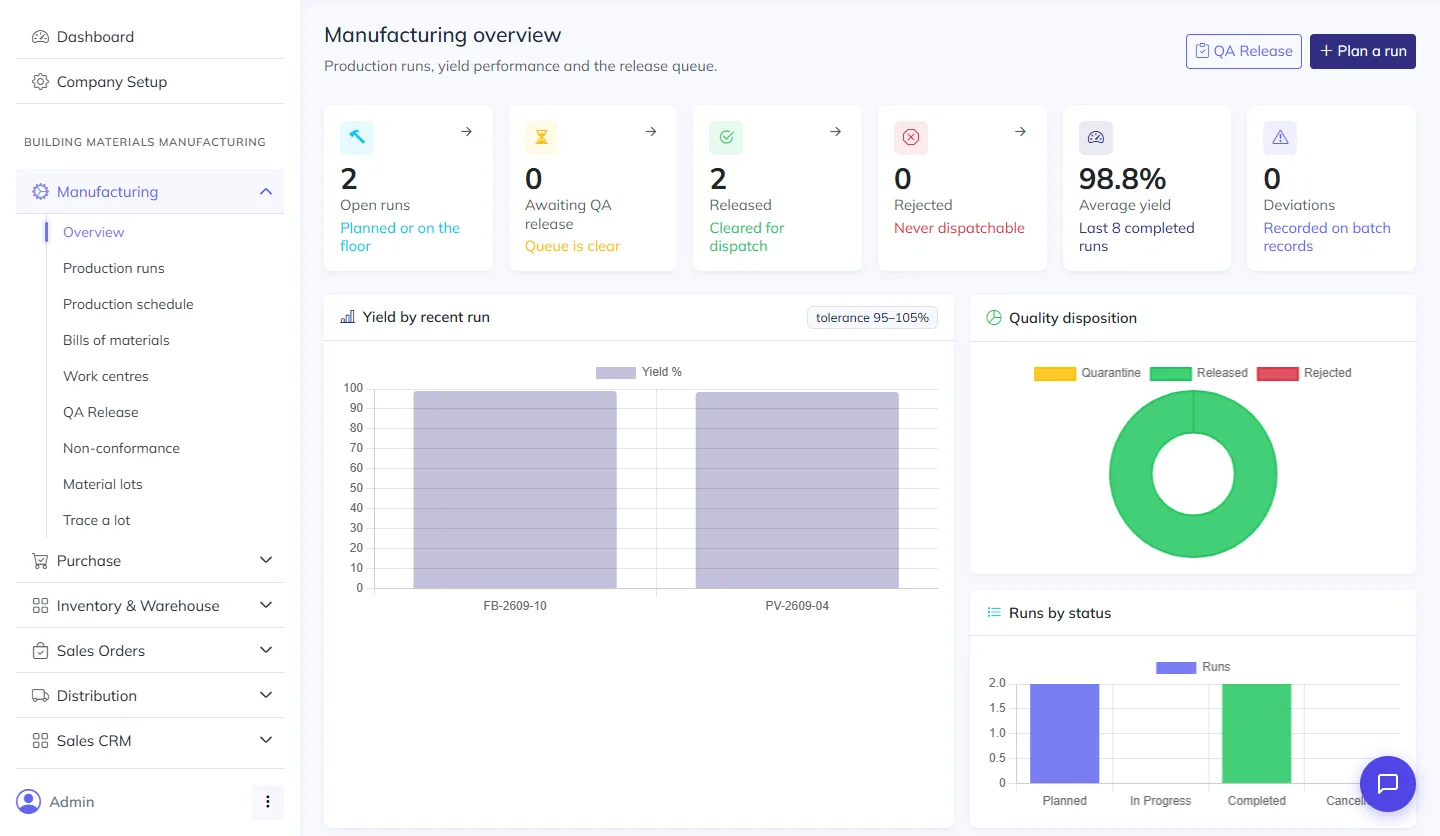
Manufacturing overview
Open runs, batches waiting for QA, released and rejected batches, average yield and deviations — with yield by recent run.
- Yield against tolerance
- Quality disposition at a glance
- Runs by status
 View larger
Production runs
Every run with its product, batch number, quantity, press and status — planned, in progress or completed.
- Plan a run from the BOM
- Filter by status or product
- Open any run for its record
 View larger
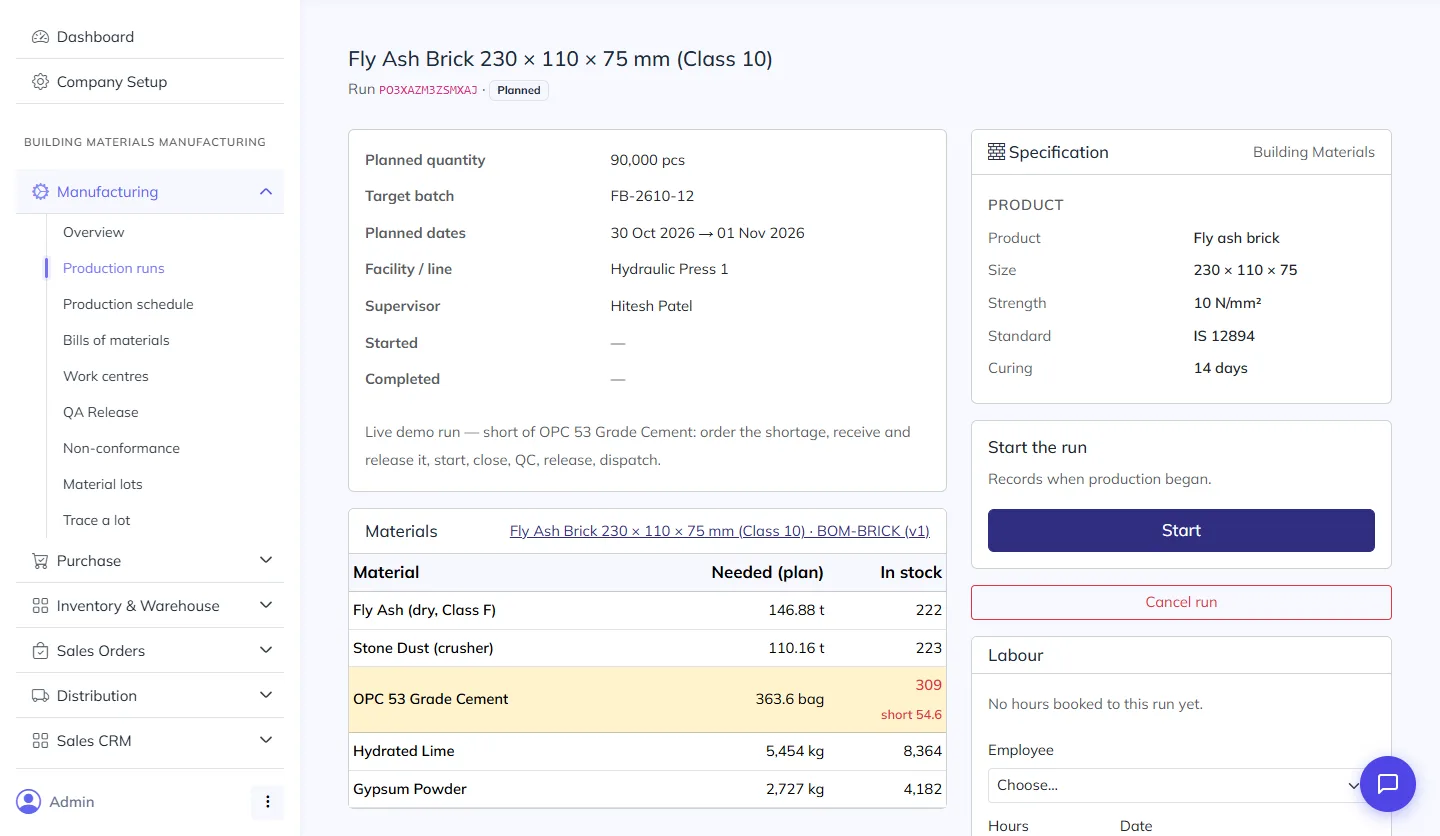
One production run
The run for Fly Ash Brick 230 × 110 × 75 (Class 10): planned quantity, target batch, press and supervisor, with every material checked against stock — OPC 53 cement is short.
- Shortage shown before you start
- Labour hours booked to the run
- Start, close, QC and release
 View larger
Bill of materials
What goes into a thousand fly ash bricks: each material with its quantity, wastage and stock, in versions — plus the routing on your presss.
- Versions kept, old runs unchanged
- Wastage % per material
- Routing steps on work centres
 View larger
Batch record
Every step of batch FB-2609-10: what was expected, what was observed, who performed it and who verified it — closed once the batch is released.
- Two people per step
- Deviations block the release
- Locked after release
 View larger
QC and release
Theoretical against actual quantity, every QC test with its specification and result, test reports attached, and the release decision.
- Pass / fail against the spec
- Non-conformance and CAPA
- Released for dispatch
Strength, absorption and size checked before a cube leaves the yard
Each batch has a batch record with these steps, and QC tests against your specification. A step needs a second person to verify it, and the batch cannot be released while a step is open or a test has failed.
How is ERP Group different from Excel and Tally, or a separate production package?
Most brick, block and paver makers plan production in Excel and keep the accounts in Tally or Busy, or buy a production package that does not talk to the books. Here is what changes when it is one system.
| What you need | Excel + Tally / BusyThe usual start | Production package + TallyTwo systems | ERP GroupOne system |
|---|---|---|---|
| Bill of materials with wastage, in versions | A sheet per product | Yes | Yes, old runs keep their version |
| Material shortage before the run starts | Found on the floor | Varies | Yes, checked against live stock |
| Batch record: who did each step and who checked it | Paper registers | Varies | Yes, two people per step |
| QC tests and release before dispatch | Lab register | Usually | Yes — no release, no dispatch |
| Material lots used in each batch | Not recorded | Partly | Yes, lot by lot |
| GST invoice, e-invoice and e-way bill | Typed again in Tally | Entered again in Tally | From the sales order itself |
| Purchase orders, goods receipt and reorder levels | In Tally, by hand | Varies | Yes, draft orders when stock runs low |
| Books, GST data and bank reconciliation | In Tally, separately | In Tally, kept in step by hand | Built in — or export to Busy / Tally |
| Payroll, CRM, dealers and the rest | More software | More software | Same login, add when needed |
"Varies" and "usually": production packages differ — ask your vendor. ERP Group columns are what the software does today.
See it on a demoWhat does building materials manufacturing software cost?
Three plans, all with GST billing and stock built in. Prices before GST.
1 plant · 3 users
- Products and materials, stock by store
- Purchase orders and goods receipt
- Sales orders, GST invoices, e-way bill
- Reorder levels and draft orders
- Stock and sales reports
1 plant · 10 users
- Everything in Starter
- Bills of materials and production runs
- Batch records and QC release
- Batch-wise dispatch and recall
- Accounts, GST data and bank reconciliation
Up to 3 plants · 25 users
- Everything in Factory
- Stock and staff per plant, with transfers
- Production schedule on work centres
- Dealers, distributors and their orders
- Payroll and HR for the plant
Compare: accounts software alone is ₹22,500+ one-time (TallyPrime Silver), and a separate production package adds its own licence and yearly fee — with the accounts still kept apart.
See the comparisonFree demo · free Tally / Busy data migration · more plants or users on request. TallyPrime price is its public list price as of October 2026.
The modules a building materials plant runs on
Production shares its materials, batches and invoices with the rest of ERP Group.
Inventory & Warehouse
Stores, bins and stock by lot — raw materials, work in progress and finished goods.
Warehouse managementPurchase
Purchase orders to fly ash, cement and stone dust suppliers, goods receipt, reorder levels and draft orders.
Purchase managementAccounting & GST
Purchase bills, sales invoices, ledgers, GST data and bank reconciliation.
Accounting softwareE-Invoice & E-Way Bill
IRN and signed QR on every invoice, e-way bills for each dispatch.
E-invoice & e-way billDealer Management
Your dealers and distributors, their orders, schemes and outstanding.
Dealer managementTraceability
Batch QR codes, shipments by batch, and a recall that finds every customer.
Traceability softwareHow does a building materials plant start on ERP Group?
More for manufacturers
See your plant on ERP Group
Tell us what you make — bricks, blocks or pavers — and how many presses you run. We'll show you a run from the mix design to the strength test and the dispatch to site on a demo plant.